
Blood Pressure Medication Recall 2026: 13,567 Chlorthalidone Bottles Recalled Nationwide
More than 13,000 bottles of chlorthalidone 25 mg have been recalled nationwide after failing dissolution specifications. Here’s how to check if your medication is affected.
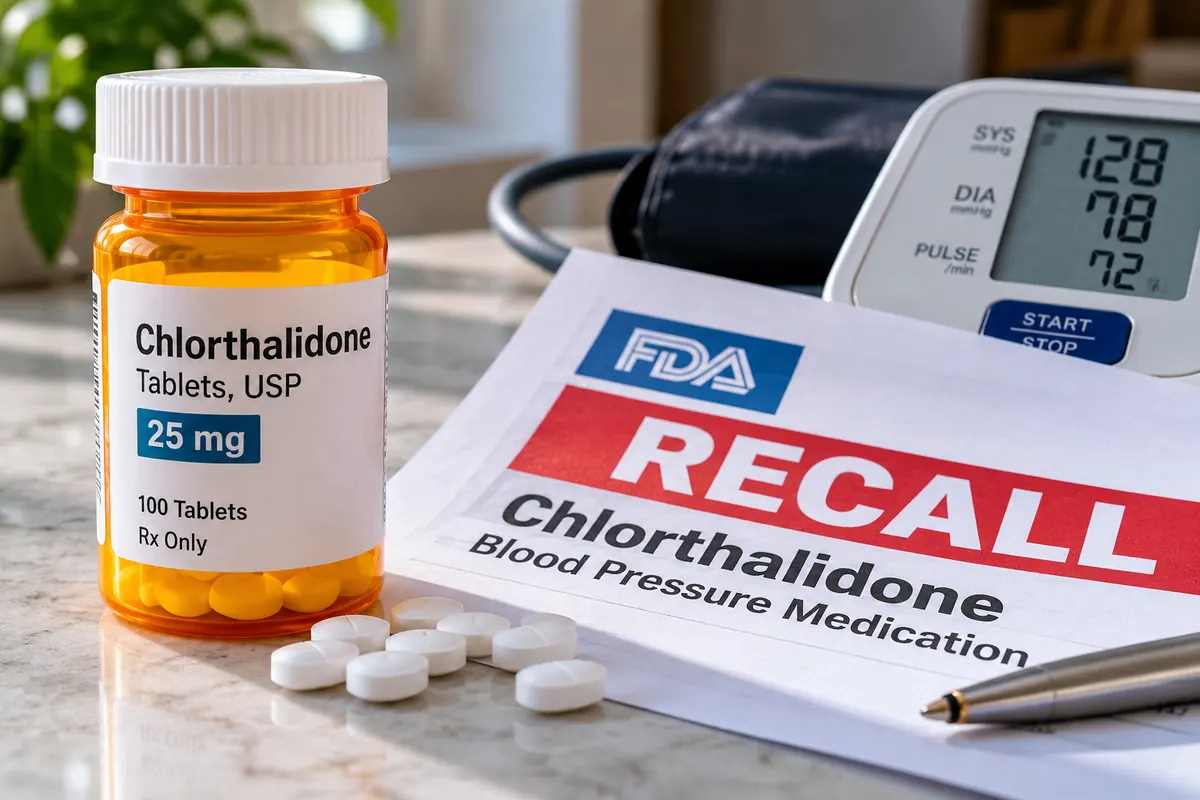
People who take chlorthalidone for high blood pressure have a new recall to check.
Inventia Healthcare Limited recalled
13,567 bottles of Chlorthalidone Tablets, USP, 25 mg after the medicine failed dissolution specifications. The recall covers 100 tablet bottles from batch RISA24002, with NDC 64980-599-01 and an expiration date of April 2027. The medicine was distributed across the United States. The recall began on September 3, 2026. FDA enforcement data lists it as an ongoing Class II recall.This is not the first chlorthalidone recall this year. Another 11,460 bottles were recalled in June, also because of failed dissolution specifications. Those bottles came from two different batches.
If you take chlorthalidone, don't assume your prescription is included just because the drug name matches. The batch and product information matter. If those details aren't printed on the bottle you received from your pharmacy, call the pharmacy and ask them to check.
Do not stop taking a prescribed blood pressure medicine without speaking with your pharmacist, doctor or another qualified healthcare professional.
Quick Look at the September Chlorthalidone Recall
These details come from the FDA enforcement record for recall D-0852-2026.
Which Blood Pressure Medication Was Recalled?
The latest recall involves
chlorthalidone 25 mg tablets manufactured by Inventia Healthcare Limited.Chlorthalidone is a prescription diuretic. Doctors commonly prescribe it to lower high blood pressure, and it may also be used to treat fluid retention.
The key point for patients is that the recall is much narrower than the drug name alone suggests.
The September action covers batch RISA24002 in 100 tablet bottles. It does not say that every chlorthalidone tablet sold in the United States is recalled.
That distinction can easily get lost when a headline simply says a blood pressure medication was recalled nationwide.
In this case, "nationwide" describes where the affected bottles were distributed. It does not mean every chlorthalidone prescription nationwide is part of the recall.
Which Chlorthalidone Lots Are Recalled in 2026?
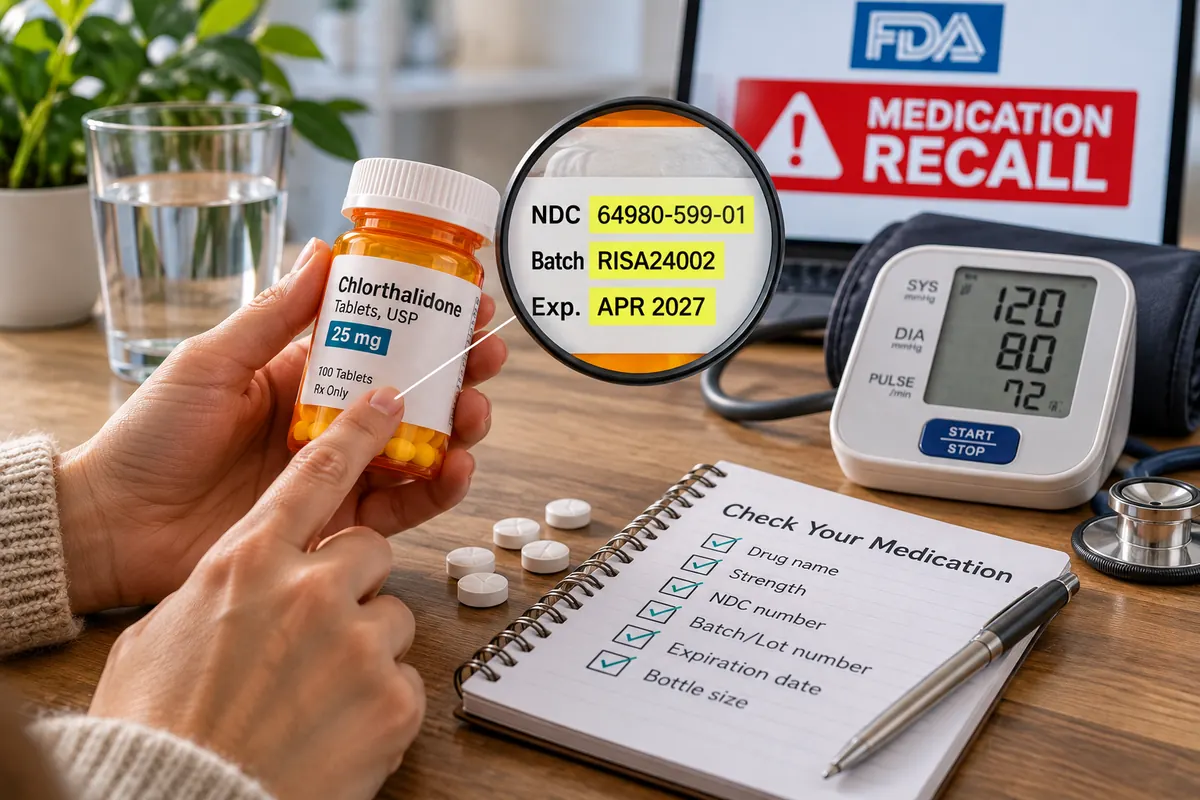
There have been two separate chlorthalidone recalls this year.
The first began in June. The second began in September.
Here is an easier way to compare them.
The June FDA enforcement record identifies 11,460 bottles in total, with nationwide distribution. It lists batch RISA24001 for the 100-tablet bottle and RISB24002 for the 1,000-tablet bottle.
The September action involves another 13,567 bottles and a different batch, RISA24002.
The batch numbers look similar, so read the entire code rather than checking only the first few letters or numbers.
Why Was Chlorthalidone Recalled?
The stated reason is
failed dissolution specifications.For someone who doesn't work in pharmaceuticals, that phrase needs a little explanation.
A tablet has to do more than contain the correct drug. It also has to meet standards for how that drug is released from the tablet. Manufacturers test this under controlled conditions.
That testing is called dissolution testing.
When a batch fails its dissolution specification, the laboratory results have fallen outside the standard established for the product.
This isn't necessarily something a patient would notice by looking at a tablet. The pill may look perfectly ordinary.
It also doesn't prove that every tablet in every recalled bottle failed to work in a person. The recall concerns a quality problem found through testing.
We have more specific laboratory information for the June recall because a notice from Rising Pharma Holdings was published by the California State Board of Pharmacy.
According to that notice, testing at the 18 month stability interval found a chlorthalidone assay result of
91.5%. The approved specification was 92.0% to 108.0%.The same testing found mean dissolution of
78%, with individual results ranging from 71% to 84%. The notice says this did not meet the acceptance criterion of not less than Q = 80% of the labeled amount.Those numbers are useful for understanding what happened in June, but they should not be assigned to the September batch. The September FDA record states that RISA24002 failed dissolution specifications but does not provide those same laboratory figures in the public enforcement entry.
What Is a Dissolution Test?
Think about what has to happen after someone swallows a tablet.
The medicine cannot simply remain locked inside the solid pill. The dosage form has to release its active ingredient in a way that meets the standards established for that product.
Dissolution testing checks that process in a controlled laboratory setting.
Manufacturers can then compare the test results with the product's required specifications.
A failed test tells quality-control teams that the batch did not perform within those requirements.
For patients, the safest interpretation is straightforward:
the recalled batches did not meet an established pharmaceutical quality standard.It would be inaccurate to take that finding a step further and claim that every recalled tablet definitely failed to provide treatment. The available recall information doesn't establish that.
What Does an FDA Class II Recall Mean?
The September chlorthalidone recall is classified as
Class II. The June recall received the same classification.The FDA uses Class II when exposure to a violative product may cause temporary or medically reversible adverse health consequences, or when the probability of serious adverse health consequences is remote.
That definition is more useful than simply describing Class II as the "second highest" recall level.
A Class II designation doesn't tell an individual patient that they will experience a health problem. It describes the regulatory assessment of the potential health hazard associated with the recalled product.
The September recall began September 3. FDA enforcement information published later in the month lists the action as Class II and ongoing.
More Than 25,000 Bottles Are Involved Across the Two Recalls
Looking only at the latest headlines gives part of the story.
The numbers from the two actions are:
June 2026 recall: 11,460 bottles
September 2026 recall: 13,567 bottles
Together, that comes to
25,027 bottles.Still, these should not be treated as one large recall. They are separate actions involving different batches.
The June action covered RISA24001 and RISB24002.
The September action covers RISA24002.
All three batches have an April 2027 expiration date.
There is another difference worth noticing. The June recall included 100 tablet and 1,000 tablet manufacturer bottles. The September recall involves the 100 tablet presentation.
Those details are far more useful to someone checking a prescription than the combined number of bottles.
How to Check Your Chlorthalidone
If chlorthalidone is one of your prescriptions, start with the label.
First, confirm the
drug name. The recalls covered here involve chlorthalidone.Next, check the
strength. The affected products are 25 mg.Then look for an NDC. The September product uses
64980-599-01.After that, look for the batch or lot number. For the September recall, the number to check is
RISA24002.For the June recall, the affected batches were
RISA24001 and RISB24002.The identified batches expire in
April 2027.You may not find all of this information on the bottle sitting in your medicine cabinet.
That's normal.
Pharmacies frequently receive medication in manufacturer containers and dispense a smaller quantity into a pharmacy bottle for the patient. The label on that bottle may not reproduce the manufacturer's original batch number.
If you cannot find the batch, don't try to identify it from the color or shape of the tablet. Call the pharmacy that filled the prescription.
What Should I Do If My Bottle May Be Recalled?
Start with the pharmacy that dispensed your prescription.
Tell the pharmacist that you're checking your chlorthalidone because of the 2026 recalls. Give them your prescription information and any manufacturer, NDC, batch or expiration information you can see.
If your bottle doesn't show the original lot, ask whether the pharmacy can determine which stock was used when your prescription was filled.
If the medication is confirmed as part of a recalled batch, ask the pharmacist or your prescribing clinician how the prescription should be handled and whether replacement medication is needed.
Follow the return or disposal instructions provided for the recalled medicine.
Most importantly,
don't stop a prescribed blood pressure medication on your own.Checking a product against a recall and deciding how an individual patient's treatment should be managed are two different things. The second decision belongs with a qualified healthcare professional.
Why You Shouldn't Stop Blood Pressure Medication on Your Own
A person who sees their medicine named in a recall may understandably want to stop taking it immediately.
There is a problem with doing that without checking first.
Chlorthalidone is prescribed to help manage conditions such as high blood pressure. Stopping prescribed antihypertensive treatment without medical guidance may leave blood pressure inadequately controlled.
There is also a reasonable chance that a chlorthalidone prescription isn't part of these recalls at all. The recall is tied to particular products and batches.
A pharmacist can help establish whether the medicine you actually received came from affected stock.
If it did, your pharmacist or prescribing healthcare professional can tell you what should happen next.
Is Chlorthalidone Dangerous?
The 2026 recalls don't establish that chlorthalidone itself is an inherently dangerous medicine.
The problem identified here concerns
specific manufactured batches that failed quality specifications.Those are two different questions.
Like other prescription medicines, chlorthalidone has known effects, risks, precautions and potential side effects. Those belong to the drug's normal medical safety profile.
The current recall concerns manufacturing quality.
This is another reason patients should avoid reading "chlorthalidone recalled" as "chlorthalidone has been declared unsafe."
That isn't what the recall record says.
What Is Chlorthalidone Used For?
Chlorthalidone is a diuretic, sometimes casually called a water pill.
One of its main uses is treating high blood pressure. Diuretics help the kidneys remove excess sodium and water from the body through urine. Chlorthalidone may also be prescribed for fluid retention in some patients.
The medication has been used clinically for many years.
None of that changes the issue behind this recall. The question regulators and manufacturers are addressing is whether particular batches met required quality standards.
For somebody already taking chlorthalidone, the practical question isn't whether chlorthalidone exists in a recall database.
It's whether
their particular medication came from one of the affected batches.What Happened in the June 2026 Recall?
The earlier recall began on
June 5, 2026.It involved 11,460 bottles of Chlorthalidone Tablets, USP, 25 mg manufactured by Inventia Healthcare Limited and distributed by Rising Pharma Holdings. The FDA enforcement record lists nationwide distribution and identifies the action as voluntary and firm initiated.
Two batches were involved.
The 100 tablet bottles carried batch
RISA24001, NDC 64980-599-01.The 1,000 tablet bottles carried batch
RISB24002, NDC 64980-599-10.Both had an April 2027 expiration date.
The manufacturer notice gives a clear reason for the action.
During 18 month long term stability testing, the product returned an assay result below the approved specification. Dissolution testing at the same interval also failed its acceptance criterion.
The notice also says a preliminary health hazard assessment anticipated no impact on patient health and safety.
The FDA subsequently classified that action as Class II on June 22.
Several months later, batch RISA24002 became the subject of the separate September recall.
Are All Chlorthalidone Tablets Recalled?
No.
This point deserves a direct answer because it's easy to leave a news article with the wrong impression.
The recalls identify specific batches of chlorthalidone 25 mg. They do not identify every chlorthalidone product sold in the United States.
For the September action, the relevant batch is RISA24002.
For June, the batches were RISA24001 and RISB24002.
If your medication doesn't provide enough information to make that comparison, the next step is to contact your pharmacist rather than assume the prescription is affected.
Are Other Blood Pressure Medications Included?
The recall covered in this article concerns chlorthalidone.
It does not establish that other common blood pressure medications such as amlodipine, losartan, lisinopril or metoprolol are part of the same recall.
Separate drugs can, of course, be recalled for unrelated reasons at different times. Anyone checking another medicine should search for that medication specifically and compare the current recall information with the product they have.
Don't use the chlorthalidone recall as evidence that another blood pressure medicine has also been recalled.
What If There Is No Batch Number on My Prescription Bottle?
Call your pharmacy.
This may be the most useful advice for people trying to check their medication at home.
The bottle a patient receives isn't necessarily the bottle that left the manufacturer. A pharmacy may receive a container holding hundreds or even 1,000 tablets and dispense a smaller number into its own labeled prescription vial.
As a result, your bottle may show your prescription number, medication, strength and instructions but not the original manufacturing batch.
That missing number doesn't prove that your medicine is safe or recalled.
It simply means you need the pharmacy's help identifying it.
Have your prescription number ready when you call. Ask whether the pharmacy can determine the manufacturer and lot associated with the chlorthalidone dispensed to you.
When Should You Call a Pharmacist or Doctor?
A pharmacist is particularly useful when the question is
which product you received.Consider contacting your pharmacy if the batch number isn't visible, you can't identify the manufacturer, you're unsure about the NDC, or some of the information matches the recall but other details don't.
If the pharmacy confirms that your medication came from an affected batch, ask what procedure you should follow.
Questions about your treatment should go to your prescribing healthcare professional.
If you're experiencing new or concerning medical symptoms, discuss those symptoms with an appropriate healthcare professional. Urgent or severe symptoms require appropriate medical attention regardless of whether a medication recall is underway.
Where Can Patients Confirm a Drug Recall?
For a medication recall, the FDA's enforcement information is an important place to verify the details.
The September chlorthalidone action is
recall D-0852-2026. Its FDA derived enforcement record lists 13,567 bottles, batch RISA24002, an April 2027 expiration date, nationwide distribution and failed dissolution specifications as the reason.The June action is
D-0610-2026. Its enforcement record lists 11,460 bottles, batches RISA24001 and RISB24002, and the same general recall reason.For the June recall, consumers can also review the actual Rising Pharma recall communication published by the California State Board of Pharmacy.
When checking any medication recall, use as many identifiers as possible. Drug name alone isn't enough. Strength, NDC, package size, batch number and expiration date can all help determine whether the product matches.
What Patients Should Take Away From the Chlorthalidone Recall
The headline is simple. The details aren't.
Yes, chlorthalidone has been recalled in 2026. In fact, there have been two separate actions.
But that doesn't make every bottle of chlorthalidone a recalled product.
The September action involves 13,567 bottles from batch RISA24002. The June recall involved 11,460 bottles from batches RISA24001 and RISB24002.
If you have chlorthalidone at home, check the information available on the bottle. If you can't find the lot or aren't certain what you're looking at, contact the pharmacy that dispensed it.
If your medicine is confirmed as part of the recall, speak with your pharmacist or prescribing healthcare professional before changing treatment.
That gives you an answer based on the medicine you actually received, rather than on a headline about thousands of bottles somewhere in the country.
Explore more practical updates and guides in our Health & Wellness section.
Frequently Asked Questions
What blood pressure medication was recalled in 2026?
Certain
Chlorthalidone Tablets, USP, 25 mg were recalled in two separate actions during 2026. The latest recall involves 13,567 bottles from batch RISA24002. An earlier June recall involved another 11,460 bottles from two other batches.Is chlorthalidone being recalled?
Yes, specific chlorthalidone products are under recall. The September action covers 25 mg tablets in 100 tablet bottles from batch RISA24002. This does not mean every chlorthalidone prescription or every manufacturer's product is recalled.
What chlorthalidone batch numbers are affected?
The September recall identifies
RISA24002. The earlier June action identifies RISA24001 for 100 tablet bottles and RISB24002 for 1,000 tablet bottles. The listed expiration date for these batches is April 2027.Why was chlorthalidone recalled?
The stated reason for both recall actions is
failed dissolution specifications. For the June batches, a manufacturer notice reports an out of specification result during 18 month stability testing, including dissolution results that did not meet the stated acceptance criterion.What does failed dissolution mean?
It means the product did not meet an established requirement used to evaluate how the active drug is released from the tablet during laboratory testing. It is a pharmaceutical quality issue. It does not, by itself, prove that every tablet in the recalled batches failed to work in every patient.
What does an FDA Class II recall mean?
FDA's Class II definition covers situations where exposure may cause temporary or medically reversible adverse health consequences, or where the probability of serious adverse health consequences is remote. Both 2026 chlorthalidone actions are listed as Class II recalls.
How many bottles of chlorthalidone have been recalled?
The June action covered
11,460 bottles, and the September action covers 13,567 bottles. That is 25,027 bottles across the two separate recalls.Should I stop taking chlorthalidone if my prescription is recalled?
Do not stop or change prescribed blood pressure treatment on your own. Contact your pharmacist and prescribing healthcare professional. They can confirm whether your medication is affected and tell you how the prescription should be handled.
How can I find my chlorthalidone lot number?
Check the prescription and manufacturer packaging first. If your pharmacy dispensed the tablets into its own prescription bottle, the original batch may not be printed there. Contact the pharmacy and ask them to identify the stock used to fill your prescription.
Are all chlorthalidone tablets recalled?
No. The 2026 actions identify particular 25 mg products and batches. A chlorthalidone prescription should not be considered recalled simply because the drug name matches.
Reader Reaction
Was this article useful?
1 reader likes this article.
Share This Article
Found this story useful? Share it with your network.
Comments
0 discussionsAdd your perspective, reply to other readers, and keep the conversation useful.
Conversation
Reader responses