
Self Driving Cars in 2026 | Are We Finally Close to Full Autonomy?
Discover how far self-driving cars have come in 2026. Explore Tesla FSD, Waymo robotaxis, autonomous driving levels, safety, and the challenges still preventing full Level 5 autonomy.
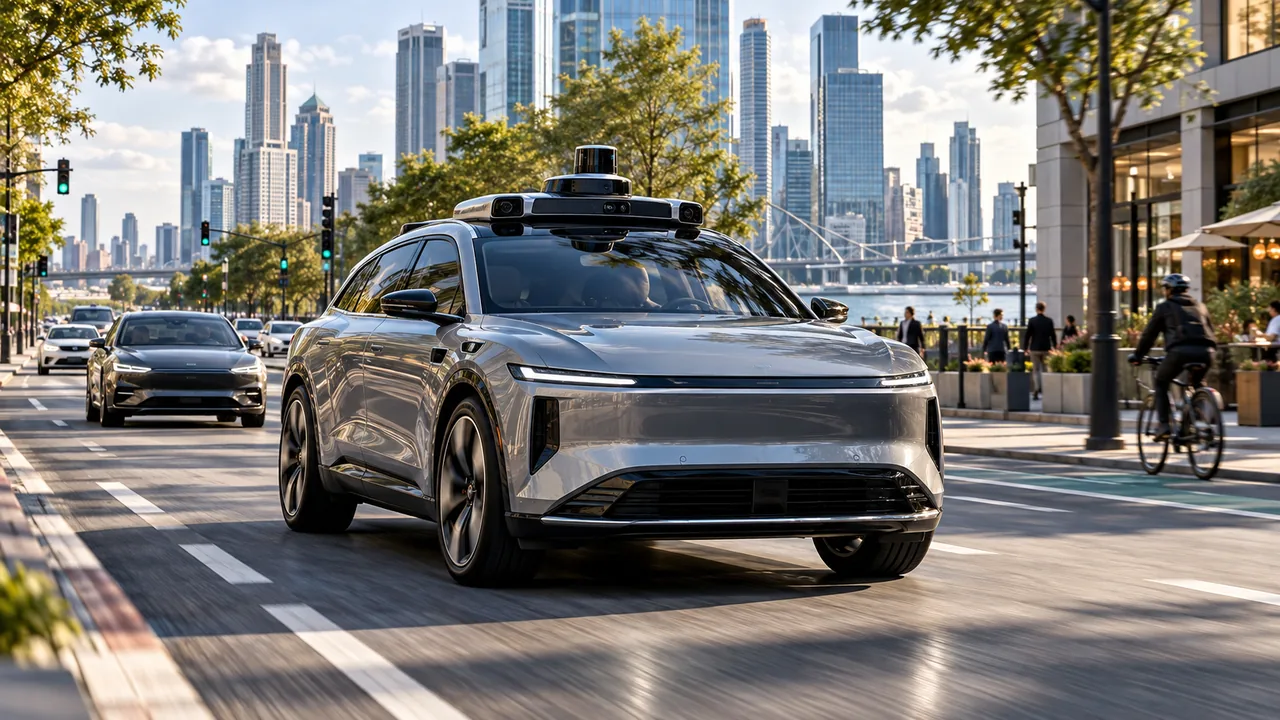
A few years ago self-driving cars felt like something from the future. Now in 2026 you can book a robotaxi in certain American cities and travel without anyone sitting behind the Steering wheel.
That sounds like full autonomy has finally arrived. But the reality is a little different.
Tesla can handle many driving tasks Waymo operates driverless taxis and artificial intelligence keeps improving. Still most vehicles sold to everyday drivers need someone paying attention.
So how far have self-driving cars come in 2026? And are we getting closer to a car that can drive anywhere without human help?
Are Self Driving Cars Fully Autonomous in 2026?
Not completely. Self-driving cars have made real progress in 2026, but Level 5 full autonomy is not commercially available.
Waymo already operates driverless robotaxis in selected areas using Level 4 automation. Tesla's Full Self-Driving (Supervised) can perform many driving tasks, but the driver must remain attentive.
The biggest challenge is moving beyond controlled operating areas. A truly Level 5 vehicle would need to handle the same driving conditions a human can, without depending on human intervention.
What Does Full Autonomy Actually Mean?
Before comparing Tesla, Waymo, or other autonomous vehicle companies, it helps to understand what self-driving actually means.
A vehicle that can steer itself is not necessarily autonomous. Even a car that handles braking, acceleration, and lane changes may still depend on its driver.
The Society of Automotive Engineers (SAE) classifies driving automation into six levels, from Level 0 to Level 5.
The important difference is who performs and supervises the driving task.
Understanding the Six Levels of Autonomous Driving.
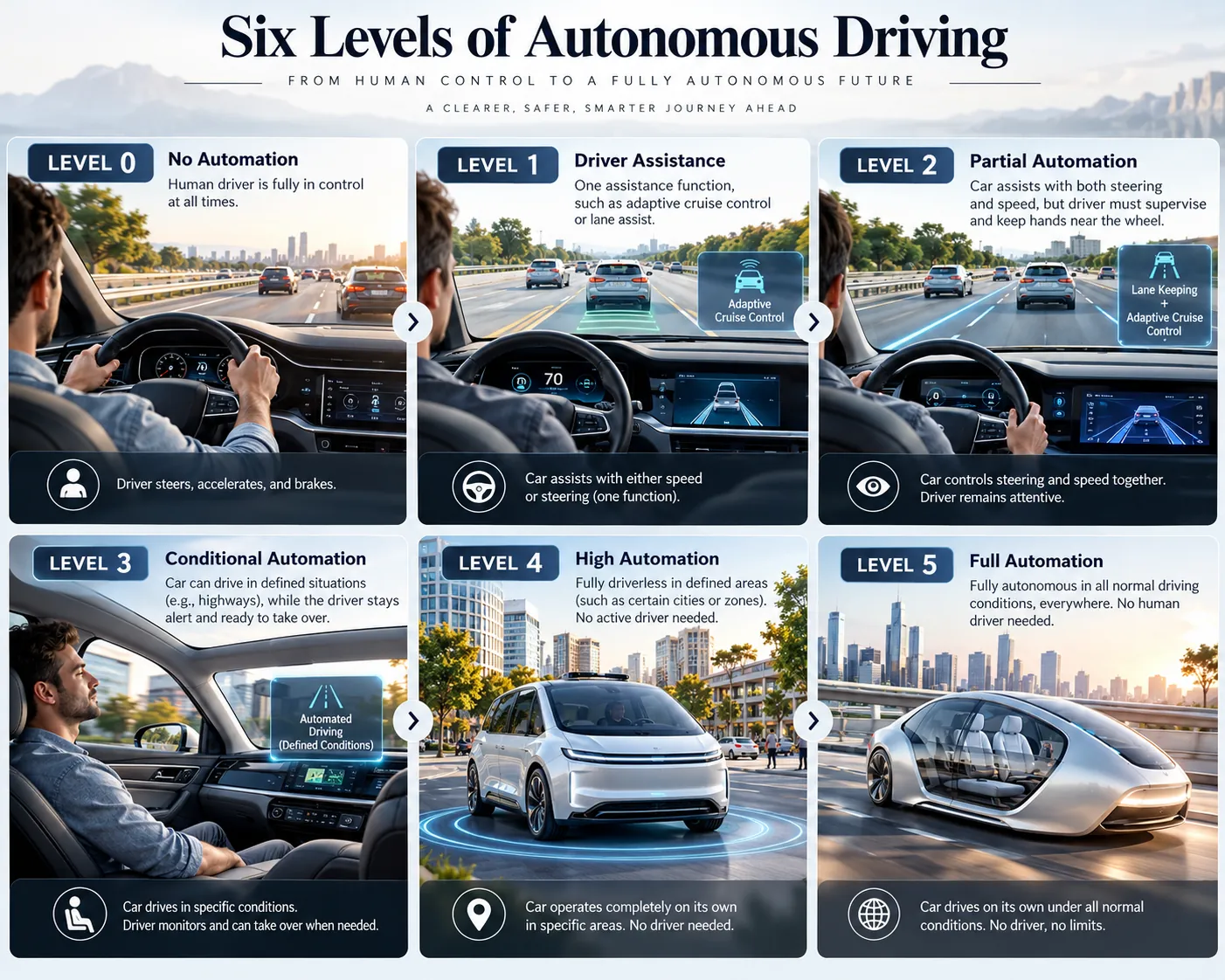
Based on SAE J3016 driving automation definitions and NHTSA guidance.
Level 2: Advanced Assistance, Not Full Autonomy.
Level 2 vehicles can control steering and speed at the same time.
For example, a car might maintain its lane, adjust speed to surrounding traffic, and assist with certain highway driving tasks.
But the driver is still responsible for watching the road and intervening when necessary.
This is an important distinction because sophisticated assistance can sometimes look like autonomous driving.
Level 3: The Car Drives Under Specific Conditions.
Level 3 is where the system performs the driving task within a defined operating environment.
The driver does not have to continuously perform the driving task while the system is properly engaged. However, they must be available to take control when the system requests it.
This makes Level 3 more advanced than ordinary driver assistance, but it still depends on a human being available.
Level 4: Real Driverless Operation.
Level 4 is where things become interesting.
A Level 4 autonomous vehicle can manage the driving task without needing a human to intervene within its approved operating conditions.
That might mean a particular city, mapped service area, or other defined environment.
If the system cannot safely continue, it must handle the situation without depending on a passenger to become the driver.
This is the kind of automation used by commercial robotaxi services.
Level 5: Full Driving Automation.
Level 5 goes further.
A Level 5 system should be capable of driving under all conditions in which a human can reasonably drive.
It should not depend on a particular city or limited service area to function.
According to NHTSA, this technology is not currently available for ordinary consumer purchase.
That is why driverless taxis operating today do not automatically mean the world has reached full autonomy.
How Far Have Self Driving Cars Come in 2026?
The progress is real. But not every company is trying to solve autonomous driving in exactly the same way.
Two of the biggest names are Waymo and Tesla.
Both use artificial intelligence and sophisticated vehicle software. Their current products, however, offer different levels of driver responsibility.
Waymo: Driverless Taxis Are Already Operating.
Waymo has moved beyond demonstration vehicles and controlled research environments.
Its robotaxis are carrying paying passengers without a human driver in selected American cities.
On September 1, 2026, Waymo announced that it was introducing public rides in Denver, San Diego, and Tampa. At that point, the company reported providing fully autonomous trips in 14 cities.
That is significant because it demonstrates that autonomous vehicles can operate as real transportation services rather than just experimental technology.
But there is a limitation.
Waymo's vehicles operate within defined areas and conditions. The service is not designed to let someone request a driverless journey anywhere in the world.
Its commercial operations therefore demonstrate Level 4 autonomy rather than universal Level 5 capability.
Tesla: Full Self-Driving Still Requires Supervision.
Tesla has taken another approach.
Its Full Self-Driving (Supervised), often called FSD, can perform tasks including navigation, steering, lane changes, parking, and handling various driving situations.
For someone sitting in the driver's seat, the experience can feel surprisingly automated.
However, Tesla explicitly states that its currently enabled supervised features require active driver supervision and do not make the vehicle autonomous.
That means the driver remains responsible.
Tesla continues to develop its autonomous driving technology, but the name Full Self-Driving should not be confused with SAE Level 5.
Why Waymo and Tesla Are Different.
The important difference is not simply which car drives more smoothly.
It is whether the human must supervise the driving task.
Waymo's driverless service is built around operating without a driver within a restricted environment.
Tesla's supervised consumer system is built to assist a human who remains responsible.
Understanding this difference helps explain why some cars can carry passengers with an empty driver's seat while others still require someone to monitor every journey.
How Self Driving Cars Actually Work?
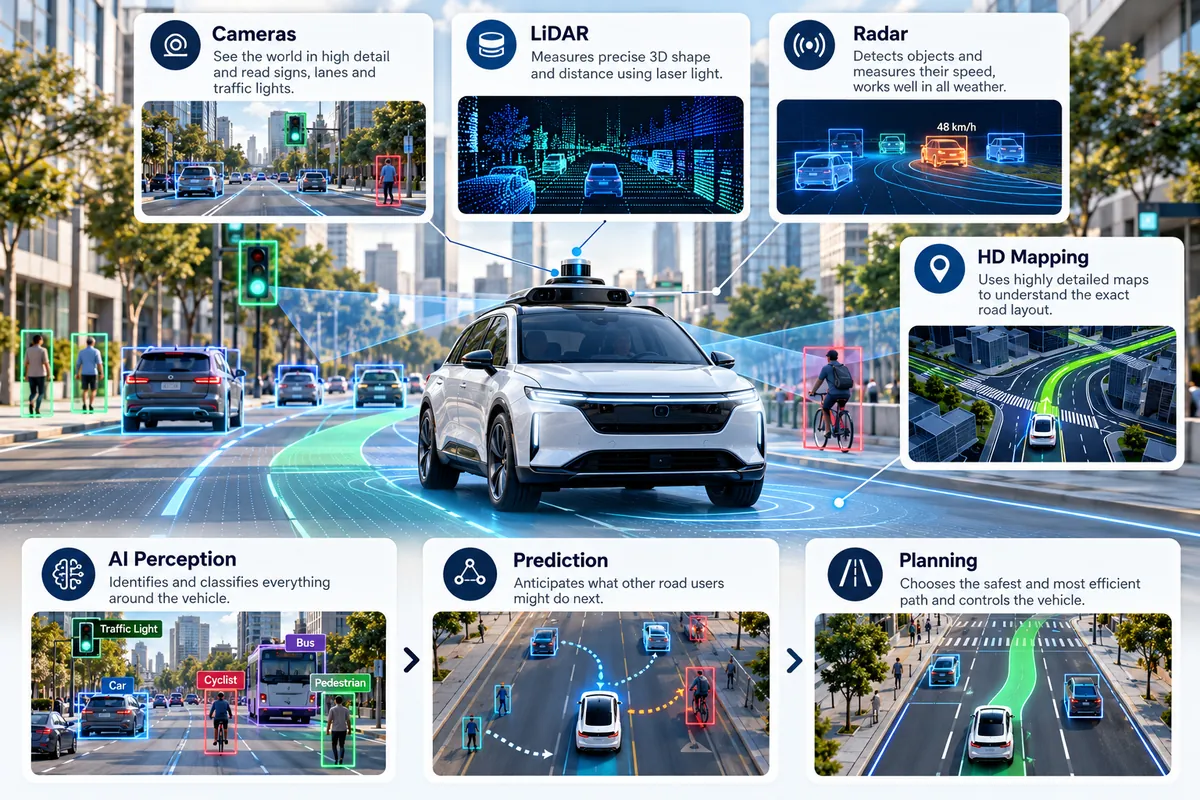
A self-driving car needs to do much more than follow a route on a navigation screen.
It must detect road users, understand traffic conditions, predict what might happen next, and decide how to move safely.
Artificial intelligence brings these processes together.
Different manufacturers use different combinations of sensors and software, but several technologies play important roles.
Cameras Help the Car Understand Its Surroundings.
Cameras capture visual information about the road.
They can help identify:
Traffic lights and road signs
Lane markings
Pedestrians and cyclists
Vehicles and other obstacles
Intersections and road layouts
Computer vision software processes this information to help the vehicle understand what it is seeing.
However, camera performance can be affected by visibility, lighting, and weather conditions.
LiDAR Measures the World in Three Dimensions.
LiDAR stands for Light Detection and Ranging.
It uses laser light to measure distances and create a three-dimensional representation of surrounding objects.
This can help an autonomous vehicle estimate the position and shape of nearby structures, vehicles, and obstacles.
Waymo uses LiDAR as part of its wider sensing system.
Radar Tracks Moving Objects.
Radar uses radio waves to detect objects and estimate information such as their distance and relative movement.
It can provide valuable information about surrounding traffic.
Radar does not replace cameras or LiDAR. Instead, it can complement them by offering another way to observe the environment.
Artificial Intelligence Makes Driving Decisions.
Sensors collect information. AI helps interpret it.
Machine-learning systems support tasks such as recognizing road users, estimating their likely movement, planning routes, and choosing appropriate vehicle actions.
Imagine a pedestrian approaching a crossing.
The vehicle needs to recognize the person, estimate whether they may enter the road, and decide whether slowing down or stopping is necessary.
That process involves perception, prediction, and planning working together.
High-Definition Maps Provide Additional Context.
Some autonomous systems also use detailed digital maps.
These maps can include lane geometry, junction layouts, and other important road features.
Waymo combines mapping with live sensor information rather than using maps as a replacement for observing its surroundings.
This can improve a system's understanding of its operating area.
Still, roads change. Construction work, temporary diversions, and unexpected obstacles mean a vehicle must continue interpreting its environment in real time.
Are Self Driving Cars Safer Than Human Drivers?
Safety is one of the biggest questions surrounding autonomous vehicles.
Human drivers can become distracted, tired, impatient, or impaired. Automated systems do not experience those problems in the same way.
But software and sensors can also make mistakes.
The important question is whether autonomous vehicles perform better than relevant human-driver benchmarks under comparable conditions.
What Waymo's Safety Data Shows.
In September 2026, Waymo published an updated safety analysis covering more than 270 million miles of fully autonomous operation through June 2026.
The analysis covered five major metropolitan service areas.
According to Waymo, its vehicles were involved in:
82% fewer injury-causing crashes compared with its modeled human-driver benchmark.
95% fewer serious-injury-or-worse crashes compared with that benchmark.
841 fewer injury-causing crashes than the benchmark predicted.
These results are encouraging. They suggest autonomous driving can deliver meaningful safety benefits in the environments studied.
However, they need context.
The figures come from Waymo's own analysis and use comparisons with estimated human-driver crash rates.
They do not prove that every autonomous vehicle is safer than every human driver.
Different roads, weather conditions, operating environments, and vehicle systems can produce different outcomes.
Why More Testing Still Matters.
An autonomous vehicle might perform well across millions of ordinary journeys while still struggling with an unusual situation.
Safety testing therefore needs to consider more than the number of successful trips.
It must examine how systems respond to unexpected hazards, equipment problems, changing road conditions, and rare events.
That is particularly important as companies expand into new cities and unfamiliar environments.
What's Still Stopping Level 5 Full Autonomy?
If driverless taxis already work, why can't every car drive itself everywhere?
Because a system that works reliably inside a known operating area faces a much larger challenge when those boundaries disappear.
Several problems remain difficult.
1. Unpredictable Road Situations.
Real roads are rarely perfect.
A human driver may encounter a police officer giving hand signals, an unusual temporary barrier, debris falling from a vehicle, or a pedestrian acting unexpectedly.
These situations do not always follow familiar traffic patterns.
An autonomous vehicle must understand what is happening and respond safely, even when the situation is unusual.
2. Difficult Weather and Visibility.
Heavy rain, snow, fog, and other weather conditions can affect how sensors interpret the environment.
Water, dirt, ice, and poor visibility may also interfere with the quality of information reaching the system.
A vehicle designed to operate in one climate may face different challenges somewhere else.
For Level 5 autonomy, those conditions cannot simply be avoided whenever a human could still drive safely.
3. Changing Roads and Construction Work.
Road layouts change constantly.
Temporary lanes appear. Construction crews close intersections. Road markings become damaged or difficult to follow.
Autonomous vehicles must adapt to these changes without depending entirely on previously mapped information.
This becomes harder when systems move beyond carefully studied operating areas.
4. The Long Tail of Rare Events.
Developers often refer to the long tail of driving situations.
Most journeys involve familiar patterns such as following lanes, turning at intersections, and stopping for traffic lights.
The difficult cases are the unusual events that occur much less frequently.
A system might need extensive testing and simulation to encounter enough variations of those events.
Even after millions of miles, proving that every important situation has been handled safely remains difficult.
5. Different Laws and Road Conditions.
Driving rules differ between countries and sometimes between states or regions.
Road signs, traffic behavior, infrastructure, and legal responsibilities also vary.
A system that works in an American city may not be ready to operate independently on a rural British road or during a Canadian snowstorm.
Expanding autonomy requires technical validation and an appropriate legal framework.
6. Proving the System Can Handle Failure.
A Level 5 vehicle needs to remain safe even when something goes wrong.
That includes detecting sensor problems, responding to software faults, and managing situations where continuing the journey may be unsafe.
Achieving impressive performance is one challenge.
Demonstrating dependable safety across an enormous range of environments is another.
Self Driving Cars in the USA, UK and Canada.
The development of autonomous vehicles does not look the same everywhere.
Technology is only part of the story. Regulations, testing permissions, insurance, and infrastructure also influence where these systems can operate.
United States: Commercial Robotaxis Are Already Real.
The United States is one of the most visible markets for commercial driverless transportation.
Waymo operates autonomous rides in selected cities, while manufacturers continue developing advanced assistance systems for consumer vehicles.
However, vehicle capabilities and local permissions vary.
A robotaxi service being available in one city does not mean the same service can automatically operate across the entire country.
United Kingdom: Moving Toward Regulated Driverless Services.
The UK has been developing a dedicated framework for automated vehicles.
In 2026, automated passenger services became an important focus, with new regulations supporting a pathway for permitted pilot operations.
The wider challenge is allowing driverless services to expand while maintaining clear safety standards and responsibilities.
For British consumers, that means autonomous transportation is progressing, but access and availability depend on approved services rather than a universal rollout.
Canada: Testing and Safety Remain Central.
Canada has also been preparing for more advanced vehicle automation.
Transport Canada's guidance addresses testing, safety assessment, operational limits, and the responsibilities of different levels of government.
The country's varied climate creates additional real-world challenges.
Autonomous systems may eventually need to handle snow-covered roads, poor visibility, and substantial differences between urban and rural driving.
For now, careful testing and regulatory development remain important parts of Canada's approach.
Common Misunderstandings About Self Driving Cars.
A lot of confusion comes from treating every automated feature as proof of full autonomy.
Here are some common mistakes.
Thinking that hands-free means driverless. A hands-free driving feature may still require continuous monitoring.
Assuming Tesla FSD is Level 5. Tesla's supervised system requires an attentive human driver.
Believing robotaxis can operate anywhere. Current Level 4 services have operational restrictions.
Treating manufacturer safety results as universal proof. Safety findings should be evaluated within their actual testing conditions.
Expecting one software update to solve everything. Full autonomy involves perception, prediction, validation, hardware, safety engineering, and regulation.
The best way to judge a system is to understand what it can do and what responsibility remains with the human.
What Should Car Buyers Look for in 2026?
If you are considering a vehicle advertised with advanced driving features, the most useful question is not whether it calls itself self-driving.
Ask what the system actually permits.
Before buying, check:
Does the feature require continuous supervision?
Can it operate on ordinary streets or only certain roads?
Is driver monitoring required?
What happens when the system reaches its limits?
Are the advertised capabilities available in your country?
Does the manufacturer clearly explain when the driver must intervene?
You should also distinguish ordinary driver assistance from a genuine automated driving system.
Never assume you can sleep, look away from the road, or leave the driver's seat simply because a car can steer or change lanes.
The manufacturer's operating instructions and local regulations remain essential.
Final Verdict: Are We Finally Close to Full Autonomy?
Self driving cars in 2026 have made impressive progress.
A vehicle carrying passengers without anyone behind the wheel is no longer just an idea. Waymo has shown that Level 4 autonomy can work as a real transportation service in selected areas.
Tesla has also demonstrated how sophisticated supervised driving assistance has become.
But Level 5 remains a different challenge.
The industry must move from vehicles that operate under defined conditions to vehicles that can safely handle the full range of situations human drivers encounter.
That will require more than better navigation or smoother lane changes.
It means solving the difficult situations, validating system safety, and building confidence that a human driver is no longer necessary.
We are closer to practical driverless transportation than before. But full autonomy, without geographic or operational boundaries, has not arrived yet.
For more insights into artificial intelligence, automotive innovation, emerging technologies, and future mobility, explore Sponsored Post Hub.
Frequently Asked Questions
1. Are fully self-driving cars available in 2026?
Driverless Level 4 services are available in selected locations, but Level 5 vehicles capable of operating universally are not available for normal consumer purchase.
2. Is Tesla Full Self-Driving actually autonomous?
Tesla's Full Self-Driving (Supervised) can handle many driving tasks, but the driver must actively supervise it. Tesla says its currently enabled supervised features do not make the vehicle autonomous.
3. Is Waymo Level 4 or Level 5?
Waymo's commercial driverless service is an example of Level 4 automation. It can operate without a human driver within defined conditions, but it is not designed to work everywhere.
4. What is the difference between Level 4 and Level 5?
Level 4 can operate independently within defined conditions. Level 5 is intended to perform driving tasks under all conditions in which a human can drive, without requiring human control.
5. Are self-driving cars safer than human drivers?
Some evidence is encouraging. Waymo reports fewer injury-related crashes than matched human benchmarks in the areas studied. However, those findings should not be applied to every autonomous vehicle or driving environment.
6. Can you buy a Level 5 car in 2026?
No. NHTSA states that Level 5 technology is not available for consumer vehicle purchase.
7. Why is Level 5 taking so long?
The main difficulties include rare road situations, changing environments, difficult weather, safety validation, system reliability, and differences in legal requirements.
8. When will Level 5 autonomous cars arrive?
There is no reliable universal launch date. Companies continue improving autonomous technology, but widespread Level 5 availability depends on technical, safety, and regulatory progress.
Reader Reaction
Was this article useful?
1 reader likes this article.
Share This Article
Found this story useful? Share it with your network.
Comments
0 discussionsAdd your perspective, reply to other readers, and keep the conversation useful.
Conversation
Reader responses