
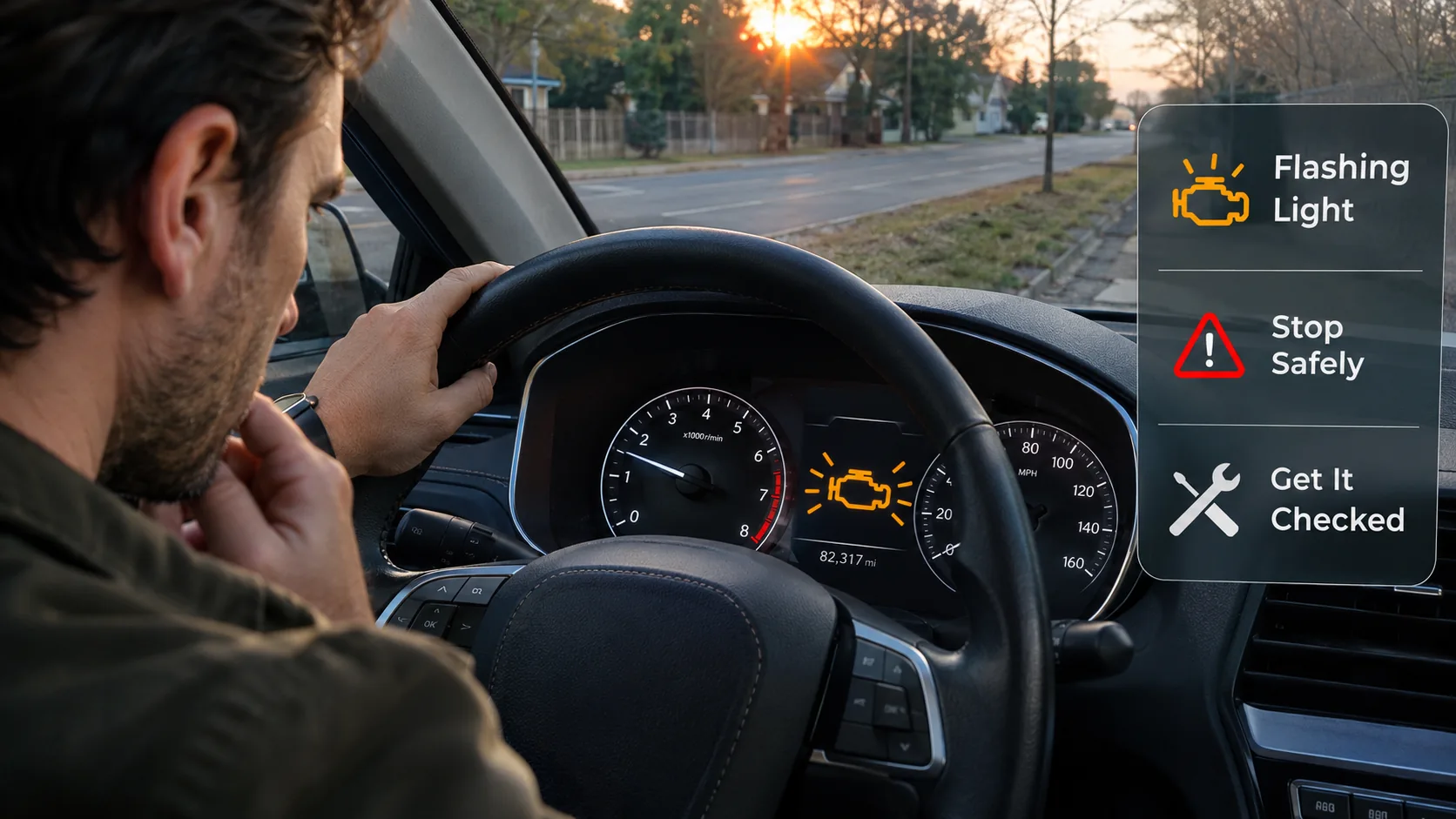
A steady check engine light is irritating. A blinking one while the car shudders under you is a whole different feeling. Can this wait until tomorrow or do you need to stop right now?
Treat it as urgent. A flashing light often points to an engine misfire and a misfire that keeps going can damage the catalytic converter. The light cannot name the failed part. You can still make a safer decision in the next few minutes before a mechanic ever looks at it.
The short version
Lift off the accelerator and skip any hard acceleration. Find a safe place to pull over instead of finishing the trip. Shaking or weak power means you should shut the engine off once you are parked and call roadside assistance for a tow. Overheating or smoke gets the same treatment. So do unusual smells.
Your owner’s manual has the last word for your particular vehicle and a professional should diagnose the problem promptly. A flashing light often signals a serious misfire but it never identifies a specific failed part.
So what is the light telling you
Your vehicle has an onboard diagnostic system that monitors engine operation and emissions control. When it detects trouble it switches on the malfunction indicator lamp. That is the dashboard warning most drivers call the check engine light.
A steady light generally means a fault was detected and needs attention. Blinking usually points to something more urgent and the common culprit is a severe misfire. A misfire simply means combustion in one or more cylinders is not happening as intended.
Fuel may fail to burn properly during that kind of event. The exhaust that follows can push the catalytic converter to excessive heat. This part helps treat your exhaust gases and continued driving under a severe misfire can damage it and possibly other components too.
The U.S. Environmental Protection Agency describes a blinking warning as a sign of severe engine misfire and recommends reducing speed and getting service. Ford’s owner manual guidance also warns that misfire can raise exhaust temperatures and harm the catalytic converter.
Steady or flashing and everything in between
The same symbol can mean very different things. Treat what follows as a rough guide since your owner’s manual and the way the car behaves matter more.
| Warning light pattern | What it may mean | What to do |
|---|---|---|
| Appears briefly at ignition, then turns off | Normal system self-check on many vehicles | No action unless it behaves unusually afterward |
| Stays on steadily while driving | An engine-management or emissions fault was detected | Check the owner's manual and arrange a diagnosis; act sooner if the car runs badly |
| Flashes while the engine runs | Possible active misfire and risk of component damage | Ease off the accelerator, stop somewhere safe and get prompt assistance; arrange a tow when symptoms are severe |
| Flashes, then stays steady or disappears | The fault may be intermittent or no longer detected | Do not assume it was repaired; arrange a diagnosis |
What to do while you are still driving

Keep your eyes on the road first. Reading diagnostic information or searching on your phone while moving is a bad idea.
Easing off the throttle comes next and that means no rapid acceleration or aggressive passing or steep climbs that demand a lot from the engine.
An exit or parking lot or rest area works well for stopping and anywhere away from moving traffic beats the shoulder of a busy lane. Stopping abruptly in an active lane is dangerous.
Strong shaking or a big drop in power or a burning smell or smoke or a rising temperature all raise the urgency. Once you are parked safely with any of those going on you can turn the engine off and call roadside assistance. A suspected fire means moving everyone away and contacting emergency services.
Manuals differ by make and model and by which warning lamps are lit so yours deserves a look. And when the car runs roughly or the flashing continues a tow is the more conservative choice than pushing on to your destination.
Some manufacturer manuals talk about moderate driving to reach a service center. Roadside organizations stress pulling over and arranging help when the vehicle runs abnormally. Those two views can both be right depending on road conditions and symptoms and what the manufacturer says. No universal safe mileage exists for a flashing check engine light.
Where the misfire comes from
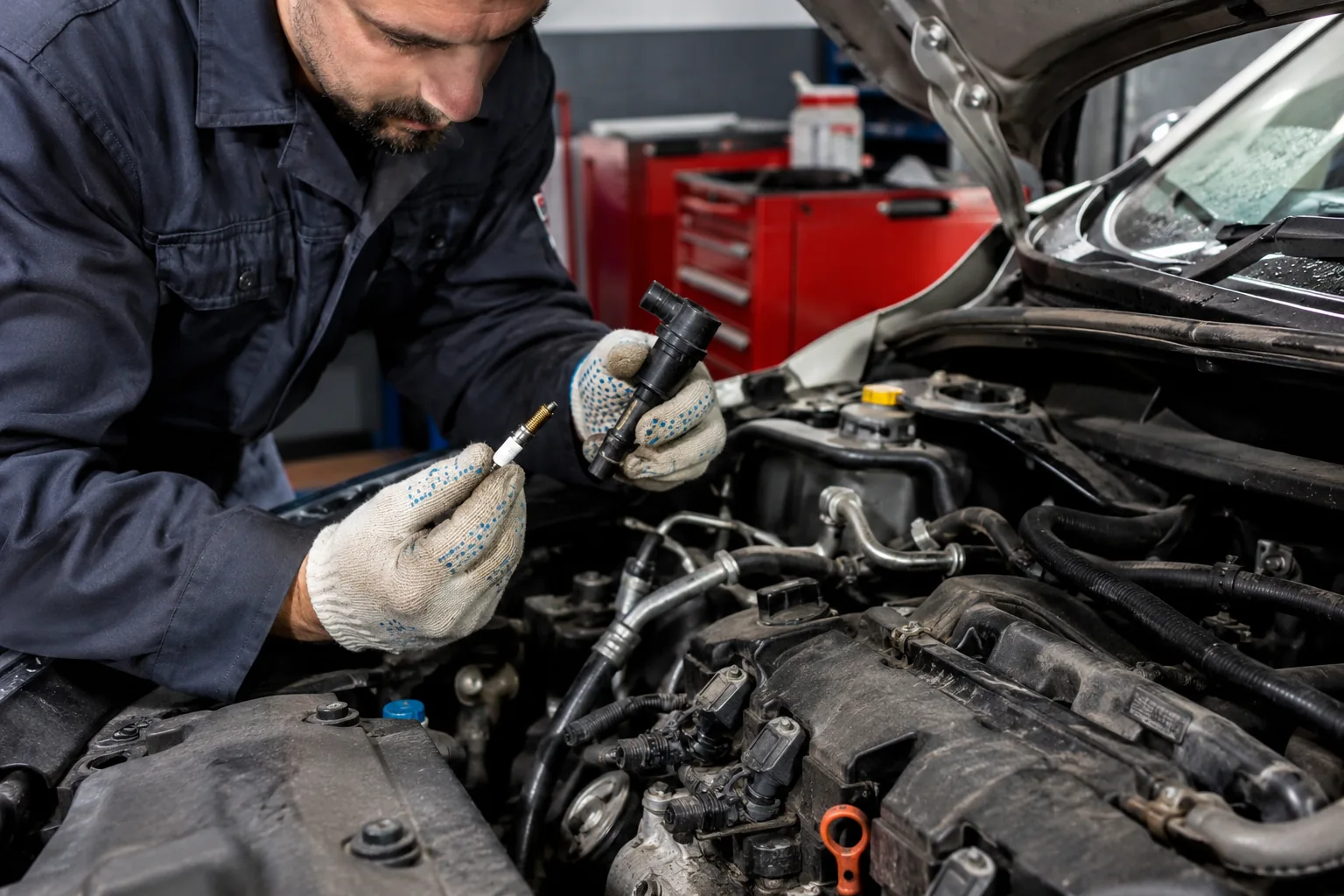
A flashing light often relates to a misfire yet the reason behind that misfire is rarely obvious. Several systems have to cooperate to produce steady combustion.
Spark plugs and ignition parts. Spark plugs ignite the air and fuel mixture in gasoline engines. A worn or damaged plug can leave its cylinder misfiring. Ignition coils and wiring and related components can produce similar symptoms.
Fuel delivery. A fuel injector is one of the things a technician may check since fuel delivery problems are a recognized source of misfire.
Airflow and engine management. Sensors and engine management systems help decide how much fuel and air the engine uses. A fault there can disturb combustion or trigger a warning light. One diagnostic code naming a sensor never proves that sensor has failed.
Mechanical trouble. Compression and valve operation matter too. Certain mechanical faults can make a cylinder run poorly even when ignition and fuel parts work fine. A code scan alone cannot settle that.
Catalytic converter and emissions issues. Severe misfiring often puts the catalytic converter at risk rather than starting the trouble itself. Other emissions system faults can also light the lamp. A repair shop has to separate the original fault from any damage that followed it.
Firestone’s May 2026 overview of flashing check engine lights covers several possible causes. It makes decent background reading for anyone curious but it cannot diagnose your own vehicle from a list.
When the car shakes too
Shuddering makes everything more worrying. The engine can feel like it is stumbling especially while accelerating or sitting at a stoplight. Some drivers notice an uneven idle or a weak response when they press the pedal or vibrations that were never there before.
Those symptoms fit an engine misfire. They still cannot identify the cylinder or the failed component. A flashing warning together with rough running calls for prompt professional attention and experimenting with more driving is a poor substitute.
Pushing harder on the accelerator to see whether the problem clears is a bad test. Find somewhere safe to stop and call for a tow when the shaking is significant.
The light flashed and then quit
An intermittent warning is easy to wave off. Maybe it blinked during acceleration and went dark once you slowed down. Maybe it happened once on a hill and the car seems normal now.
Some conditions only show up under a certain engine load or speed or temperature. Depending on the vehicle and the fault conditions the diagnostic system may keep stored or pending trouble codes even when the lamp is dark.
Jot down when it happened and how the car behaved and any other warnings that appeared. Unnecessary driving should wait until a diagnosis is arranged. A second flash or shaking or power loss or overheating means stopping safely and getting help.
A light that stopped flashing says nothing reassuring about the catalytic converter. Nor does it say the engine can handle a long journey without damage.
So can you drive it anywhere
There is no universal safe mileage for a flashing check engine light. Do not continue a normal trip as though nothing happened. Reduce engine load, stop safely and arrange a tow if the engine runs roughly, loses power, overheats or produces smoke or unusual smells.
What a mechanic actually does
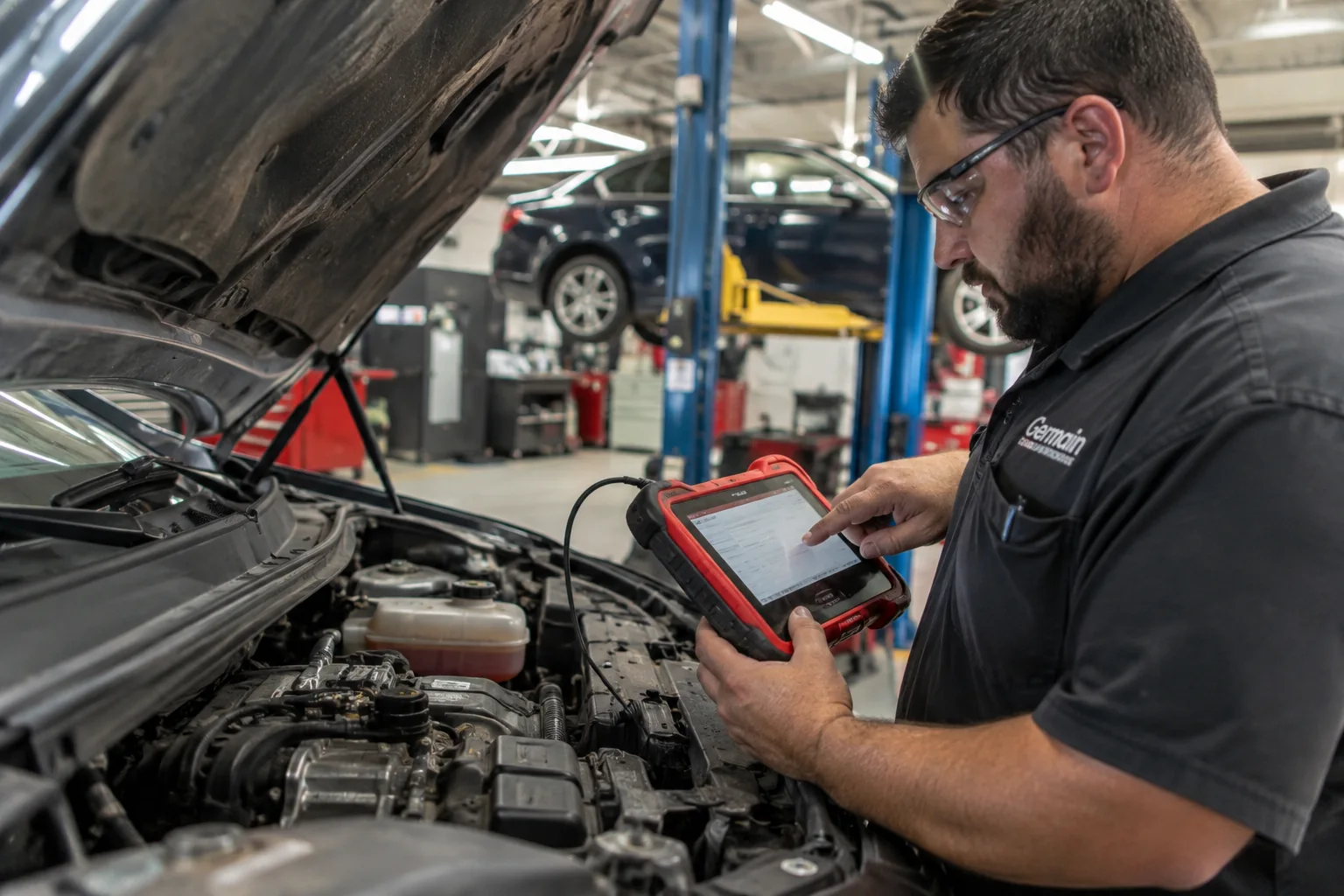
Repairs start with evidence. The technician may ask what happened and confirm the dashboard warning and inspect the vehicle. A diagnostic tool then retrieves fault codes and operating information.
Many U.S. vehicles use a system called OBD II which stands for onboard diagnostics. It stores diagnostic trouble codes or DTCs that help narrow down which areas need further testing.
Misfire codes might point toward one cylinder or toward a general misfire condition. Codes only give a starting point. They never prove that an ignition coil or sensor or catalytic converter needs replacing.
A professional may compare the codes against live engine data and check ignition performance. Fuel delivery gets evaluated and leaks get inspected and mechanical testing happens when needed. AAA has a diagnostic code resource that explains the terminology. Hands on diagnosis is something it cannot replace.
Telling the shop whether the light was steady or flashing constantly or only now and then gives them a head start. Mention whether the engine shook or idled roughly or lacked power. Say when it happened whether during acceleration or at highway speed or on a hill or while idling. Recent work and other warning lights belong in the story too. A fuel smell or smoke or a climbing temperature gauge does as well. A description like that is worth more than guessing which part failed.
How Much Does a Flashing Check Engine Light Cost to Fix?
Nobody can honestly give you one price for a flashing check engine light. The bill depends on the actual cause along with your vehicle and location and parts and labor. Diagnostic testing and any further damage matter too.
An ignition issue needs a different repair than a fuel delivery fault or a mechanical engine problem. Driving on through a serious misfire can also damage the catalytic converter and that makes waiting potentially expensive.
A generic online price range tells you nothing about your car. Ask for a diagnosis and a written estimate before approving work when circumstances allow. Should the shop suggest replacing several components ask which test results support that recommendation. Ask whether any damage came from the original fault.
Mistakes that make things worse

Treating a flashing light like a maintenance reminder is the first one. A warning tied to active misfiring should not be ignored for the rest of a road trip.
Blaming the gas cap right away is another. A loose cap can explain some steady check engine lights yet it is a poor explanation for a flashing warning linked to severe misfire. Testing that theory is no reason to delay a proper diagnosis.
Replacing a part because of one code is tempting. The computer can flag a symptom or an affected system without finding the root cause. Replacing whatever the scanner mentions first can waste money if the real problem sits elsewhere. Proper testing is what settles it.
Some drivers decide the car fixed itself because the light stopped blinking. Intermittent faults can come back. Others restart the engine repeatedly or drive harder to see whether the warning returns and neither one tells you anything useful about safety.
Your checklist for right now
An active warning means your job is reaching a safe stopping location and nothing more. Once you are parked check for severe symptoms. A tow is the move if the car runs abnormally or you are unsure it can be moved safely.
After that comes the owner’s manual and a written note of what happened. A qualified repair facility can then provide code results and a diagnosis and an explanation of why the proposed repair fits the evidence.
Maybe the light came and went earlier. An assessment before another long journey still makes sense especially if the vehicle shook or lost power. A short account of the event helps the technician reproduce the fault.
Quick answers to common worries
Can bad spark plugs cause a flashing check engine light?
A worn spark plug can certainly contribute to a flashing light and so can ignition coils and other issues. A technician needs to test the system before deciding which part gets replaced.
Can a flashing check engine light stop on its own?
A flashing light may stop on its own once the triggering condition fades. That says nothing about the fault being fixed and the problem can return.
Can an OBD-II scanner tell me exactly what is wrong?
A code scanner points toward detected conditions or affected systems. Further testing has to follow.
Is a blinking check engine light worse than a steady one?
Generally a blinking light is worse than a steady one since a steady light signals a detected problem while blinking often indicates a more urgent misfire. Vehicle behavior and any extra warnings still count.
Can I drive with a flashing check engine light?
Reduce engine load and find a safe place to stop. Do not assume there is a safe distance you can drive. If the car shakes badly, loses power, overheats or produces smoke or unusual smells, shut the engine off once parked safely and arrange roadside assistance.
Why is my check engine light flashing and my car shaking?
A misfire can cause both a flashing warning and rough running. Spark plugs, ignition coils, fuel delivery or mechanical problems may be involved, but the symptoms alone cannot confirm the cause.
What if the check engine light flashes and then stops?
The problem may be intermittent. Record when it happened and arrange a diagnosis, even if the engine seems normal afterward. Stored or pending fault codes may help a technician investigate.
Can a bad ignition coil make the check engine light flash?
Yes. A faulty ignition coil can contribute to a misfire, but the warning does not prove the coil is defective. Testing is needed before replacing parts.
Bottom line
A flashing check engine light while you drive calls for an immediate change of plan. Ease off the accelerator and pull over safely. Rough running and shaking and power loss all deserve serious attention. Roadside assistance or a tow is the conservative response when the engine misbehaves.
An engine misfire is a common explanation yet only diagnosis reveals the actual cause. Prompt help may keep a manageable problem from growing into a bigger repair.
For more practical vehicle care and troubleshooting explainers you can explore the Automotive & Mobility guides on Sponsored Post Hub.




Comments
0 discussionsAdd your perspective, reply to other readers, and keep the conversation useful.
Conversation
Reader responses