
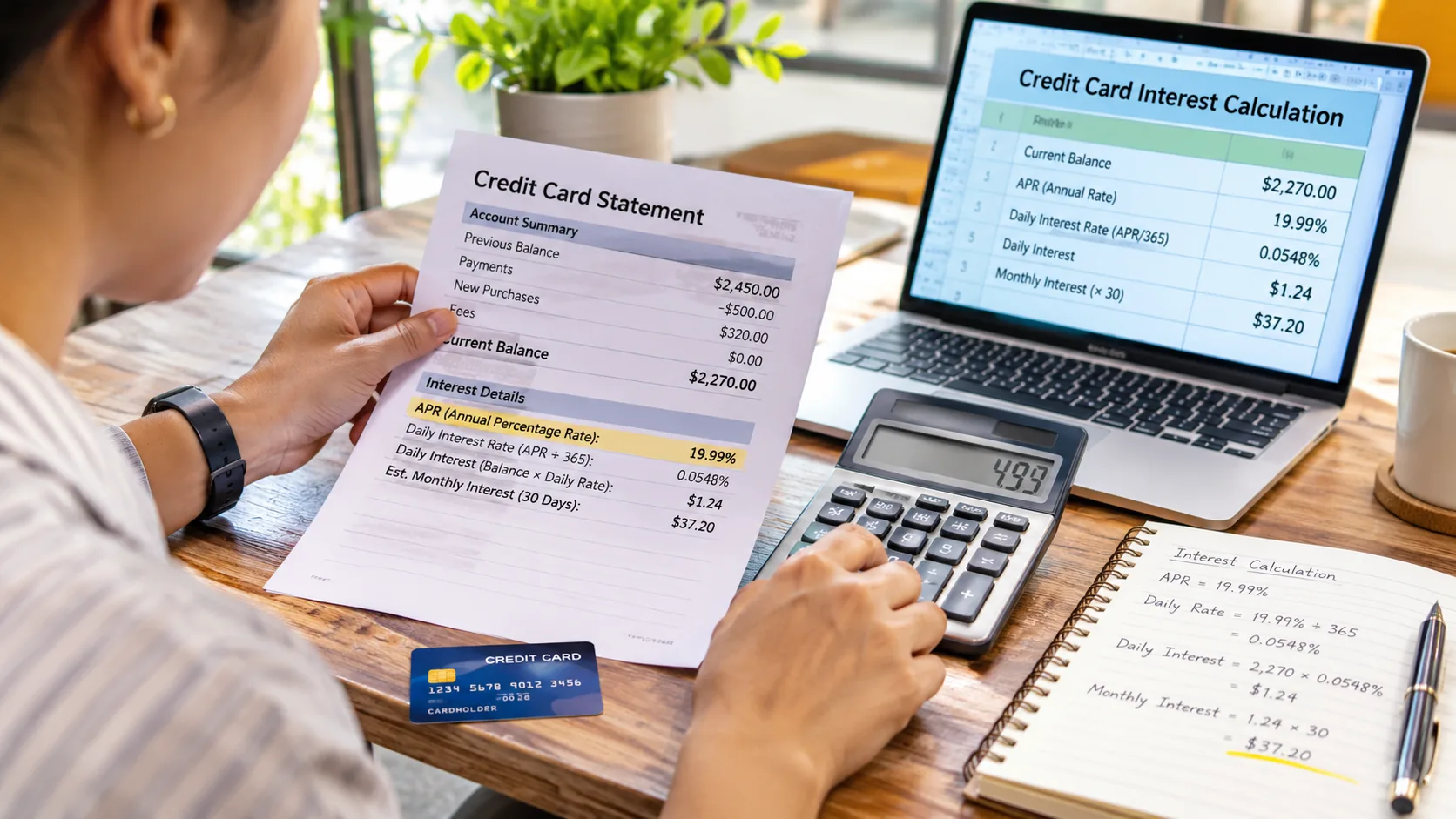
Your statement shows an interest charge of $28.47. You know your APR and you have a rough idea of what you owe. So where did that exact figure come from?
Nobody hands you the answer. A card might advertise 24% a year while many issuers calculate interest using the balance you carry on each separate day. Payments and new purchases keep nudging that balance around and the length of your billing cycle changes the total too.
You can estimate the cost yourself.
To learn how to calculate credit card interest start by dividing your APR by 365 to get a daily rate. Multiply that rate by your interest bearing balance and then by the number of days. Some issuers divide by 360 instead of 365 and trickier methods kick in when your balance shifts or interest compounds. A $1000 balance at 24% APR over 30 days comes to about $19.73 in interest. That assumes a 365 day calculation with a constant balance and no daily compounding.
One big exception applies. When your purchases qualify for a grace period and you pay the required statement balance in full by the due date your purchase interest may be $0.
What follows is the math itself and a way to hold it up against a real bill.
The Credit Card Interest Formula
Here is the straightforward estimate:
Interest = Balance × (APR ÷ 365) × Number of Days
The APR has to become a decimal first. A 24% APR turns into 0.24 and dividing that by 365 gives roughly 0.00065753 which equals a daily rate of about 0.06575%.
Run it on a $1000 balance and the daily charge is $1000 × 0.24 ÷ 365 = $0.6575 or about 66 cents a day under this simplified method. Stretch it across 30 days and you get $1000 × 0.24 ÷ 365 × 30 = $19.73.
The Consumer Financial Protection Bureau’s explanation of daily periodic rates confirms that card companies may divide APR by either 360 or 365 depending on the issuer.
Think of the result as a gauge of what a balance costs. Matching your statement to the cent is a different matter since your card could use daily compounding or different balances or extra calculation rules.
Working Through It Step by Step
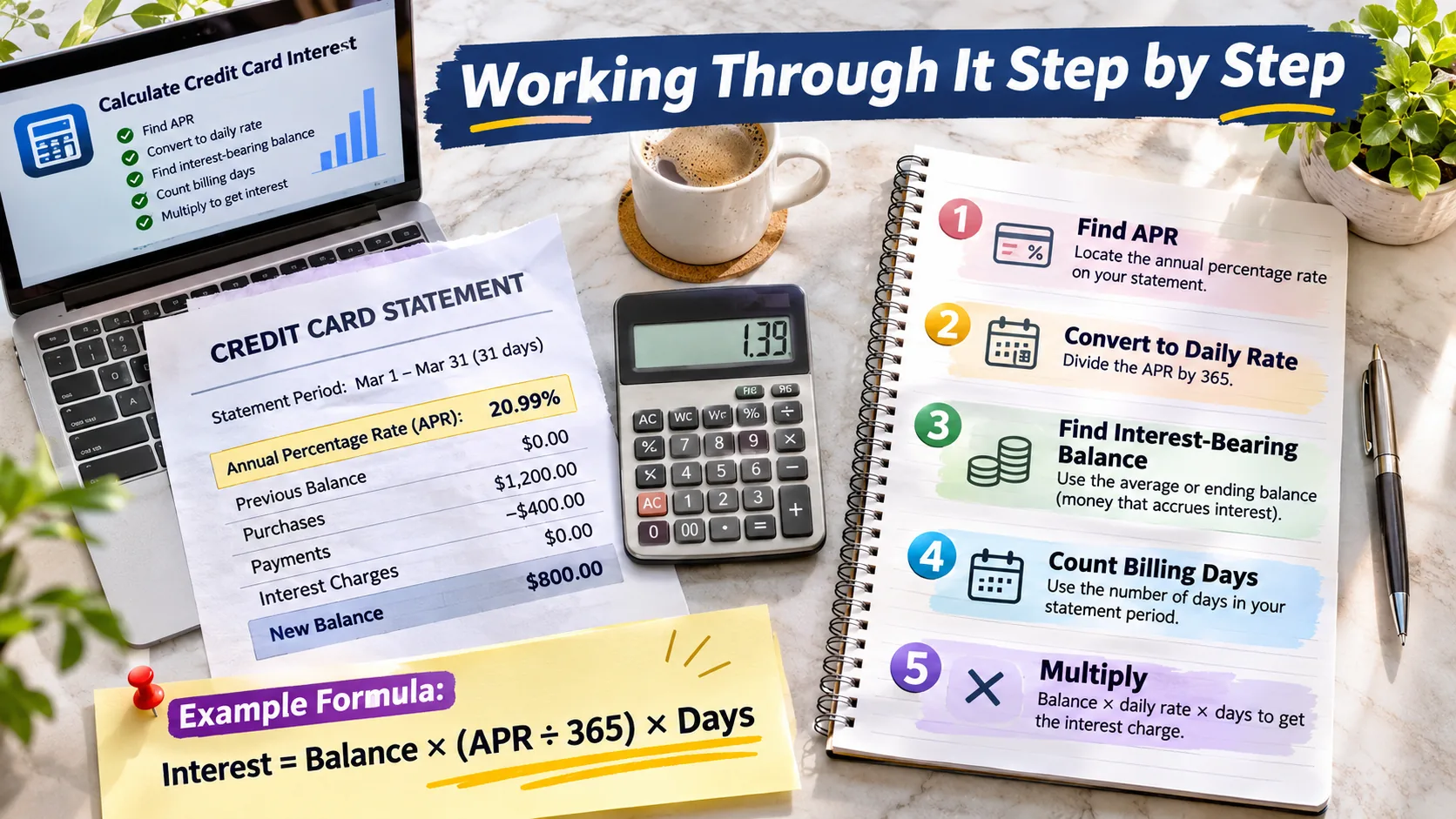
A phone calculator covers every bit of this. Picking the right numbers is where people stumble.
Step 1: Find the APR on your statement
The Annual Percentage Rate (APR) appears on your statement and in your cardholder agreement. Whatever rate was advertised when you applied may differ from what you are charged today. Some cards carry variable APRs while others use separate rates for purchases and cash advances along with balance transfers. A purchase example calls for the purchase rate. Say it is 24%.
Step 2: Turn the APR into a daily rate
If your card specifies 365 days you divide that way: 0.24 ÷ 365 = 0.000657534. Typing 24 where 0.24 belongs inflates your answer 100 times. Issuers on a 360 day basis divide by 360 instead and your agreement settles which one applies.
Step 3: Pin down your interest bearing balance
This is the messy one. Your current balance and statement balance can both differ from the amount actually used for interest. The statement balance was recorded when the billing cycle closed while your current balance can include newer transactions or payments. What you owed on each day of the cycle can drive the interest. Our example assumes a purchase balance sitting at $1000 the whole time.
Step 4: Count the days
Billing cycles do not always match a calendar month. Opening and closing dates are printed on your statement. The demonstration here uses 30 days.
Step 5: Multiply
$1000 × (0.24 ÷ 365) × 30 lands at about $19.73. A 360 day divisor turns the same example into $20.00. Even a gap that small can explain why your own figure misses the statement.
When Your Balance Moves During the Month
Hardly anyone carries the identical balance every day. A payment might go through halfway into the cycle. A purchase may post late and a refund could shrink what you owe. Many issuers handle these swings with an average daily balance or another daily balance method. According to the CFPB many card companies base interest on daily balances rather than on the amount showing at month end.
Average daily balance in action
Think of the average daily balance as one number that spreads out what you owed across the whole cycle. The simplified version looks like this:
Average Daily Balance = Sum of Daily Balances ÷ Number of Days
Picture a $1000 balance for the first 15 days of a 30 day cycle before a $400 payment posts and drops the balance to $600 for the final 15 days.
| Period | Balance | Days | Balance × Days |
|---|---|---|---|
| First half | $1000 | 15 | $15000 |
| Second half | $600 | 15 | $9000 |
| Total | 30 | $24000 |
Divide $24000 by 30 and the average daily balance is $800. Interest then works out to $800 × (0.24 ÷ 365) × 30 = $15.78.
| Scenario | Estimated interest |
|---|---|
| $1000 balance throughout 30 days | $19.73 |
| Balance reduced to $600 halfway through | $15.78 |
| Difference | $3.95 |
Both rows assume 24% APR on a 365 day basis with no daily compounding and no other transactions or charges. The early payment lowers the average balance although real statements may differ depending on when a payment posts and which method the card uses.
Why Your Statement Might Show More Interest
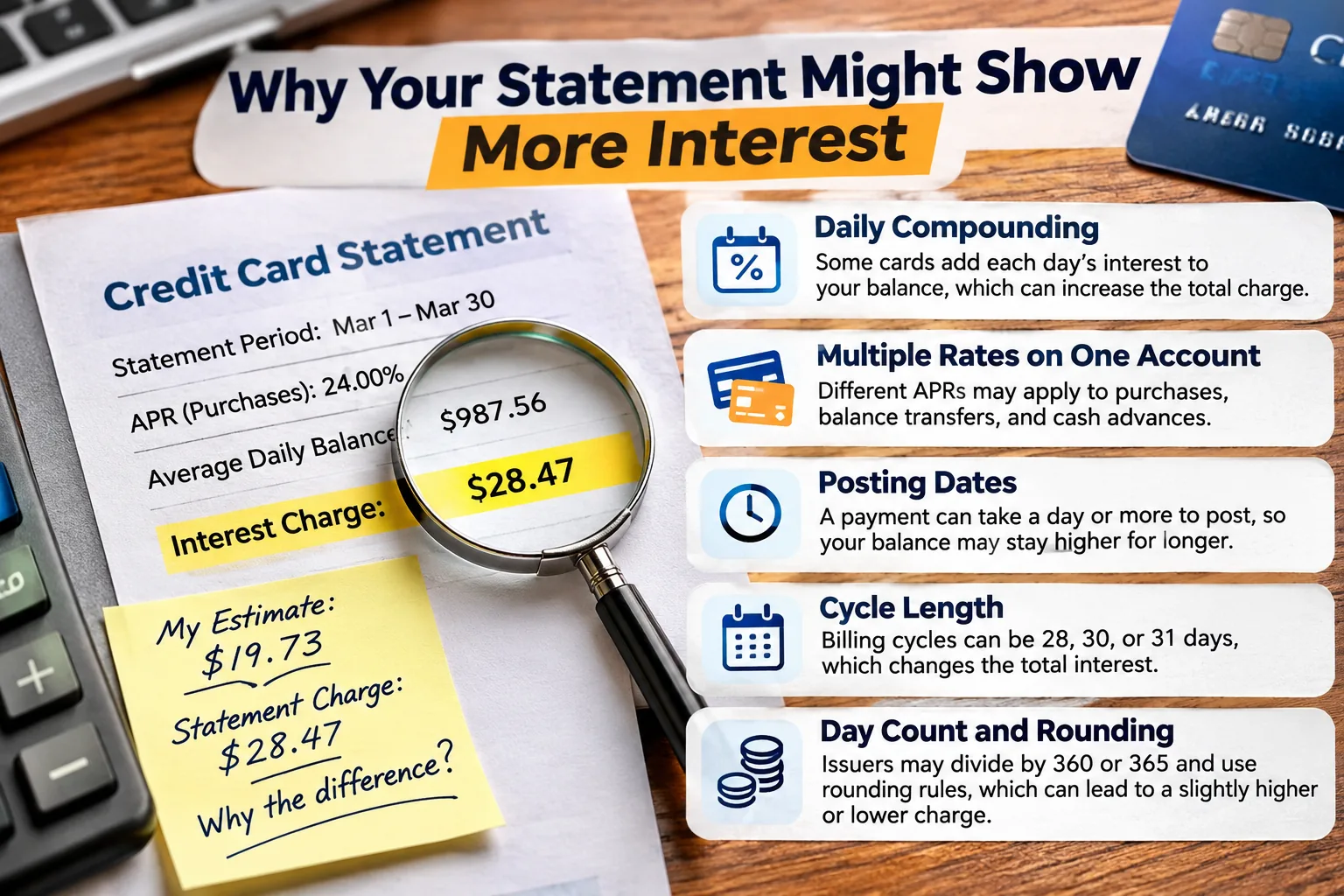
Say you follow the formula and land on $19.73 while the statement shows something else. The issuer has not automatically made a mistake. A few details can account for the gap.
Daily compounding. Some agreements compound daily so accrued interest joins the balance used for later days. The simplified formula never adds one day’s interest to the next day’s balance and that alone separates a rough estimate from the actual charge.
Several rates on one account. Separate APRs can sit on the same card for purchases and balance transfers along with cash advances. One APR applied to the total may be inaccurate so each rate needs to be matched to its own balance category.
Posting dates. The day you start a payment may not be the day it cuts the balance. Processing and posting rules matter and the daily balances used in the calculation count for more than the day you clicked pay.
Cycle length and rounding. Same balance but a 28 day cycle and a 31 day cycle give different results. Issuers may also use different day count conventions and rounding methods which makes the interest calculation section of your cardholder agreement the place to look for a closer comparison.
Paying in Full: Do You Still Owe Interest?
Often no. Eligible purchases stay interest free as long as you keep your grace period which is the stretch between the end of a billing cycle and the payment due date. On many cards paying the required statement balance in full by the due date avoids purchase interest.
Picture $1000 of purchases during a cycle with the statement closing at $1000. Those purchases qualify and you pay the full required statement balance by the due date so the purchase interest may be $0. The daily interest formula should not be applied automatically to purchases still covered by a grace period. The CFPB’s grace period guidance lays out the conditions and warns that carrying a balance can cost you that protection.
What the minimum payment does
When at least the required minimum payment is received by the applicable deadline the account generally avoids being reported as past due for that payment. Other fees or obligations may still apply. Interest on the remaining revolving balance generally keeps running though. Your next statement may include charges on what you still owe and new purchases may lose grace period protection under your card’s terms. Making the minimum and preserving the grace period are two separate things.
Interest After You Pay Off the Card
The payment went through. The balance looks settled. Then another interest charge shows up.
Residual interest (sometimes called trailing interest) is the usual cause. Suppose you carried an interest bearing balance through the previous cycle. Interest can keep accruing between the date your statement was generated and the date your payment arrived and that extra amount may not appear until the next statement. The CFPB covers this in its guidance on interest charged after a credit card payment.
Clearing a revolving balance completely means asking the issuer for the current payoff amount and whether more residual interest is expected. Assuming the last statement balance covers everything accrued since the closing date is the less reliable route.
Purchases Versus Cash Advances Versus Balance Transfers
Transaction type matters as much as the APR does.
| Transaction | Typical interest treatment | What to check |
|---|---|---|
| Purchases | May qualify for a grace period | Purchase APR and grace period conditions |
| Cash advances | Often accrue interest immediately | Cash advance APR and transaction fees |
| Balance transfers | May have a promotional rate or separate APR | Promotional expiration with transfer fee and purchase grace period terms |
Cash advances deserve special attention. On many cards pulling cash with your credit card starts interest immediately and a fee may apply too.
Balance transfers can help under the right conditions but promotional rates call for careful reading. A 0% introductory APR is not necessarily a deferred interest offer. Under some deferred interest promotions missing the deadline to pay off the promotional purchase in full can trigger interest calculated from the original purchase date. The CFPB explains how deferred interest offers work. Promotions do not all work the same way so read the actual offer.
Does It Work the Same Worldwide?
Many countries charge interest on borrowed balances but calculations and disclosures and consumer protections vary. The examples here lean on U.S. credit card terminology and regulatory explanations.
United States
The CFPB offers guidance on APR and daily interest rates along with grace periods and statements. Under U.S. payment-allocation rules when a payment exceeds the required minimum issuers generally must apply the excess to the balance with the highest APR first subject to relevant exceptions. Issuers often have more say over how the minimum portion gets allocated. Do not assume these rules cover accounts issued elsewhere.
United Kingdom
Customers in the UK should review the purchase rate and terms from their lender. The representative APR advertised for a product is not necessarily the exact rate on every customer’s account. MoneyHelper’s simple guide to credit cards explains common repayment and interest points.
Canada
Different transaction types can carry different rates and conditions according to Canada’s Financial Consumer Agency. Cardholders should check their agreement for payment allocation rules and grace period conditions. The agency’s guide to how credit cards work covers the local framework.
Australia
Terms depend on the issuer. CommBank for instance describes a method built on average daily balances and an annual rate divided by 365. Its credit card interest guide explains that calculation along with its eligible interest free periods. Those details describe CommBank products and should not be read as terms for every Australian card.
Checking Your Own Interest Charge
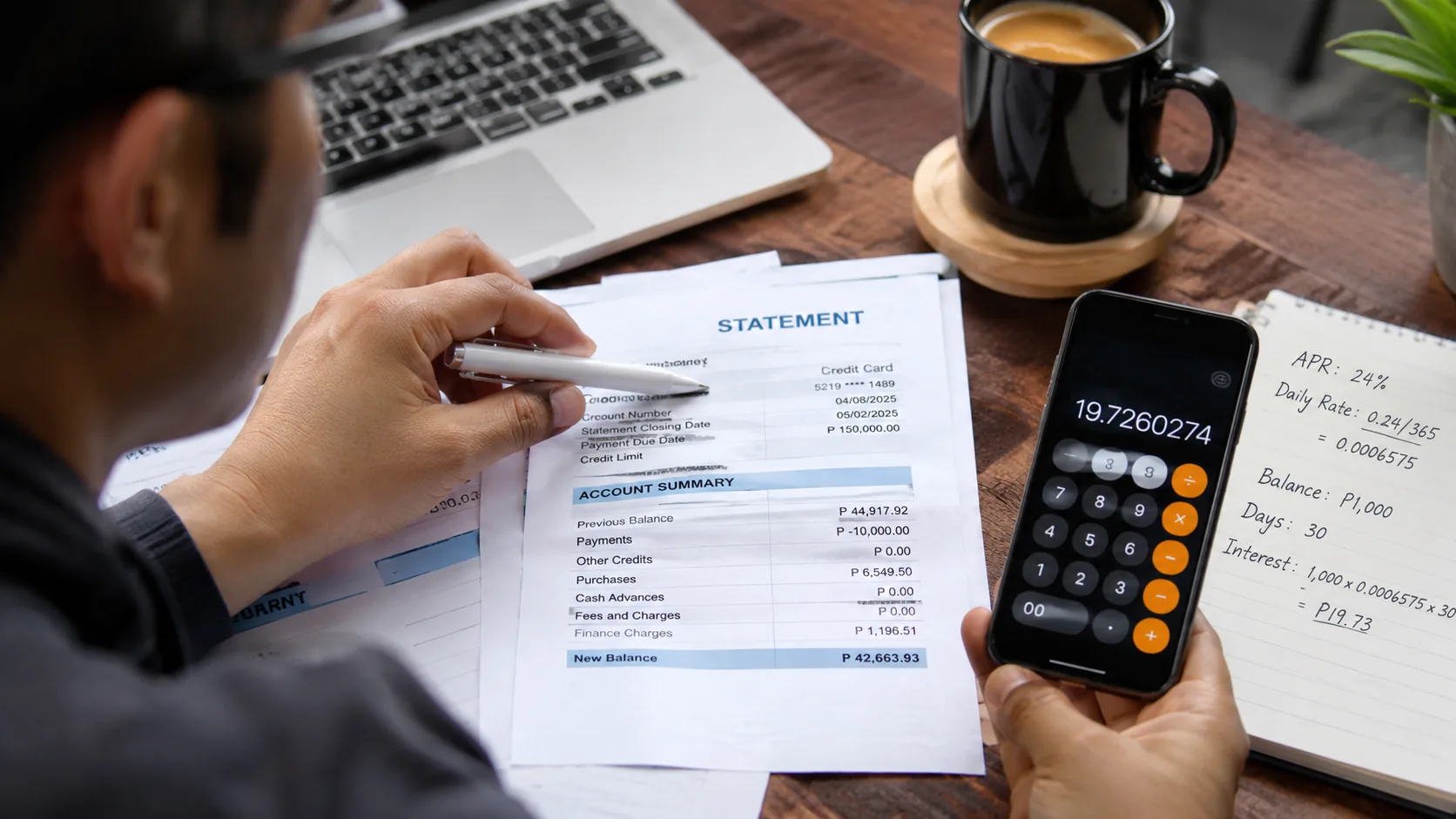
Rebuilding the whole statement at once is unnecessary. Begin with the information that counts.
Find your purchase APR and see whether another rate covers any balance transfers or cash advances. Next pull the billing dates and count the days in the period. Your statement may show an average daily balance or similar information about balances subject to interest so look for that. Go through payments and credits and note when each one posted. After that open the cardholder agreement for the daily rate and calculation method and grace period conditions. Armed with all of it make an estimate using the right rate and balance details. Anything unexplained goes to the issuer along with a request for a breakdown of how the interest was calculated.
The basic check formula is Estimated Interest = Average Daily Balance × Daily Periodic Rate × Billing Days. It only fits the simplified assumptions and the balance category you are evaluating.
When you contact the issuer a specific question works best. Something like: “My statement shows a purchase APR of 24% and an interest charge of $28.47. Can you explain which daily balances and day count method and billing dates were used?” That hands the representative a concrete issue to investigate.
Ways to Cut Credit Card Interest
Knowing the math helps and lowering the bill helps more.
The simplest route when your finances allow it is paying the required statement balance in full since a maintained grace period can prevent interest on eligible purchases.
Carrying an interest bearing balance changes the picture. Paying sooner means the larger amount sits outstanding for fewer days and even partial early payments reduce the daily balance and may lower future interest. Going beyond the minimum shrinks the balance faster provided you are not adding new debt and other terms stay the same. Minimum payments can stretch repayment over a long time.
High APR balances need a watchful eye. A cash advance or another category might carry a higher rate than purchases and knowing how your issuer allocates payments shows which balances are actually shrinking. Promotional offers deserve a careful read since introductory APRs and transfer fees plus deadlines and deferred interest provisions all shape the total cost. A tempting promotional rate gets expensive when its conditions go unnoticed.
While you build savings and manage credit it may help to compare where your emergency cash sits. Our guide to best high-yield savings accounts in 2026 covers the savings side of that decision. Big sales bring their own pull toward unnecessary borrowing so see our guide to Black Friday 2026 buying decisions and fake deals. Neither one replaces knowing your card’s actual borrowing cost.
Frequently Asked Questions
How much interest is charged on $1000 at 24% APR?
About $19.73 on a constant $1000 interest bearing balance over 30 days under a simplified 365 day calculation. Daily compounding or other calculation methods or payments or other transactions could change the real charge. An eligible purchase balance covered by a grace period may produce no interest when the required full statement payment arrives on time.
How do I calculate daily interest on a credit card?
Convert your APR to a decimal. Then divide by the number of days your issuer specifies which is commonly 365 or 360 and multiply that daily rate by the balance subject to interest for that day. Balances that change mean working across the relevant days instead of assuming one amount all cycle.
Is credit card interest calculated daily or monthly?
Both in a sense. Many issuers calculate or accrue interest from daily balances and the resulting finance charge shows up on the monthly statement. Your card agreement spells out the exact method.
Does APR mean I pay that percentage every month?
No. APR is an annualized rate. A 24% purchase APR does not mean the issuer charges 24% of your balance each month because billing cycle interest depends on the rate and balance and duration and calculation method.
What happens if I pay half my credit card balance?
A lower balance reduces the interest calculated for later days when you already owe interest. Grace period protection is the catch since paying half the statement balance may not preserve an eligible purchase grace period. The exact effect depends on the balance category and card terms.
Do credit cards charge interest if I pay in full every month?
On eligible purchases many cards let you avoid interest by paying the required statement balance in full by the due date. Cash advances and certain other transactions and previously accrued residual interest may follow different rules.
Why does my credit card still charge interest after I pay?
Between your statement closing date and the date your payment was received interest may have accrued on an existing revolving balance. This is often called residual or trailing interest and your issuer can explain the specific dates and amounts involved.
Is credit card interest compounded daily?
Some issuers use daily compounding while others may use different contractual calculation methods. The CFPB describes daily periodic rates and compounding but your own card agreement controls how interest is calculated.
Is a 0% APR credit card always interest free?
Not always. A genuine 0% introductory APR may temporarily remove interest on qualifying balances under the offer terms although fees and other transaction rates may still apply. Deferred interest promotions work differently and can bring retroactive interest when their conditions are missed.
Can I calculate my credit card interest exactly?
Possibly. You would need the exact daily balances and applicable APRs and calculation rules and posting dates. A basic APR formula is an estimate that may miss some details.
Final Thoughts
Three numbers drive the whole thing: your APR and the balance subject to interest and the number of days involved. The simplified formula gives a solid estimate while your statement may call for a closer look at changing balances and compounding and grace periods and transaction specific rates. Even a basic calculation shows the gap for someone carrying $1000 at 24% APR who pays halfway through the cycle versus later. The next time an unfamiliar charge appears you can run the numbers and put a pointed question to your issuer.
Explore more practical borrowing and savings and consumer money guides in Sponsored Post Hub’s Finance & Money section.




Comments
0 discussionsAdd your perspective, reply to other readers, and keep the conversation useful.
Conversation
Reader responses