
How to Write a Resume That Gets Interviews: A Step-by-Step Guide
Learn how to write a strong resume with practical examples, ATS-friendly tips, and expert guidance for job seekers in the USA, UK and Canada.
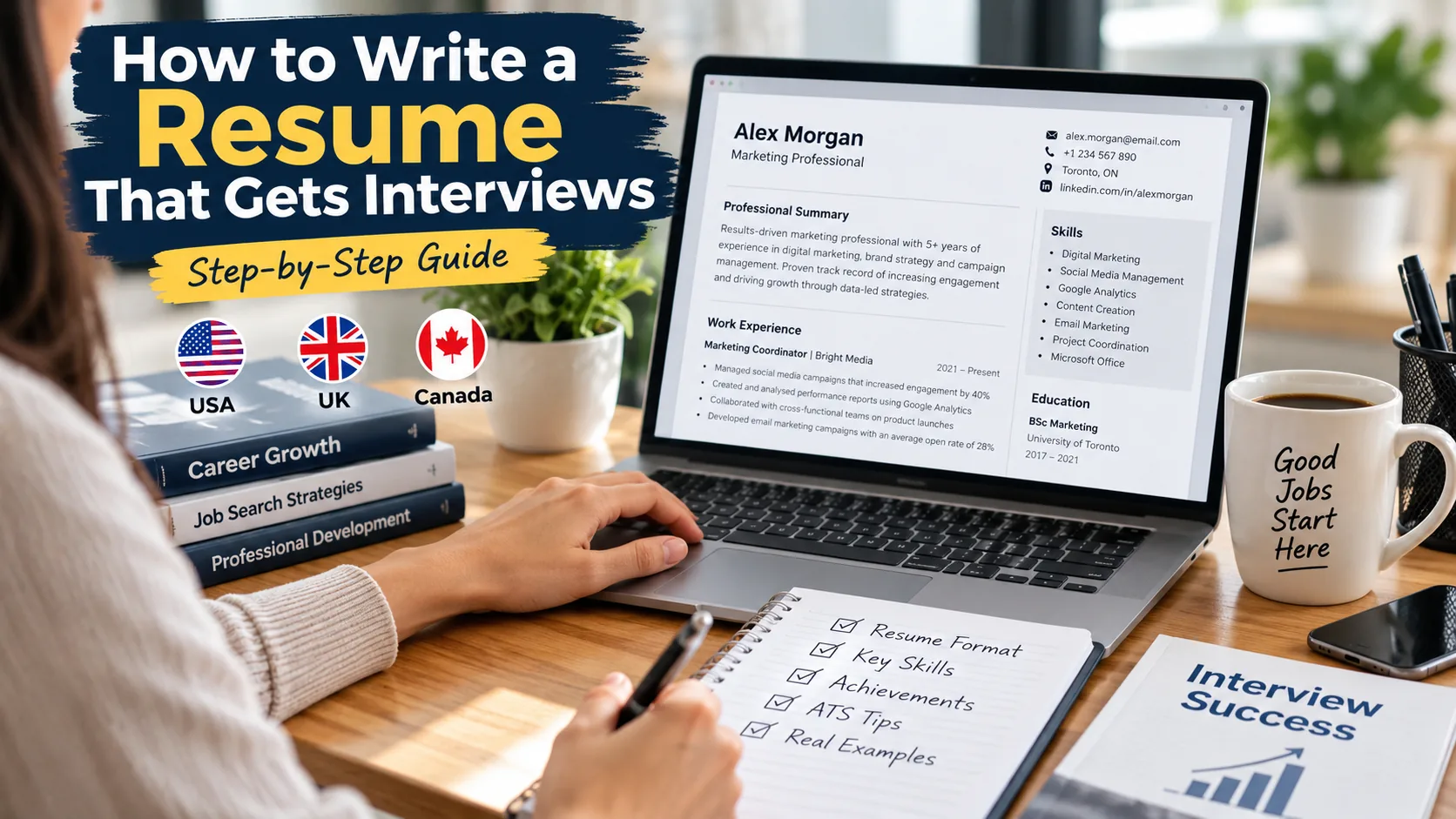
Most people make the same mistake when they sit down to write a resume: they try to squeeze their entire working life onto the page.
That usually gives an employer more to read, but not necessarily more reasons to call.
A better question is:
what does this employer actually need to know about me?If you're applying for an account management role, for example, a summer job from ten years ago probably deserves little space. Your recent experience retaining clients, resolving difficult account issues or increasing revenue matters much more.
That's the thinking behind a strong resume. It isn't a career autobiography. It's a carefully edited account of the experience, skills and results that make sense for a particular opportunity.
This guide explains
how to write a resume from scratch, including what to include, what to leave out, how to describe your experience and how to tailor it without rewriting the whole document every time.A quick language note: Americans and Canadians usually call this document a
resume. In the UK, you'll normally hear CV. In the United States, a CV can mean something different—a longer document commonly associated with academic, research and some medical careers. Pasted textHow to Write a Strong Resume in 8 Steps
If you're staring at a blank document, start here:
Read the job description properly.
Pick a format that suits your career history.
Add your professional contact details.
Write a short, job-specific summary or profile.
Build your experience around achievements and useful evidence.
Add relevant skills, education and qualifications.
Check that terminology from the vacancy appears naturally where accurate.
Proofread everything and follow the employer's submission instructions.
The order matters. Starting with the vacancy makes almost every decision that follows easier.
Resume vs CV: What Is the Difference in the USA, UK and Canada?
Before writing anything, make sure you're preparing the document employers in your market expect.
These aren't rules followed by every employer. A graduate programme, small creative agency and university research department may all ask for different things.
There is one particularly important distinction.
If a British employer asks for your CV for a normal commercial job, they're usually asking for roughly the same type of document that a US employer would call a resume.
An American university asking an academic for a CV may be asking for something considerably longer, potentially covering research, publications, teaching, presentations and other academic work.
Read the application instructions rather than relying on terminology alone.
Step 1 — Read the Job Description Before Writing Your Resume
Imagine two people applying for the same role.
The first opens an old resume, changes the filename and sends it.
The second spends five minutes working out what the employer actually wants before changing anything.
The second applicant has an obvious advantage.
A job description tells you what information deserves space on the page. You're looking for recurring themes rather than words to copy.
Pay attention to:
Essential qualifications
Technical or professional skills
Main responsibilities
Software and tools
Industry terminology
Experience requirements
Level of responsibility
Preferred qualifications
It helps to separate
must-haves from nice-to-haves.Consider this fictional vacancy:
Marketing Coordinator
We're looking for someone with experience supporting email campaigns, social media and website content. You'll coordinate several campaigns at once and help report on performance using Google Analytics and CRM data. Experience with HubSpot would be useful but isn't essential.
There's quite a lot of information packed into those few sentences.
The employer appears to care about campaign coordination, email marketing, social media, website content, analytics and CRM experience. HubSpot is useful, but the wording suggests it isn't mandatory.
Now compare those requirements with your own background.
Perhaps you've never used HubSpot, but you've spent two years using Salesforce. Don't claim HubSpot. Your genuine CRM experience is still relevant.
Maybe your current job title is “Marketing Assistant,” but you've coordinated several campaigns simultaneously. That's worth bringing forward because it addresses something this employer explicitly needs.
Don't turn the advert into your resume
Tailoring doesn't mean repeating the vacancy back to the employer.
If the advert says:
Strong stakeholder communication skills required.
Don't simply add:
Strong stakeholder communication skills.
Show it:
Coordinated weekly campaign updates between sales, marketing and external creative partners.
Now the employer has evidence rather than an unsupported claim.
Step 2 — Choose the Right Resume Format
You don't need an unusual layout to make a resume memorable. You need one that lets somebody understand your career without having to decode the page.
For most applicants, that means choosing between three broad formats.
Reverse chronological
Your latest position appears first, followed by earlier roles.
For example:
2024–Present — Account Manager, Company A
2021–2024 — Account Executive, Company B
2019–2021 — Sales Coordinator, Company C
This format works well for many candidates because career progression and recent experience are immediately visible.
Combination
A combination resume gives more prominence to relevant skills or accomplishments while retaining a clear employment history.
It can make sense when your strongest qualification for a job comes from several different roles rather than your current position alone.
Skills-based or functional
Here, skills and capabilities receive more emphasis than employment chronology.
It may occasionally help someone with an unusual career history or major career transition. But use it thoughtfully.
If dates and employers become difficult to understand, the format may create questions rather than remove them. And there's no sound reason to assume that a functional resume automatically performs better with applicant tracking systems.
A straightforward structure that works for many applicants
Name and contact details
Professional summary/profile
Key skills
Professional experience
Education
Certifications/training
Additional relevant information, if necessary
A recent graduate might move education above professional experience. Someone with ten years of relevant experience will usually have less reason to do that.
Your strongest evidence should influence the order.
Step 3 — Keep Your Contact Section Simple
You'd be surprised how much unnecessary information ends up at the top of resumes.
You generally need:
Your full name
Phone number
Professional email address
City and state/province/region where useful
LinkedIn profile, if it's current and relevant
Portfolio or professional website, where appropriate
For example:
Daniel Carter
Toronto, ON
[email protected] | +1 xxx xxx xxxx
linkedin.com/in/example
That's enough for many applications.
What doesn't belong there?
Don't put sensitive identification numbers on your resume. That includes a Social Security Number in the United States or Social Insurance Number in Canada.
For ordinary applications in the USA, UK and Canada, details such as your religion, political views, marital status and date of birth generally don't need to be there either.
A complete residential address often isn't necessary. City and region may be sufficient when location matters.
What about a photograph?
For ordinary US and Canadian applications, a photo generally isn't expected. It's also not standard practice on a typical UK CV.
There are industries and countries where conventions differ, so don't turn this into a worldwide rule. We're talking specifically about normal employment applications in the three markets covered by this guide.
Step 4 — Write a Summary Someone Can Actually Use
The summary is often where otherwise decent resumes become vague.
You have probably seen something like this:
Hardworking and motivated team player seeking a challenging position in a dynamic organisation where I can grow professionally.
What job is this person good at?
What have they done?
What can they offer?
We don't know.
A useful summary answers some of those questions within a few lines.
Experienced professional
Operations manager with eight years of experience across multi-site retail, staff development and inventory control. Currently responsible for three locations and teams of up to 35 employees, with recent projects focused on reducing stock discrepancies and improving store processes.
Recent graduate
Business graduate with internship and university project experience in market research, campaign reporting and customer analysis. Comfortable using Excel and Google Analytics, with particular interest in consumer marketing and data-led campaign planning.
Career changer
Customer service professional moving into HR after six years of experience handling sensitive enquiries, conflict resolution and case records. Recently completed professional HR training and looking to bring strong employee-facing communication and case-management experience into an HR support position.
Limited professional experience
Entry-level administrative candidate with practical experience from university projects and volunteering, including event scheduling, spreadsheet management and document preparation. Confident using Microsoft Excel, Word and PowerPoint.
These aren't impressive because they use grand language. They work because they give the employer something concrete.
Summary, objective or profile?
A
professional summary usually focuses on experience and qualifications.A
profile, common on UK CVs, often serves much the same purpose.An old-fashioned
objective tends to focus on what the candidate wants.Compare:
Seeking a position where I can develop my marketing career.
with:
Marketing graduate with internship experience in email campaigns, social content and campaign reporting.
The employer gets much more useful information from the second version.
Step 5 — Turn Job Duties Into Evidence
This is where a resume can change significantly without changing a single fact.
Suppose you worked in customer service.
You could write:
Responsible for customer enquiries.
That's probably true. It's also what an employer would already expect from the job title.
What else happened?
Did you handle difficult cases? Train new employees? Improve a process? Work with a particularly large customer base? Take responsibility for escalations?
Those details tell the reader more.
Here are some fictional examples. The numbers are examples only—you should never invent figures for your own resume.
Again, don't look at those percentages and think your bullets need invented numbers.
They don't.
When you have numbers, use them
Reliable numbers can add context.
“Managed a team” becomes more informative when you can truthfully say:
Managed a team of 18.
“Reduced response times” becomes clearer as:
Reduced average first-response time from 11 hours to 4 hours.
But a real achievement without a number is better than a fictional achievement with one.
Try this achievement formula
A useful starting point is:
Action + Task + Result + Evidence
For example:
Redesigned the support triage process, reducing average first-response time from 11 hours to 4 hours.
Not every bullet needs all four pieces. Think of the formula as a prompt when you're struggling to explain why a piece of work mattered.
What if you don't have measurable results?
Numbers aren't the only form of evidence.
You can show scope:
Supported finance operations across three regional offices.
Or complexity:
Coordinated executive meetings involving participants across five time zones.
Or trust and responsibility:
Managed confidential correspondence and scheduling for the managing director.
Or process improvement:
Created an onboarding checklist that gave managers one standard process for new starters.
Or recognition:
Selected to train new team members on the company's customer-service system.
When you're stuck, ask yourself:
What was different because I did this work?
Sometimes the answer is revenue. Sometimes it's speed. Sometimes it's fewer mistakes, smoother communication or simply taking responsibility for something difficult.
That's the material you want.
Step 6 — Make Every Bullet Earn Its Space
Resume bullets don't need to sound sophisticated. They need to be clear.
Instead of:
Was responsible for the management of weekly reporting activities.
Write:
Produced weekly performance reports.
Instead of:
Assisted with the implementation of the new CRM system.
If accurate, you might write:
Supported the CRM rollout by cleaning customer records and helping train the sales team.
The second version tells us what “assisted” actually involved.
Here are a few more:
You don't need a thesaurus beside you.
Words such as
managed, built, analysed, trained, resolved, reduced, created, coordinated, negotiated and delivered work because they tell the reader what happened.Also look at the order of your bullets.
If your fourth bullet is the achievement most relevant to the new job, why is it fourth?
Move it.
Step 7 — Choose Skills That Mean Something
A skills section shouldn't become a collection of qualities every employer would like to hear.
This is weak:
Communication | Teamwork | Leadership | Hardworking | Problem-solving
Not because those abilities are unimportant, but because the list proves nothing.
Specific skills are easier to evaluate:
Salesforce | Google Analytics | Power BI | Financial Modelling | SQL | Adobe Photoshop
The right skills depend entirely on the role.
You can think of them in four broad groups.
Hard skills
Learned, practical capabilities such as bookkeeping, copywriting, data analysis or financial modelling.
Technical skills
Specific systems, tools or technologies such as Python, Salesforce, AutoCAD or Power BI.
Transferable skills
Capabilities that remain useful when you move between roles or industries: project coordination, research, budgeting or stakeholder management.
Soft skills
Things such as communication, leadership, adaptability and teamwork.
Soft skills usually become stronger when they're demonstrated elsewhere.
Don't just claim:
Leadership
Show:
Led an eight-person team through a three-month CRM migration.
Don't just write:
Communication
Show:
Presented monthly campaign results and recommendations to sales and marketing leadership.
The experience backs up the skill.
Step 8 — Add Education Without Letting It Take Over
Where education appears depends partly on where you are in your career.
If you graduated recently and don't yet have much professional experience, education may be one of your strongest selling points. Put it relatively high.
If you've been working in your field for 12 years, your latest degree probably doesn't need to occupy half the first page.
A straightforward entry might look like:
BSc Business Management
University of Example, Manchester
2026
Students and graduates can add particularly relevant modules, projects or academic achievements when those details support the application.
You can also include:
Relevant professional certifications
Occupational licences
Industry qualifications
Job-relevant training
Don't list every online course you've ever opened.
Ask the same question you've been asking throughout the resume:
does this help the employer evaluate me for this job?If not, it may not need space.
Step 9 — Make the Resume ATS-Friendly Without Obsessing Over ATS
Applicant tracking systems have acquired almost mythical status online.
You'll find advice claiming a particular font guarantees rejection, one specific template “beats the bots,” or every graphic automatically sends your application to a digital graveyard.
Hiring technology isn't that uniform.
At a basic level, an applicant tracking system helps an employer collect, organise and work with job applications. Depending on the software and how an employer uses it, the system may parse resume information, support candidate searches, apply screening criteria or help recruiters manage different stages of hiring.
So what should you actually do?
Keep things sensible.
Use familiar headings such as:
Professional Experience
Education
Skills
Make the hierarchy easy to understand.
Keep important information as real text rather than placing essential qualifications only inside an image.
If the employer calls a skill
“financial modelling” and that's genuinely what you do, using the same normal industry terminology makes sense.Don't stuff it into every paragraph.
Think about keywords as vocabulary, not tricks
Suppose a vacancy repeatedly mentions:
Project management
Budget forecasting
Stakeholder communication
A poor attempt at optimisation might look like:
Project management professional with project management skills, project manager experience, stakeholder communication and budget forecasting skills.
Nobody wants to read that.
A real experience bullet might say:
Coordinated four client projects simultaneously, maintained budget forecasts and provided weekly progress updates to internal and external stakeholders.
The relevant concepts are there because they describe the work.
That's a much healthier way to think about resume keywords.
How to Tailor Your Resume in About 15 Minutes
You don't need to write a brand-new resume every time you apply.
Keep a larger
master resume containing your useful achievements, projects and skills. Then create a targeted version from it.Here's a quick routine.
Minutes 1–3: Read
Read the vacancy once for the overall role and again for specific requirements.
Minutes 4–6: Pick the priorities
Identify roughly five to eight things that seem particularly important.
Compare them with your actual experience.
Minutes 7–10: Rework your experience
Move the most relevant bullets higher.
Rewrite vague bullets where you have better evidence.
Remove details that are taking up space without helping this application.
Minutes 11–12: Revisit the summary
Does the opening describe the candidate this employer is trying to hire?
Adjust it if necessary.
Minutes 13–14: Check skills
Make sure important genuine skills aren't missing. Remove unrelated ones if the section has become crowded.
Minute 15: Read the application instructions
Check spelling, dates, filename and requested document format.
That's tailoring.
Copying half the vacancy into your resume isn't.
How Long Should a Resume or CV Be?
The answer depends on what you have to say.
In the United States
One page can be plenty for many students, graduates and early-career applicants.
Experienced professionals may reasonably need two pages when the additional material is relevant.
In the United Kingdom
Many conventional CVs are kept to roughly two A4 pages. That doesn't mean adding filler until page two is full.
In Canada
One to two pages is common, and Government of Canada Job Bank guidance recommends keeping a resume to two pages. The original article brief specifically requires this distinction to be handled by country rather than presented as a universal rule. Pasted text
Here's the more useful principle:
Don't make a resume longer because you can. Don't make it shorter at the expense of useful evidence.
If removing a bullet makes no difference to the employer's understanding of your suitability, remove it.
If squeezing onto one page means tiny text, almost no white space and deleting your strongest recent achievement, one page isn't helping you.
Resume Formatting: Make the Page Easy to Read
Good resume design is surprisingly quiet.
The reader should notice your experience before noticing your formatting choices.
Use a readable font. Keep headings consistent. Give sections enough breathing room. Align dates consistently. Use bullets where they genuinely make information easier to scan.
Colour isn't forbidden. Neither are creative layouts.
The question is whether the design suits the job and application method.
A graphic designer sending a resume directly to a creative director may reasonably make different visual choices from an accountant uploading a document into a large employer's recruitment portal.
For conventional applications, restrained formatting is usually the safer starting point.
You can still make it polished.
Just don't make the employer hunt for your employment history because the page looks like a magazine cover.
PDF or Word: Which Should You Send?
Look at the application instructions.
That's the answer that matters most.
If the employer requests
DOCX, don't send PDF because somebody online told you PDFs are always better.If they request
PDF, send PDF.PDF is useful because it normally preserves the document's visual layout. Word files are still requested by some employers and recruitment systems.
If no format is specified, use a clean, commonly supported file and make sure the information remains readable.
Your filename deserves a quick check too.
Instead of:
resume-new-final-version3.pdf
use:
Daniel-Carter-Resume.pdf
For a UK application:
Daniel-Carter-CV.pdf
It's a tiny detail, but an easy one to get right.
How to Write a Resume With No Work Experience
“Experience” doesn't only mean a full-time salaried job.
A first-time applicant may have useful evidence from:
University or school projects
Internships
Volunteering
Part-time jobs
Student societies
Extracurricular activities
Freelance projects
Relevant coursework
Certifications
Personal projects
Suppose you're applying for an entry-level marketing position.
You might have this:
Consumer Marketing Project — University of Example, 2026
Worked with three other students to develop a launch proposal for a fictional consumer brand. Designed a customer survey, reviewed competitor positioning and presented campaign recommendations to a faculty panel.
That's legitimate experience.
You haven't pretended it was employment. You've clearly labelled it as a university project and explained what you did.
A weekend retail job can also demonstrate customer service, cash handling, reliability or responsibility.
Volunteering may demonstrate event organisation, fundraising, administration or teamwork.
Look at what you have actually done before deciding you have “no experience.”
How to Write a Resume When Changing Careers
Career changers often make one of two mistakes.
They either describe the old career in enormous detail, leaving the employer to figure out what's transferable, or they almost erase it because they think it isn't relevant.
There's a better middle ground.
Imagine a retail manager applying for project coordinator roles.
Old version:
Managed a busy retail store.
Targeted version:
Coordinated staff schedules, supplier deliveries, promotional launches and weekly operational priorities for a 20-person store team.
Same job.
Different emphasis.
The second version surfaces coordination, scheduling, suppliers, launches and competing priorities—all useful evidence for certain project roles.
A career-change summary can make the connection explicit, while recent qualifications or training can show that you've prepared for the move.
You aren't trying to disguise where you've worked.
You're helping the employer understand which parts of that experience travel with you.
How Should You Explain an Employment Gap?
Start by resisting the urge to make the dates look different from reality.
Don't invent jobs. Don't stretch employment dates to cover a gap.
If something relevant happened during the period, it can sometimes be included.
That might be:
Career Break — 2025–2026
Full-time family caregiving. Completed advanced Excel training before returning to work.
Or:
Professional Development — 2026
Completed certification in [relevant field] and worked on two independent portfolio projects.
Study, volunteering, freelance work and professional development can all be relevant when they're genuine.
You don't have to turn a personal period of your life into a long explanation on your resume.
Give enough context where it helps. Save detailed discussion for later in the hiring process if it's relevant and you're comfortable discussing it.
What Should You Leave Off a Resume?
Editing is part of writing.
Some things generally don't earn their space:
Sensitive identification numbers
Don't include Social Security or Social Insurance Numbers.
Unnecessary personal information
Your resume isn't the place for unrelated private details.
Old, irrelevant detail
A previous job can remain in your employment history without receiving six bullets if it no longer matters to your target role.
Generic objectives
“Seeking a challenging opportunity” doesn't tell the employer why they should consider you.
Private referee information
Don't distribute someone else's phone number and email unnecessarily. Provide references when requested.
Reasons for leaving jobs
These normally don't belong beside each employment entry.
Salary expectations
Include them only where the application asks.
Obvious everyday skills
“Email” isn't likely to strengthen a modern professional resume unless the role requires some unusual email-related expertise.
Above all, don't include information simply because an old template has a box for it.
10 Resume Mistakes That Make a Good Candidate Harder to See
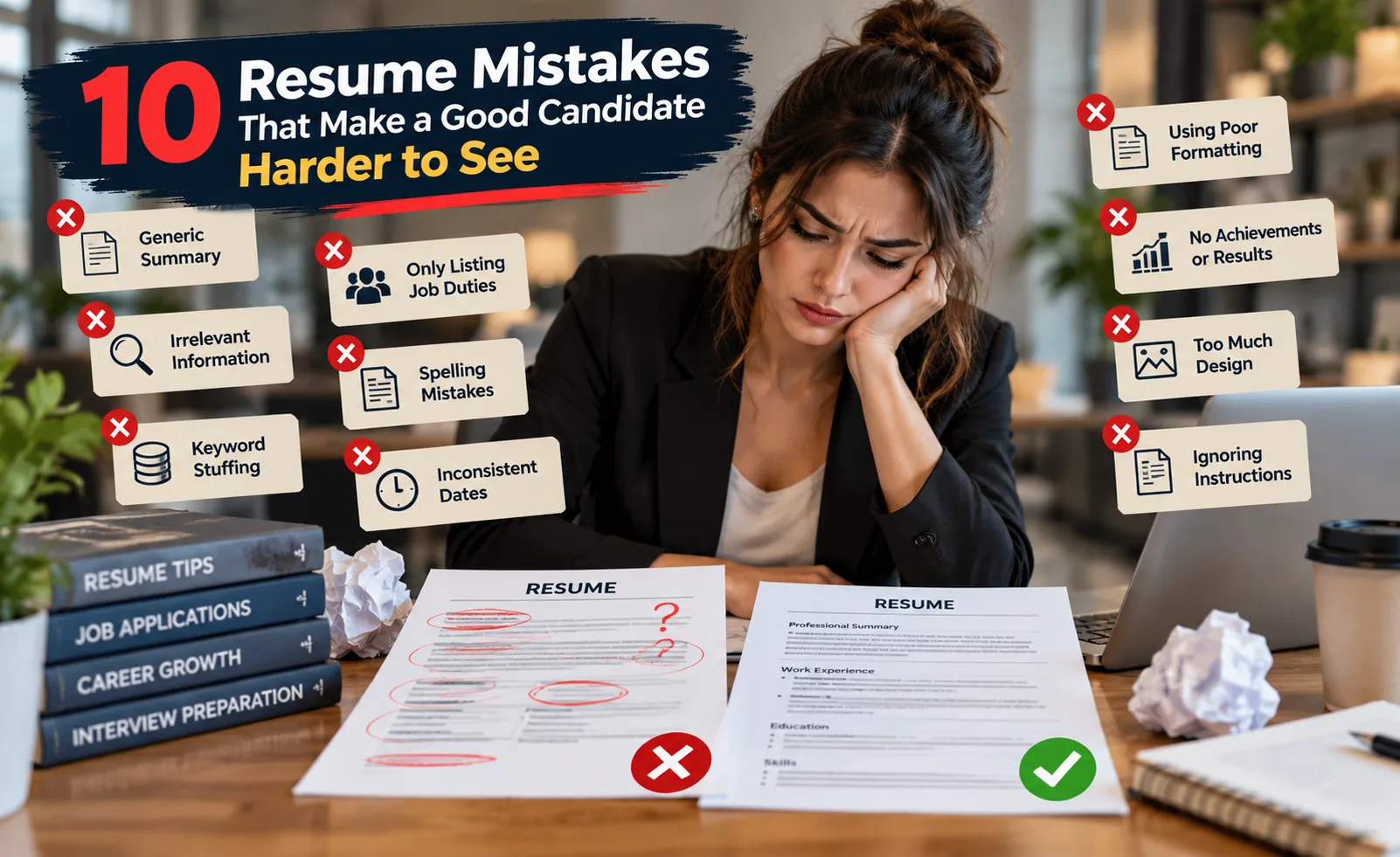
Your experience doesn't change, but its relevance does.
The best bullet for one vacancy may be almost irrelevant to another.
2. Opening with a summary that could describe anyone
If you remove your name and the summary could belong to 10,000 applicants, rewrite it.
3. Repeating the job description of your old role
Employers want to know what you contributed, not only what somebody with your job title was supposed to do.
4. Leaving obvious spelling mistakes
A typo won't always destroy an application, but avoidable errors create unnecessary doubt.
5. Making dates difficult to follow
Use a consistent style throughout the document.
6. Giving irrelevant experience too much room
Your resume isn't required to give every job equal treatment.
7. Stuffing keywords
Repeated phrases make the document worse for the person you're hoping will read it.
8. Designing for appearance at the expense of readability
A resume can look polished without making basic information difficult to locate.
9. Making claims you couldn't comfortably explain in an interview
If you say you increased revenue by 47%, be prepared to explain where that figure came from.
Never invent it.
10. Ignoring what the employer asked for
Wrong file type. Missing portfolio. Unanswered application question. Incorrect submission method.
These are avoidable problems.
Resume Example: From Forgettable to Useful
Let's take a fictional candidate named
Maya Collins.Maya has three years of marketing experience and is applying for a marketing coordinator position.
Her first draft looks like this:
Before
Profile
Hardworking marketing professional and team player looking for a new opportunity to grow and develop my skills.
Skills
Marketing, teamwork, communication, social media, leadership, hardworking
Marketing Assistant — Northfield Home Ltd
Responsible for social media.
Helped with emails.
Worked on reports.
Assisted with the website.
Communicated with different teams.
Nothing here is necessarily false.
The problem is that we still know very little about Maya.
Now look at the same candidate after asking better questions about her work.
After
Professional Summary
Marketing coordinator with three years of experience supporting email, social and website campaigns for consumer brands. Experienced in campaign reporting, Google Analytics and CRM segmentation, with regular responsibility for coordinating work between marketing and sales teams.
Relevant Skills
Email marketing | Google Analytics | CRM segmentation | Social media management | Campaign reporting | Website content
Marketing Assistant — Northfield Home Ltd
Managed content scheduling across four social channels and coordinated the monthly campaign calendar.
Built segmented promotional emails and prepared post-campaign reports for the marketing manager.
Updated product and campaign pages on the company website, coordinating approvals with sales and product teams.
Created a monthly reporting template combining website, email and social performance data.
Coordinated creative assets and approvals for overlapping seasonal campaigns.
Notice what didn't happen.
We didn't suddenly make Maya a “visionary marketing expert.”
We didn't add dramatic language.
We found the useful information hiding behind “helped,” “worked on” and “responsible for.”
That's often where the biggest resume improvement comes from.
Final Resume Checklist Before You Apply
Give yourself five quiet minutes before uploading the document.
Check:
□ Is this clearly targeted to the correct job?
□ Is my phone number correct?
□ Is my email address professional and current?
□ Does my summary say something specific?
□ Is my most relevant experience easy to find?
□ Have I prioritised achievements over routine duties?
□ Are every number and claim accurate?
□ Have I included relevant terminology naturally?
□ Are employment dates consistent?
□ Are job titles and company names accurate?
□ Have I removed unnecessary personal information?
□ Have I checked spelling and grammar?
□ Is the layout easy to scan?
□ Is the filename professional?
□ Am I sending the format the employer requested?
□ Have I checked the normal expectations for the country where I'm applying?
Then submit it.
There will always be another sentence you could tweak. At some point, accuracy and relevance matter more than endless polishing.
USA, UK and Canada: Key Resume Differences at a Glance
Because so much career advice online mixes countries together, here's the practical comparison in one place.
These distinctions are useful, but the vacancy still wins.
If an employer gives specific instructions, follow them.
How Often Should You Update Your Resume?
The worst time to reconstruct your achievements is two years after they happened.
You remember that a project went well. You might not remember that it reduced processing time by 18%, involved six departments or finished three weeks early.
Keep a private master resume and add important information as it happens.
Update it after:
A promotion
A major project
A new qualification or certification
A measurable result
A significant change in responsibility
You don't need to redesign the document every month.
Just capture the evidence while you still remember it.
When a good vacancy appears, you'll spend your time tailoring rather than trying to remember what you achieved three jobs ago.
Final Takeaway
A good resume doesn't try to make every part of your career look equally important.
It makes choices.
It gives more room to experience that matters for the job and less to experience that doesn't. It replaces vague claims with specific examples, keeps the structure easy to follow and gives the employer enough evidence to understand what you could bring to the role.
If you're learning
how to write a resume, start with the vacancy rather than the template. Work out what the employer needs. Then look honestly at your own experience and find the strongest overlap.Write for the person who needs to make sense of that information—not for a keyword counter.
No resume can guarantee an interview. But a relevant, readable and evidence-based one makes it much easier for your genuine experience to be evaluated on its merits.
Frequently Asked Questions
How do I write a resume for the first time?
Start by reading the type of job you want to apply for and identifying its main requirements. Then gather evidence from education, part-time work, volunteering, internships, projects and extracurricular activities. You don't need to pretend you have professional experience you haven't earned. Clearly labelled academic and personal projects can provide useful evidence for entry-level applications.
How long should a resume be?
There isn't one correct length for every applicant. Many early-career US candidates can work effectively with one page, while experienced professionals may need two. UK CVs are commonly around two A4 pages. In Canada, one to two pages is common, with Government of Canada Job Bank guidance recommending a maximum of two pages. Relevance matters more than forcing a particular page count.
What should I put in a resume summary?
Tell the employer what kind of professional you are, your relevant level or type of experience, your strongest applicable skills and, where possible, some useful evidence. Skip generic descriptions such as “hardworking individual” unless the rest of the resume actually demonstrates the quality.
Should I include a photo on my resume?
Generally, no for ordinary applications in the United States, United Kingdom and Canada. Canadian government guidance advises against including a photograph, and photos aren't normally expected on standard US resumes or UK CVs either. Different conventions can apply elsewhere and in particular specialist industries.
Should my resume be one page or two?
Use one page if it comfortably contains the information an employer needs. Use two when your relevant experience genuinely needs the extra room. An experienced applicant shouldn't remove valuable achievements or use tiny text just to satisfy an arbitrary one-page rule.
How do I write a resume with no experience?
Broaden what you count as experience. Academic projects, volunteering, internships, extracurricular activities, certifications, part-time employment and relevant personal projects can all demonstrate useful abilities. Label them accurately and explain what you actually did rather than trying to make them sound like formal employment.
What skills should I put on a resume?
Choose skills relevant to the vacancy that you genuinely possess. Specific hard and technical skills are often easiest for an employer to evaluate. Transferable and soft skills matter too, but they become more credible when your work or project examples demonstrate them.
Should I put references on my resume?
Usually, references can be provided separately when requested. You don't need to distribute another person's private contact information with every application. If an employer specifically asks for references as part of the initial application, follow those instructions.
Is PDF or Word better for a resume?
The employer's requested format is best. PDF normally preserves the visual layout, while some recruitment systems or employers ask specifically for DOCX files. Don't ignore explicit application instructions because of a universal rule you've read online.
How do I make my resume ATS-friendly?
Use clear headings, straightforward formatting and relevant terminology that accurately reflects your experience. Keep important information as actual text and avoid stuffing keywords. Applicant tracking systems differ, so be cautious of anyone claiming one template or formatting trick will work with every system.
What is the difference between a CV and a resume?
For standard employment, “resume” is the common term in the United States and Canada, while “CV” is normally used in the UK. In the United States, CV can instead refer to a longer academic, research or related professional document. Context therefore matters.
How often should I update my resume?
Update your master resume whenever you complete something worth remembering: a promotion, major project, certification, measurable achievement or substantial new responsibility. You don't need to apply for a job immediately. Recording the information while it's fresh makes future applications much easier.
Reader Reaction
Was this article useful?
2 readers like this article.
Share This Article
Found this story useful? Share it with your network.
Comments
0 discussionsAdd your perspective, reply to other readers, and keep the conversation useful.
Conversation
Reader responses