
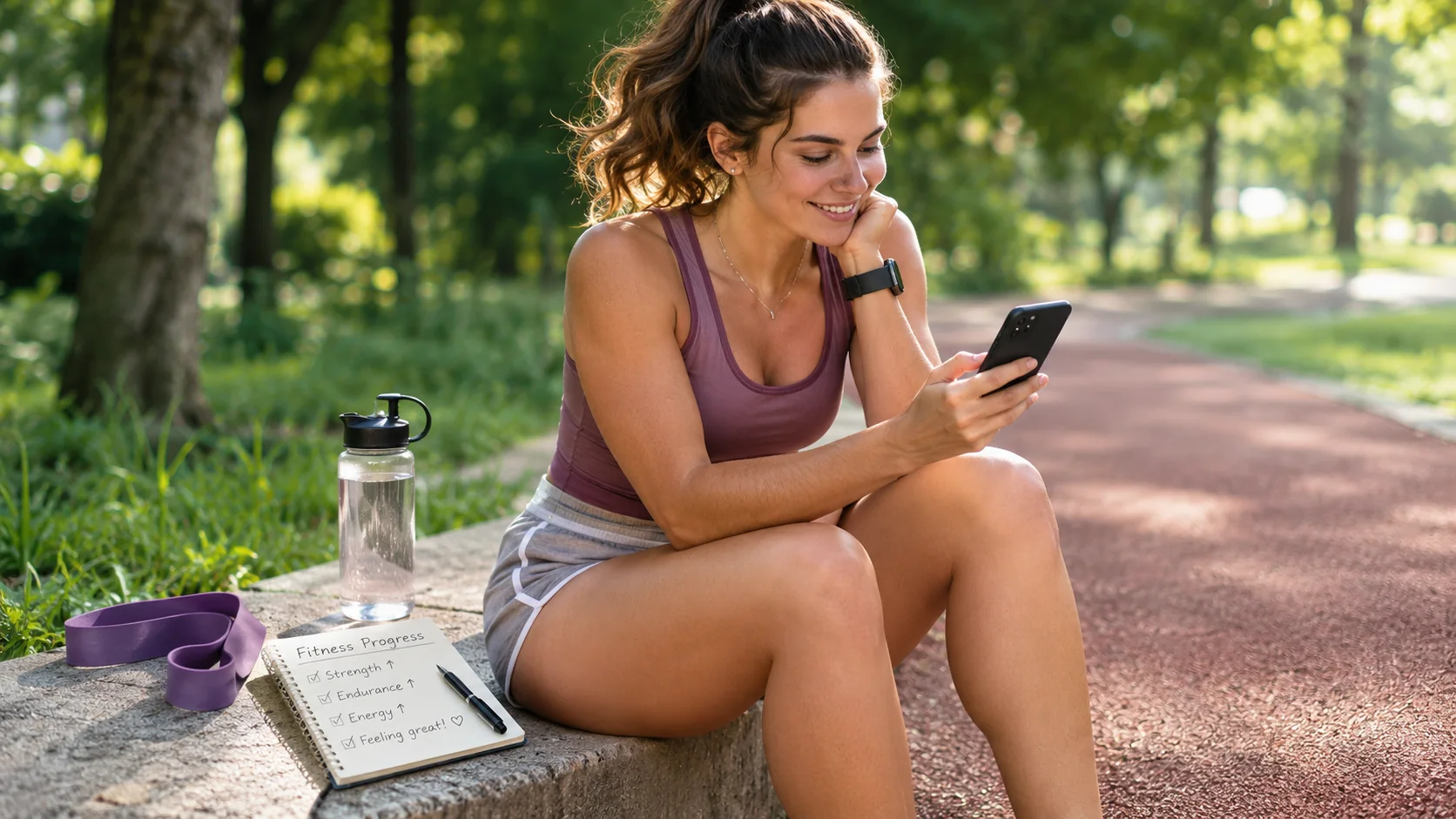
A few weeks into a regular exercise habit the walks start to feel lighter. Your legs push out extra repetitions and the stairs at home no longer leave you gasping. Then the bathroom scale shows the same number it showed last month.
That flat number can make all the effort look pointless. A scale reports body weight, but it cannot show how strong your legs have become or how comfortably you handle a hill. Balance and recovery sit outside its reach too.
You can track fitness progress without relying on weight by measuring strength, endurance, mobility, workout consistency and how everyday activities feel. A notebook and a phone timer cover everything you need. Pick a few measurements and write down your starting point. Then compare after several weeks. The real skill lies in knowing what to measure and giving those numbers enough time to say something.
Why the Scale Doesn't Show Fitness Progress
Your weight bundles muscle and fat into one figure. Bones and organs are in there too along with water.
The number also shifts during a single day. A salty dinner or a change in hydration can nudge it. Digestion and hormonal fluctuations do the same thing temporarily. None of those swings tells you whether yesterday’s workout helped.
Take a person who starts strength training. Their muscular strength can climb while their weight stays roughly where it was. Another person might build cardiovascular endurance with no visible change in body size.
Losing weight and becoming fitter are separate things. Weight loss can be a reasonable goal for some people. Fitness gains happen without it too. Regular physical activity supports health in ways that sit outside the scale.
How to Track Strength Progress
Strength gives you something repeatable to measure and that makes it one of the clearest signals. Say you begin with bodyweight squats. In week one you manage eight controlled repetitions before your form slips. A few weeks later you reach twelve with the same comfortable range of motion. That counts as real progress.
No gym membership or heavy equipment is required. Wall pushups and chair stands are familiar starting points. If you already lift weights then write down the resistance first. Add repetitions and sets for a few regular movements.
Here is how it might look. Wall pushups could go from 8 repetitions to 14 with more control. Chair stands might climb from 10 to 15 which shows better muscular endurance. A dumbbell row could rise from 8 repetitions per arm to 11 at the same weight. Even a grocery carry counts when one light bag starts to feel easier because the effort seems lower. None of these numbers are guaranteed results.
Keep the conditions of each session similar since a deep squat can’t be compared with a shallow one. Swinging your body to squeeze out extra reps doesn’t prove you got stronger. Technique counts as much as the number itself.
Our guide to training like an athlete explains how strength and endurance fit into a broader training routine for anyone curious about building different physical abilities.
How to Measure Walking Endurance
One familiar route reveals a lot about your stamina. Choose a distance you can finish comfortably such as a loop around the neighborhood or a local park or one kilometer of flat path.

Write down how long it took. Note how hard it felt and whether you had to stop. Then walk the same route again under similar conditions next time.
Say your one kilometer walk took 16 minutes at first. Several weeks on you finish it in 14 minutes and it feels about as comfortable. That points to better walking performance. Walking for a longer stretch at the same comfortable pace shows progress too. Running never has to enter the picture.
The talk test
Speech works as an effort meter. During moderate intensity activity you can talk but singing would be a struggle. Vigorous activity leaves you unable to say more than a few words at a stretch. That gives you a way to describe effort without a heart rate monitor.
Weather, hills, tiredness and the surface under your feet can all affect the result. A humid afternoon can’t be fairly compared with a cool morning so a single outing proves little.
Our 5K training plan for beginners uses walking and running intervals for readers aiming at a longer distance.
Everyday life as a fitness test
Some of the best evidence turns up away from the workout. Carrying shopping bags upstairs. Walking from the parking lot to work. Getting out of a low chair or spending an afternoon exploring a city on foot. Ordinary moments like these show gains that a gym session can miss.
Maybe you no longer stop halfway up a familiar flight of stairs. A long shopping trip drains you less. Household chores get done with fewer breaks. None of this is a precise test yet it links your exercise to how comfortably you live.
Pick one everyday activity that feels hard right now and write it down. Checking in on it every couple of weeks gives you something to compare against. The answer might surprise you.
Mobility and balance
Mobility means moving through a useful range of motion with control. Flexibility describes how far a muscle and its related tissues can comfortably lengthen. The two are connected yet different.
Strength can go up while ankle or shoulder mobility still limits a movement. Another person may stretch comfortably but wobble on one leg. Since these are separate abilities they deserve separate tracking.
Pick a few simple movements you can repeat safely. Sitting down on a stable chair and standing back up without using your hands works if that is comfortable for you. Notice how controlled it feels. You can also watch how comfortably your shoulders move when reaching overhead or how easily you turn your upper body. For balance a one leg stand near a sturdy support gives a simple reference point if it is safe for you.
Pushing into deeper stretches just for a better number makes little sense because pain is no proof of useful progress. Use the same movement and similar conditions each time.
Our Pilates vs Gym comparison explains how each can support different strength and movement goals.
How you bounce back
Think back to your first workout after a long break. Even a modest session probably left you tired or sore the next day. Once your body adapts to a suitable routine some familiar workouts start to feel more manageable. Soreness alone is an unreliable fitness gauge though.
Your recovery notes can cover whether you feel ready for the next planned session. Add how tired you feel afterward. Mention any discomfort that interferes with normal activities.
Sleep belongs here as well. Regular physical activity can support sleep and general wellbeing. A single restless night does not necessarily mean your training plan is failing. Stress, illness and work schedules can all play a part. Patterns across several days are worth watching instead of grading each morning on its own.
A short entry gives better context than a single rating. Something like this works: “Slept reasonably well. Legs slightly tired. Walk felt comfortable today.”
Persistent exhaustion or worsening pain or declining performance calls for attention instead of an automatic jump in training.
Showing up counts
Sometimes the biggest early win is simply turning up regularly.
You may have exercised once every couple of weeks before. Now your routine includes regular walks and two strength sessions. That is a real change.
A workout calendar shows it well. Mark each day you exercised and jot down roughly what you did. Weekly active minutes can go in the same record.
According to the CDC’s general physical activity guidance for adults, people should work toward at least 150 minutes of moderate intensity aerobic activity each week or an equivalent amount of vigorous activity. The guidance also recommends muscle strengthening activity on two or more days. Someone starting from very little activity doesn’t have to hit those numbers right away since smaller amounts of movement bring benefits too.
Missed workouts happen. The useful question is whether you return to the routine afterward.
Energy on a 1 to 5 scale
Energy is harder to pin down than walking time or repetition counts. A short daily note still shows how your routine sits within your life. Rate yourself from 1 to 5. A 1 means very low energy and a 2 means more tired than usual. A 3 is fairly normal. A 4 means good energy for daily activities while a 5 means energetic and comfortable. Record it around the same time each day.
A week of poor sleep can drag your scores down even when your fitness has improved. Busy workdays and illness do the same. Energy ratings therefore work as a supporting observation and never as your main performance measure.
Reaching a 5 every day isn’t the target. The aim is to learn your own patterns.
Resting heart rate for people who like numbers
Some people enjoy tracking resting heart rate which is the number of beats per minute while you are at rest. With suitable aerobic training the figure may drop over time as cardiovascular fitness improves. That pattern isn’t universal. Medication and illness can shift the reading. Hydration and stress do the same along with other health factors. A lower number isn’t automatically better for every person.
Take readings under similar resting conditions and follow the longer trend instead of a single measurement. A suitable wearable works or you can check your pulse manually. Buying a smartwatch just for this tracking system is unnecessary.
Anyone who already knows they have a heart condition or takes medication that affects heart rate will get more from individual medical guidance than from comparing numbers with someone else.
Four-Week Fitness Progress Tracker
Measuring everything in this article would turn tracking into another job. Three or four indicators matched to your goals are enough. A walker might follow distance and walking time along with weekly active minutes. Someone focused on strength could record repetitions and resistance along with how manageable the regular exercises feel.
Here is a sample run with no scale involved.
| Progress indicator | Week 1 | Week 2 | Week 3 | Week 4 |
|---|---|---|---|---|
| Comfortable wall pushups | 8 | 9 | 11 | 13 |
| Time for familiar 1 km walk | 16 min | 15:40 | 15:10 | 14:45 |
| Workouts completed | 2 | 3 | 3 | 3 |
| Average energy rating | 3/5 | 3/5 | 4/5 | 4/5 |
| Comfortable chair stands | 10 | 11 | 12 | 14 |
These fictional results only show how a tracker works. Your progress may be slower or faster or uneven.
Not every measurement moves each week and that is normal. A steady routine can be worth keeping even when one performance measure stalls for a while.
Your own tracking sheet
Copy this layout into a notebook or a spreadsheet or a notes app.
| What I want to improve | Starting result | Latest result | Notes |
|---|---|---|---|
| Strength | |||
| Walking or cardio endurance | |||
| Weekly workout consistency | |||
| Mobility or balance | |||
| Everyday energy |
After four weeks you compare the results and decide what deserves attention next. Starting results should stay realistic since a maximum effort challenge isn’t needed to set a baseline. Stick to activities you already know how to perform safely.
How Often Should You Measure Fitness Progress?
Workout details take under a minute to record after each session once you get used to it. Weekly reviews show whether the routine is settling in. Strength and walking performance are easier to judge across a few weeks than from one day to the next. Mobility works the same way.
A practical starting schedule looks like this.
| What to track | Suggested frequency |
|---|---|
| Exercises and repetitions and resistance | Each strength workout |
| Walking distance and time and effort | Once a week |
| Workout consistency | Weekly |
| Energy and recovery notes | Brief daily notes if useful |
| Mobility or balance comparison | Every 2 to 4 weeks |
| Overall progress review | Every 4 weeks |
This is a practical schedule, not a medical requirement. The right rhythm is one you can sustain without pressure to improve on every attempt.
When the weight stays put and you feel stronger
Meaningful progress is still possible. Say you walk the same neighborhood route with fewer breaks. Heavier grocery bags feel comfortable and your workouts include more controlled repetitions. Your weight may be identical yet those gains stand.
Body composition is a separate matter. Better performance doesn’t prove you gained muscle or lost body fat so the two goals shouldn’t be mixed up.
Weight management can stay on the table as part of a broader health discussion if it matters to you. It just doesn’t have to be the only measure of whether exercise is worthwhile.
Mistakes that muddy the numbers
Changing the test every time is the first one. A different walking route each week makes pace comparisons meaningless. Hills and distance affect the result. So does the surface.
Pushing difficulty up too fast to produce better numbers is another. Extra weight with poor form or faster runs while exhausted can muddy your measurements and raise injury risk.
Comparing yourself with other people is a trap too. Training experience and health shape performance. Age and starting abilities do as well.
Then there is treating soreness or sweat as proof of a good workout. A sweaty session may be demanding yet sweat depends partly on temperature and individual physiology. Soreness can follow unfamiliar exercise without meaning you built more strength.
Last comes letting the tracking take over your training. Three meaningful measurements go further than twenty numbers you never look at again. You are collecting information to understand your progress and no exam is waiting for you.
When a routine deserves a change
A quiet week doesn’t call for a new plan. Fitness gains zigzag. Some sessions feel easier than others and a rough week at work can drag your performance down. A reasonable and manageable routine needs time to do its job.
If your measurements stay flat for several weeks then look at the whole picture. Check whether you are exercising consistently and whether the workouts suit your current ability. Recovery time matters and so does whether your chosen test actually measures the goal you care about.
Better walking endurance may call for gradually adding suitable walking. Strength needs enough appropriate resistance along with chances to recover. Changes should arrive gradually and never as punishment for slow progress.
Declining performance or persistent fatigue or unusual symptoms are reasons to get professional advice before adding workload. Chest pain or fainting or severe breathlessness means stopping activity and seeking appropriate urgent medical care.
Frequently Asked Questions
How can I tell if I’m getting fitter without losing weight?
Look at strength and walking endurance first. Exercise consistency and mobility count along with everyday tasks. Familiar workouts feeling easier or more controlled repetitions with an unchanged body weight both suggest you are getting fitter.
What is the best way to measure fitness progress at home?
A familiar walking route or comfortable chair stands or wall pushups all work as repeatable activities. Record your starting results and compare them under similar conditions every few weeks. A notebook and a phone timer usually cover it.
Can you get stronger without seeing changes on the scale?
Yes. Muscular and nervous system adaptations can raise strength with no noticeable change in total body weight. More controlled repetitions or better performance at the same resistance can show that improvement.
How long does it take to notice fitness progress?
No fixed timeline exists. Some people notice changes in exercise comfort or performance within several weeks while other improvements take longer. Starting fitness and training consistency shape the result. Recovery and the activity being measured do too.
Is walking enough to track fitness improvement?
Walking is a useful way to monitor cardiovascular endurance especially for beginners. Compare time and distance on a familiar route along with how hard it felt. Walking alone won’t measure every aspect of fitness such as upper body strength.
Do I need a fitness watch to track progress?
No. A fitness watch can collect information like steps and heart rate yet it is optional. A phone timer and a simple exercise log along with repeatable movements give useful measurements without extra equipment.
Should I take progress photos or body measurements?
They are optional. Photos and measurements may help people with specific body composition goals but they don’t directly measure strength or stamina or cardiovascular fitness. If they make tracking stressful or distract from your goals you can skip them.
More than a number
A scale reports how much you weigh at one particular moment. It says nothing about how confidently you move through the day.
Your progress might be another five minutes of walking. It might be carrying the groceries without stopping or finishing a workout with better control. Maybe it is finally keeping a routine that fits your schedule.
Start with one strength measure and one endurance measure along with a simple record of how often you exercise. Give it a few weeks and review what has changed and adjust the routine when needed. Not every workout has to produce a personal best.
Comments
0 discussionsAdd your perspective, reply to other readers, and keep the conversation useful.
Conversation
Reader responses