
How to Train Like an Athlete: A Practical Fitness Guide for Strength, Speed and Endurance
Learn how to train like an athlete with a practical approach to strength, speed, power, endurance, agility, mobility and recovery—without copying extreme professional training routines.

Watch a professional athlete train and it is easy to focus on the spectacular parts: heavy lifts, explosive jumps, fast sprints and exhausting drills.
Those are only pieces of the picture.
Trying to copy an NFL player's gym session or an Olympic sprinter's track workout doesn't suddenly make your training athletic. Their programs have been built around their sport, training history, competition schedule and individual needs. They may also have coaches, physiotherapists and other professionals managing the work you never see in a short training clip.
For everyone else, there is a much more useful lesson to borrow.
Athletes train for capability. They want to become stronger, move faster, produce force quickly, maintain effort, change direction efficiently and recover well enough to do it again.
You can apply the same thinking without living like a professional athlete.
How do you train like an athlete?
Build your training around abilities rather than exhaustion. Develop strength with fundamental movements, practice speed and explosive actions while fresh, improve aerobic fitness and conditioning, work on mobility and movement control, and recover between demanding sessions. Track a few meaningful measures and increase the challenge gradually.
What Does It Actually Mean to Train Like an Athlete?
Think about two people leaving the gym.
The first has completed a difficult workout and burned through plenty of energy. The second has also worked hard, but today's session had a specific job: improve acceleration and lower-body strength.
Both exercised. Only the second example tells us what physical quality the session was intended to develop.
That distinction sits at the heart of athletic training.
A performance-oriented program usually asks what you need your body to do, then works backwards from there. Perhaps you need stronger legs for hiking, better acceleration for recreational soccer, more stamina for tennis or a combination of strength and conditioning for everyday fitness.
Your goal determines the training.
Gym Training vs Athletic Training
This doesn't make conventional gym training inferior. Someone primarily interested in muscle growth has different priorities from a recreational basketball player.
The important part is knowing what you are training for.
The 7 Physical Qualities Behind Athletic Performance
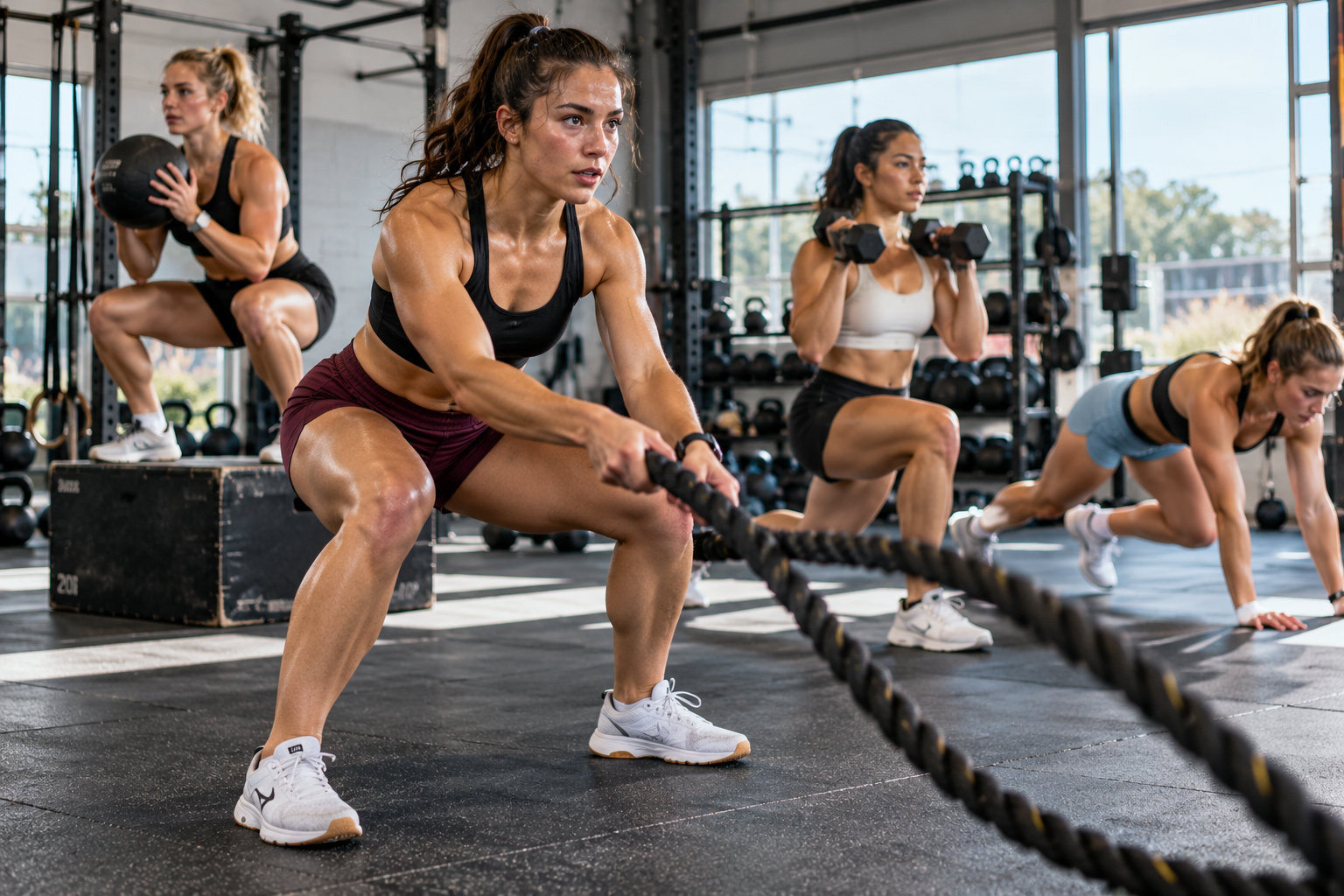
Being athletic isn't one skill.
Someone can be remarkably strong but relatively slow. Another person may have excellent endurance yet struggle to produce force quickly. That's why balanced athletic training draws from several qualities, with the emphasis changing according to the activity
.1. Strength
Consider what happens during the first few steps of a sprint. Your foot meets the ground, you apply force, and your body moves forward.
Force matters elsewhere too. You need it to jump, climb, push, pull, absorb a landing and maintain position when another player makes contact.
That is where strength training earns its place.
For most recreational trainees, useful choices are surprisingly familiar: squat variations, deadlift or hinge variations, split squats, rows, presses, pull-ups and loaded carries.
You aren't trying to win a powerlifting meet. You're creating a stronger physical base for the things you actually want to do
.2. Power
Now imagine two people who can lift roughly the same weight. One can apply that force much more quickly.
On a slow strength exercise, the difference might not look dramatic. During a jump or sprint, it can matter a great deal.
That's the practical idea behind power.
Jumps, low-level hops and medicine-ball throws are common options because they allow you to practise producing force quickly. They don't need to be complicated, and beginners certainly don't need to rush into technically demanding Olympic lifts.
A low box jump performed cleanly and confidently can be more appropriate than an impressive-looking exercise you cannot control.
3. Speed
If you want to become faster, at some point you need to practise moving fast.
That sounds obvious, yet many gym programs contain plenty of leg work and cardio without any genuine speed exposure.
Short accelerations are a sensible entry point for many recreational athletes. They also resemble what happens in sports such as soccer, basketball and tennis, where you repeatedly accelerate over relatively short distances.
Speed work comes with one important condition: quality matters.
We'll return to that shortly.
4. Endurance and Conditioning
“Good cardio” means different things depending on what you're asking your body to do.
A 10K runner needs to sustain movement for a relatively long period. A basketball player repeatedly moves, accelerates, slows down and gets brief opportunities to recover. A tennis match has another rhythm altogether.
All three require conditioning. They don't require identical conditioning.
That's why a useful athlete workout plan combines a general aerobic foundation with harder work chosen for the activity
.5. Agility and Change of Direction
Place five cones on the floor and you have a drill. You don't automatically have agility training.
First, you need to be able to slow yourself down. Then you need enough control to plant a foot, manage your body position and move in another direction.
True agility adds another ingredient: a decision.
A planned shuttle run is change-of-direction training because you already know where you're going. Reacting to an opponent or visual cue introduces the decision-making element found in sport.
6. Mobility and Movement Quality
Mobility isn't a competition to see who can reach the biggest range of motion.
What matters is whether you can comfortably access and control the positions your activities demand.
An ankle that moves well enough for your squat, hips that allow you to run comfortably and shoulders that handle overhead movement are practical examples.
Your requirements will depend on your body and your sport. More range isn't automatically useful if you cannot control it.
7. Coordination and Balance
Athletic movement is rarely about one muscle working in isolation.
Your limbs and trunk have to cooperate, often while your body is moving quickly or balancing on one leg.
Skipping variations, single-leg exercises, controlled landing practice and appropriately chosen sport movements can all challenge coordination.
You don't need to turn every exercise into a circus-style balance drill. Solid movement fundamentals come first.
Build Strength That Has a Job
You could build an effective strength program around a surprisingly short list of movement patterns:
Squat. Hinge. Push. Pull. Lunge. Carry. Rotate or resist rotation.
Those are categories rather than mandatory exercises.
For a squat pattern, one person might use a goblet squat. Someone more experienced might choose a front or back squat. A trainee uncomfortable with one variation may use another that better suits their mobility, equipment and skill.
The same applies to hinging. Conventional deadlifts are not compulsory. Romanian deadlifts, trap-bar deadlifts and other appropriate variations can train similar broad patterns in different ways.
What Progressive Overload Really Looks Like
Progressive overload often gets reduced to “add more weight.”
That's one option, not the entire concept.
Suppose you performed eight split squats per leg last month and the final repetitions were shaky. Today, you use the same load but move through a comfortable range with much better control.
That's progress.
Over time, progression could mean an extra repetition, slightly more resistance, a harder variation, better technique or a greater usable range of motion. Which variable you change depends on the exercise and your goal.
ACSM's current resistance-training guidance similarly emphasizes consistent resistance training and matching the program to the desired outcome rather than searching for one universally superior method.
Train Power Before Fatigue Takes Over
Power exercises are unusual because the goal isn't to grind through them.
Picture your first broad jump of the session. It is sharp and explosive. Several rounds later, the distance has clearly fallen, your landing has become messy and each repetition looks slower.
Doing more is not necessarily productive.
For that reason, explosive training usually fits best near the beginning of a workout, once you're warm but before heavy fatigue develops.
Depending on your experience, that might include:
vertical jumps
broad jumps
small hops
medicine-ball chest passes
rotational medicine-ball throws
Start at the level you can control.
Someone new to jumping might practise a small jump and quiet, stable landing. A person who needs a lower-impact option could use an appropriate medicine-ball exercise where equipment is available.
The session doesn't need to leave you exhausted to have done its job.
How to Train for Speed Without Turning It Into Cardio
A common speed-training mistake is easy to make.
You sprint. Rest for a few seconds. Sprint again. Repeat until every run feels brutal.
You've certainly trained hard, but the later efforts may no longer resemble your best speed.
If speed is the target, give yourself enough recovery to produce another high-quality effort.
A Simple Beginner Speed Session
After an appropriate warm-up:
Running preparation: a few simple marching, skipping or technique drills.
Accelerations: 4–6 runs of roughly 10–20 metres/yards.
Between runs: walk back, then take additional recovery when necessary.
Stop: before your running mechanics and speed noticeably deteriorate.
There is no prize for squeezing in another sprint once quality has disappeared.
Repeated-sprint conditioning has a place too. Research suggests it can improve several fitness measures in trained athletes. It simply serves a somewhat different purpose from practising high-quality speed with generous recovery.
If you haven't sprinted for years, don't begin by trying to recreate your teenage best. Sprinting places different demands on the body than jogging. Build exposure and intensity gradually.
Build Endurance for the Activity You Actually Do
You don't need to choose between being strong and having endurance.
You do need to manage both intelligently.
For most people, conditioning can be understood through three useful buckets.
Easy Aerobic Training
This is the work you can sustain without turning every minute into a struggle: easy running, cycling, rowing, swimming or similar activities.
It can help build the aerobic foundation that supports longer efforts and recovery between repeated bouts of activity.
Intervals
Intervals alternate harder work with recovery.
The duration and intensity should have a reason behind them. Ten-second efforts and four-minute intervals are both “interval training,” but they create very different sessions.
Sport-Specific Conditioning
Here, the demands of the activity start shaping the workout.
A field-sport player may need repeated runs and changes in pace. A recreational runner needs far more running-specific volume. Someone training primarily for general fitness may be better served by straightforward aerobic sessions plus occasional harder intervals.
For perspective, the CDC recommends that adults obtain at least 150 minutes of moderate-intensity aerobic activity per week, or 75 minutes of vigorous activity, or an equivalent mixture, along with muscle-strengthening activity on two or more days.
Those are health guidelines, not a ready-made sports performance program.
Your athletic training can sit within or beyond those recommendations depending on your goals and circumstances.
Agility Starts With the Brakes
People naturally notice acceleration.
Deceleration deserves just as much attention.
Before you can redirect your body quickly, you have to control the speed you've already created. That requires positioning, strength and coordination.
Begin with predictable movements. Accelerate gently, slow down under control and hold your finishing position. Later, add lateral movement and sharper direction changes. Once those mechanics are reliable, reactive cues can make the drill more representative of genuine agility.
For a recreational tennis or basketball player, that progression is usually more useful than memorizing increasingly elaborate cone patterns.
A Warm-Up Should Resemble What Comes Next
Ten minutes on a treadmill may raise your temperature, but it doesn't necessarily prepare you for everything in the session.
A more useful warm-up moves from general preparation toward the specific task ahead.
An 8–12 Minute Warm-Up Framework
1. Get warm — about 2–3 minutes
Use easy jogging, cycling, skipping or another simple whole-body activity.
2. Open the ranges you'll need — about 2 minutes
Sprinting today? Ankles and hips may deserve attention. Pressing overhead? Shoulder and upper-back movement becomes more relevant.
3. Switch on the important patterns — 1–2 minutes
Keep this simple. The purpose is preparation, not fatigue.
4. Rehearse the session — 2–3 minutes
Bodyweight squats can lead into loaded squats. Marching and skipping can lead into running. Easy practice sets can lead into heavier lifting.
5. Increase intensity gradually — about 2 minutes
Move toward the speed, load or effort you'll use in the actual workout.
Research on warm-ups supports the idea that appropriately designed preparation can benefit subsequent performance. Stretching also has legitimate uses, particularly for range of motion, but it shouldn't be sold as a guaranteed way to prevent injury.
Recovery: The Part You Can't Replace With More Effort
Suppose Monday's training is excellent, Tuesday is harder than planned, Wednesday becomes another intense session, and by Friday your usual weights feel unusually heavy.
Adding another hard workout isn't automatically discipline. Sometimes it is simply poor workload management.
Training works because your body responds to a challenge. That response needs time and resources.
Sleep is part of that equation, as are rest days, easier sessions, food and hydration.
Rather than obsessing over one tired morning, watch for patterns. Is your performance repeatedly dropping? Are you unusually sore for longer than expected? Does normal training suddenly feel much harder? Has motivation fallen at the same time?
Those observations don't diagnose a medical problem. They can, however, tell you that your current workload deserves another look.
Athlete-style training isn't about avoiding fatigue. It's about spending fatigue where it produces something useful.
Nutrition for Athletic Training Doesn't Need to Be Complicated
Food supports the work you're asking your body to perform.
That starts with eating enough overall to support your training and daily life.
Protein contributes to tissue repair and training adaptation. Carbohydrate becomes particularly useful fuel as the volume and intensity of exercise rise. Dietary fat remains an important part of an overall diet, while hydration needs change with factors such as exercise duration, environment and individual sweat loss.
Sports nutrition guidance from the Academy of Nutrition and Dietetics, Dietitians of Canada and ACSM emphasizes this broader context rather than treating one nutrient as the answer to performance.
For many recreational athletes, a normal meal containing a source of carbohydrate, protein and fluids around training is more practical than a complicated “athlete diet.”
Specific medical or performance nutrition needs deserve individualized guidance from an appropriately qualified professional.
Three Realistic Athlete-Style Weekly Training Plans
The best weekly schedule isn't the one containing the most sessions. It's the one you can recover from while still improving the qualities that matter.
These templates show three ways to organize the week. They are frameworks, not personalized prescriptions.
Plan A: 3-Day Beginner Schedule
Best suited to: Someone new to structured athletic training or returning after a long break.
The beginner advantage is simplicity. You have enough training to practise regularly without needing to recover from five demanding sessions.
Plan B: 4-Day Balanced Schedule
Best suited to: Recreational athletes and intermediate gym users.
If Tuesday's speed session is demanding, don't turn it into a second leg-destroying workout simply because Monday went well.
Plan C: 5-Day Performance-Focused Schedule
Best suited to: Experienced recreational trainees who already tolerate regular training.
Notice the rhythm. Hard work is interrupted by easier work and rest.
That's deliberate.
If you also practise or compete in a sport, those sessions count toward your workload. A Saturday soccer match isn't an “off day” just because it isn't written in your gym program.
Can You Train Like an Athlete at Home?
Absolutely, although equipment changes what you can progress easily.
Useful Home Options
Bodyweight squats and split squats, push-ups, resistance-band movements, carefully selected jumps, outdoor accelerations and safe hill work can all fit into home-based athletic training.
A sturdy backpack can sometimes provide additional resistance for simple exercises or carries, provided the setup is secure and appropriate.
The main challenge arrives as you get stronger. Loading lower-body strength progressively becomes harder when your only resistance is bodyweight.
What a Gym Adds
Barbells and dumbbells make progressive loading straightforward. Cable machines broaden exercise choices. Medicine balls offer useful throwing options, sleds can provide resisted movement, and cardio equipment makes conditioning less dependent on weather.
Those are conveniences and progression tools—not prerequisites for becoming fitter or more athletic.
Measure Progress Without Turning Yourself Into a Lab Experiment
You don't need force plates, GPS tracking or expensive testing equipment to know whether training is working.
Pick a few measures you can repeat reasonably consistently.
The key word is repeatable.
If your first 20-metre sprint is performed fresh on a dry track and the next one is measured after a leg workout on wet grass, the comparison tells you very little.
You also don't need maximal strength testing to prove progress.
Suppose you used to perform six controlled repetitions with a certain load and can now complete eight with equally good technique. That's useful information without testing your absolute maximum.
How to Progress Over 8–12 Weeks
A good program should look familiar from one week to the next.
If every workout changes completely, it becomes difficult to tell whether you're actually improving.
Here's one simple way to think about an eight-week block.
Weeks 1–3: Learn and Establish
Find suitable exercises. Practise technique. Establish a workload you can recover from. Don't rush progression just because the first week feels manageable.
Week 4: Check the Fatigue
Some people benefit from a lighter week here; others may not need much adjustment.
Look at how you're moving and performing rather than automatically following a calendar.
Weeks 5–7: Add an Appropriate Challenge
That could mean a little more load, an additional repetition, slightly better sprint performance, a more demanding movement or a modest increase in conditioning work.
Don't increase everything simultaneously.
Week 8: Reassess
Repeat a few of the measures you established earlier.
Did your sprint improve? Are you stronger at the same movement? Is your conditioning test easier or faster? Are your jumps more consistent?
The answers help shape the next block.
For a 12-week program, the same principle can be extended into another period of progressive work and reassessment rather than treating week eight as a finish line
.Different Sports Need Different Athletes
There is no universal “athlete body,” and there shouldn't be a universal athlete program either.
Football/Soccer
Players typically need a mixture of acceleration, change of direction, repeated running ability, lower-body strength and aerobic conditioning. The exact balance varies by playing level and position.
Basketball
Jumping, acceleration, braking and lateral movement appear frequently, so strength and power work need to coexist with the demands of practices and games.
Running
Running itself takes priority. Strength training can support the program, but adding so much gym work that it compromises important runs misses the point.
Tennis
Short accelerations, lateral movement, rotation and repeated efforts matter. Training also has to fit around technical court practice.
Combat Sports
Technical work is central. Strength, power and conditioning should support rather than constantly compete with sport practice.
General Recreational Fitness
You have the freedom to stay balanced. Strength, short speed work, some power training and a reasonable aerobic base can all receive attention without specializing heavily in one quality.
The foundation is similar. The proportions change.
9 Mistakes That Make “Athletic” Training Less Effective
Copying a Famous Athlete's Program
Their workout solves
their problems. You probably have different ones.Adding Everything at Once
Going from three ordinary gym sessions to lifting, sprinting, jumping and interval training six days a week is a large change in workload. Introduce new stress gradually.
Making Every Workout Brutal
A speed day shouldn't accidentally become conditioning because you refused to rest. An easy aerobic day doesn't need a punishing finisher
.Using Soreness as a Score
A workout can make you sore without improving the quality you care about. Track performance instead.
Avoiding Strength Work
Running drills and cone exercises may look athletic, but strength remains a valuable part of a well-rounded physical base.
Never Moving Fast
The opposite problem exists too. Someone may become stronger in the gym while never practising acceleration or faster movement.
Treating Recovery as Lost Time
Recovery makes the next useful training session possible. That is part of the process, not time stolen from it.
Replacing Exercises Constantly
You need enough consistency to improve a movement and judge whether the program is working.
Recording Nothing
You don't need a complicated spreadsheet. A few numbers loads, repetitions, sprint times or conditioning results can tell you far more than memory alone.
When Is a Coach Worth It?
You can learn a great deal on your own, particularly if your goals are general fitness and recreational performance.
There are also times when another set of qualified eyes is valuable.
A strength-and-conditioning professional can help you organize competing training demands, refine lifting or sprint technique, and prepare for a specific sport or event.
Pain, injury, recent surgery or significant physical limitations are different. Those situations may require assessment and guidance from an appropriate healthcare professional, such as a physiotherapist or athletic trainer, depending on your circumstances and location.
You don't need to wait until something goes wrong to seek coaching. Sometimes the benefit is simply removing guesswork.
This article provides general fitness education, not individualized medical advice. If you have an injury, medical condition, recent surgery or significant exercise limitation, seek appropriate professional guidance before beginning demanding exercise.
Final Takeaway
Training like an athlete isn't about making ordinary workouts more extreme.
It's about knowing why each piece is there.
Strength gives you a foundation for producing force. Power asks you to express force quickly. Speed needs moments when you are fresh enough to move fast. Conditioning helps you sustain and repeat effort. Agility, mobility and coordination influence how effectively you use those abilities.
None of that requires a professional athlete's schedule.
Start with the amount of training you can perform consistently and recover from. Keep the important movements around long enough to improve them. Measure a handful of useful outcomes. Add difficulty when your performance shows you're ready—not simply because another week has passed.
The best sign that you're training more like an athlete isn't how destroyed you feel afterward.
It's that, over time, you can do more.
Frequently Asked Questions
How do you start training like an athlete?
Start with the basics rather than trying to train every athletic quality immediately. Build general strength with fundamental movement patterns, establish aerobic fitness and learn to move well. Once that foundation feels manageable, introduce small amounts of jumping, acceleration and agility work. Three organized sessions per week can be plenty for someone new to structured athletic training.
Can a beginner train like an athlete?
Yes. The principles are scalable. Beginners can train strength, endurance, coordination and basic speed without using professional-level loads or complicated exercises. What matters is choosing movements you can perform competently, keeping the initial workload manageable and increasing the challenge as your ability improves.
How many days a week should you train like an athlete?
There isn't one correct number. Three structured days may suit a beginner, while four or five can work for an experienced recreational athlete. Sport practices and competitions also count toward your total workload. Choose a schedule that lets you train consistently without making every day physically demanding.
What exercises make you more athletic?
Athleticism comes from a combination of abilities, so no single exercise can provide everything. Squats, hinges, lunges, rows, presses and carries can build strength. Jumps and throws can develop power. Short sprints train speed, while aerobic work and intervals develop different aspects of conditioning. Your sport and current weaknesses should determine the emphasis.
Can you train like an athlete at home?
Yes. Push-ups, split squats, resistance-band exercises, controlled jumps, outdoor accelerations and various bodyweight movements can form a useful program. The biggest limitation is usually resistance: once you become stronger, a gym makes it easier to continue progressively loading certain movements.
How do athletes train for speed and endurance?
They generally train them as distinct qualities while coordinating the overall workload. High-quality speed work uses fast efforts with enough recovery to preserve performance. Endurance training may include easy aerobic work, intervals and sport-specific conditioning. The balance changes considerably between sports.
Should athletes lift weights?
Resistance training is commonly used to build strength and support physical performance. The amount and type of lifting should reflect the athlete's sport, training experience, technical ability and total workload. Weight training is a tool rather than a requirement to perform every possible barbell exercise.
How long does it take to become more athletic?
There is no dependable universal timeline. Your starting fitness, age, training history, recovery, program and the particular quality being measured all affect the rate of progress. Establishing a baseline and reviewing selected measures after an 8–12 week training block is more useful than expecting a guaranteed result by a particular date.
Do you need a coach to train like an athlete?
No, especially for basic recreational training. A qualified coach can still be valuable when you need help with technique, program design, sport preparation or stalled progress. If pain, injury, recent surgery or a medical condition affects your ability to exercise, seek guidance from an appropriate healthcare professional rather than relying solely on a general training program.
Reader Reaction
Was this article useful?
1 reader likes this article.
Share This Article
Found this story useful? Share it with your network.
Comments
0 discussionsAdd your perspective, reply to other readers, and keep the conversation useful.
Conversation
Reader responses