
25 Best Small Business Ideas to Start in 2026
Explore 25 practical small business ideas for 2026, from low-cost services and online ventures to home-based and AI-enabled opportunities.

Most people who want to start a business don't struggle to find ideas. They struggle to decide which idea deserves their time and money.
That distinction matters. A business can sound exciting and still be a poor fit for your experience, budget or local market. On the other hand, a fairly ordinary service can become a solid business if customers genuinely need it and you can deliver it well.
The small business ideas for 2026 below were chosen with that reality in mind. You'll find online services, local businesses, home-based options and newer opportunities built around AI and automation.
Don't treat the list as a shopping catalogue. Look for the ideas that match what you already know, the time you can realistically commit and the customers you can reach without spending heavily before you've made a sale.
What Makes a Good Small Business Idea in 2026?
A sensible business idea gives somebody a clear reason to pay you.
It should also be possible to test on a small scale. If an idea requires a long lease, a warehouse full of stock and months of development before you know whether anyone wants it, the risk is naturally higher.
Recurring problems are worth paying attention to because recurring problems can lead to repeat customers. Technology can help as well. AI use in business has broadened considerably, for example, which is creating practical work around implementation, training and workflow design rather than just software development.
Still, technology doesn't rescue a weak offer. Customer demand comes first.
25 Best Small Business Ideas to Start in 2026
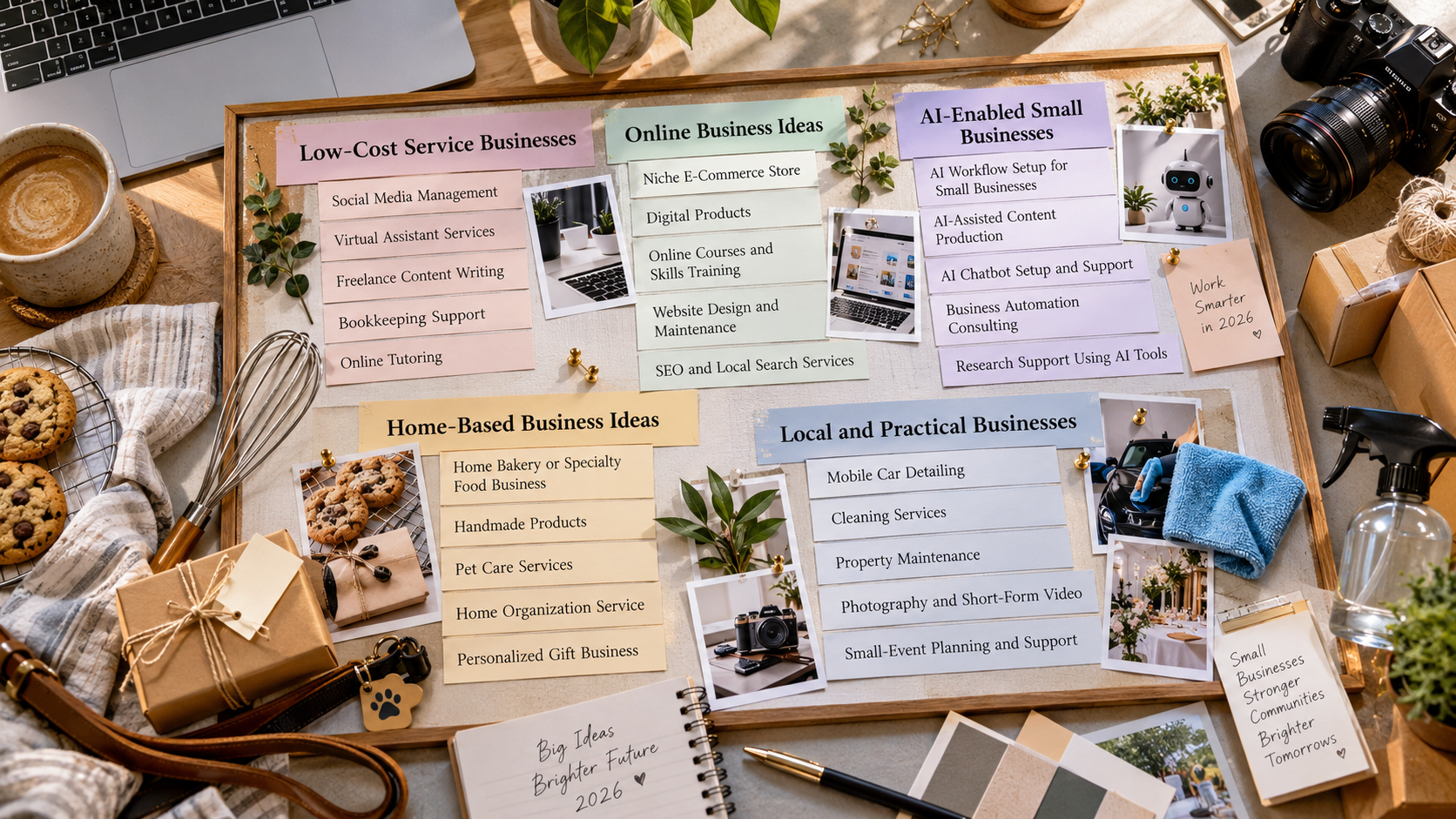
Low-Cost Service Businesses
1. Social Media Management
Best for: Marketers, writers and people who understand online communities
Many smaller companies have social accounts but no consistent plan for using them. A social media manager can take care of calendars, posts, community replies and basic performance reporting. It is easy to start with one or two clients, especially in a niche you understand. The harder part is showing that your work contributes to something beyond likes and impressions.
Startup level: Low
Business model: Online / Hybrid
2. Virtual Assistant Services
Best for: Organised people who are comfortable with admin and client communication
A virtual assistant may handle scheduling, inboxes, research, data entry, travel arrangements or routine customer follow-up. You can begin with a laptop, a reliable internet connection and a clearly defined service. Where people get into trouble is taking on every task a client sends them. A narrower offer makes both pricing and workload easier to control.
Startup level: Low
Business model: Online / Home-based
3. Freelance Content Writing
Best for: Strong writers with knowledge of a particular industry
Companies still need useful material for websites, newsletters, case studies, product pages and sales campaigns. Generic writing is crowded, so subject knowledge matters more than it once did. Someone who understands finance, construction, technology or healthcare, for example, has a clearer position than somebody who simply offers “content writing.” Expect to spend time finding clients as well as writing.
Startup level: Low
Business model: Online
4. Bookkeeping Support
Best for: Detail-oriented people with bookkeeping or accounting experience
Bookkeeping solves a routine problem that business owners rarely want to ignore for long. Work can include transaction records, invoices, reconciliations and preparing organised information for an accountant. Because the need repeats, good clients may stay for years. If your work extends into tax preparation, financial advice or regulated services, check the rules that apply where you operate.
Startup level: Low to Moderate
Business model: Online / Hybrid
5. Online Tutoring
Best for: Teachers, graduates and people with a skill they can explain clearly
Tutoring can cover school subjects, languages, professional exams, software or workplace skills. One-to-one lessons are a simple way to begin because you don't need to build a complete course first. Reputation is important, though. Students and parents are buying confidence as much as information, so qualifications, references and clear results can make a real difference.
Startup level: Low
Business model: Online
Online Business Ideas
6. Niche E-Commerce Store
Best for: People who understand a specific audience or product category
“Start an online shop” is too broad to be useful advice. A better approach is choosing a narrow customer group whose buying habits you understand. You might focus on a hobby, profession, household need or specialist product category. Keep the first range small. Inventory, returns, shipping and customer acquisition can turn an attractive idea into an expensive experiment surprisingly quickly.
Startup level: Moderate
Business model: Online
7. Digital Products
Best for: Designers, consultants, educators and professionals with useful knowledge
A good spreadsheet, template, planner, workbook or specialist guide can save somebody hours. That is the real appeal of digital products, not simply the absence of shipping costs. The barrier to entry is low, which also means there is plenty of mediocre competition. Products that solve a narrow, irritating problem usually have a better story than another generic downloadable bundle.
Startup level: Low
Business model: Online
8. Online Courses and Skills Training
Best for: People with genuine expertise and the ability to teach it
Before recording thirty lessons, try teaching the subject live.
A paid workshop or small group gives you immediate feedback on what people actually want to learn. It also exposes the questions that a recorded course needs to answer. Courses can scale, but they aren't automatically easy to sell. Trust, a clear outcome and access to the right audience matter more than polished video.
Startup level: Low to Moderate
Business model: Online
9. Website Design and Maintenance
Best for: Developers, designers and technically confident freelancers
Building websites remains useful work, but the opportunity has shifted. Basic templates are widely available, so clients often need help with the things templates don't solve: structure, performance, maintenance, landing pages, integrations and ongoing updates. Monthly support can be more valuable than chasing one-off builds. The market is competitive, which makes a clear industry focus particularly useful.
Startup level: Low
Business model: Online / Hybrid
10. SEO and Local Search Services
Best for: Marketers who enjoy research, content and analytics
A local plumber, solicitor, dentist or restaurant doesn't need traffic from everybody. It needs visibility among people who may actually become customers.
That creates work around website structure, local pages, business profiles, content and reporting. SEO isn't a sensible service to sell with guaranteed rankings. Search results depend on competition, site quality and factors outside any consultant's control.
Startup level: Low
Business model: Online / Local
AI-Enabled Small Businesses
11. AI Workflow Setup for Small Businesses
Best for: People who understand business processes as well as AI tools
Many companies have tried AI without deciding what it should actually do for them. That gap is a business opportunity.
You could help a team map repetitive tasks, choose suitable tools and build straightforward workflows for research, document handling or customer enquiries. The work is less about clever prompts and more about reliable processes. Confidential data and privacy policies need to be considered from the start.
Startup level: Low
Business model: Online / Hybrid
12. AI-Assisted Content Production
Best for: Editors, marketers and content professionals
There is a big difference between generating text and producing material a business is comfortable publishing.
An AI-assisted content service can combine research, drafting, editing, fact-checking and brand consistency. Clients are paying for judgment and the finished result, not access to the software. The weak version of this business is selling lightly edited machine output. That is easy for competitors to reproduce.
Startup level: Low
Business model: Online
13. AI Chatbot Setup and Support
Best for: Technical freelancers and customer-service specialists
Small companies may want chatbots for FAQs, lead capture or internal knowledge without having anyone on staff who wants to configure them.
A service could cover setup, knowledge preparation, testing and maintenance. There is an obvious catch: a chatbot that confidently gives customers the wrong answer is worse than no chatbot at all. Human escalation and regular review should be built into the project.
Startup level: Low to Moderate
Business model: Online / Hybrid
14. Business Automation Consulting
Best for: People who notice inefficient processes and enjoy fixing them
Look inside almost any office and you'll find someone copying information from one system into another.
Automation consulting turns those repeated steps into workflows. A simple form-to-CRM or enquiry-routing project can be enough for a first engagement. Resist the temptation to automate everything. If the underlying process is confusing, making it run faster won't make it better.
Startup level: Low
Business model: Online / Hybrid
15. Research Support Using AI Tools
Best for: Researchers, analysts and experienced fact-checkers
Companies need competitor briefs, source summaries, market scans and background research, often without needing a full-time analyst.
Modern AI tools can speed up document review and information gathering, but somebody still has to judge the quality of a source and spot a shaky conclusion. That human layer is the service. This is particularly suited to people who already know how to research before they introduce AI into the workflow.
Startup level: Low
Business model: Online
Home-Based Business Ideas
16. Home Bakery or Specialty Food Business
Best for: Skilled bakers and cooks with a product people already ask for
A home food business can begin much smaller than a café or restaurant. Limited menus, pre-orders and local collection make it possible to see what sells before expanding.
Food isn't a casual category, though. Rules around registration, hygiene, allergens and premises vary. In the UK, for example, official guidance specifically covers food businesses operated from home.
Startup level: Moderate
Business model: Home-based / Local
17. Handmade Products
Best for: Makers whose work has a recognisable style
Jewellery, candles, ceramics, prints, textiles and other handmade goods can be tested in small batches rather than produced at scale from day one.
One common mistake is pricing only the materials. Time, packaging, selling fees and the occasional failed item are part of the real cost too. A focused range is much easier to manage than twenty products launched at once.
Startup level: Low to Moderate
Business model: Home-based / Online
18. Pet Care Services
Best for: Dependable people who are confident around animals
Dog walking and pet sitting are simple businesses to understand, and that simplicity is part of their appeal. Owners need somebody they trust when work, travel or health gets in the way.
Start within a manageable area rather than spending half the day driving between appointments. Insurance, emergency procedures and any local licensing requirements are worth sorting out before accepting clients.
Startup level: Low
Business model: Local / Home-based
19. Home Organisation Service
Best for: Practical people who enjoy bringing order to messy spaces
Some customers aren't looking for interior design. They want to open a cupboard without everything falling out.
Home organisers help people declutter, rethink storage and put everyday systems in place. It is an unusually personal service, so tact matters. Nobody wants to pay someone to arrive at their home and make them feel embarrassed about it.
Startup level: Low
Business model: Local
20. Personalised Gift Business
Best for: Creative people who enjoy custom design and production
Names, dates, messages and custom artwork can turn ordinary products into gifts for weddings, birthdays, company events and holidays.
The sensible way in is a limited product range. Buying machinery for every possible item before you know what customers want ties up money unnecessarily. Personalisation also raises the cost of mistakes because an incorrectly customised product may be impossible to resell.
Startup level: Low to Moderate
Business model: Home-based / Online
Local and Practical Businesses
21. Mobile Car Detailing
Best for: Hands-on entrepreneurs who prefer practical work
Customers like services that come to them, particularly when the alternative is giving up part of a weekend.
Mobile detailing can begin with a small number of clearly priced packages and a limited travel area. Equipment isn't the only consideration. Weather, journey time and local rules around water use can all affect how many jobs you can complete profitably in a day.
Startup level: Moderate
Business model: Local
22. Cleaning Services
Best for: Reliable operators looking for repeat local work
Cleaning doesn't need a fashionable pitch. Customers know exactly why they need it.
Residential work can begin with a few regular households, while commercial cleaning may involve offices, shops or other small premises. Repeat bookings can make scheduling more predictable. Growth brings a different challenge: maintaining the same standard once other people are doing the work under your name.
Startup level: Low to Moderate
Business model: Local
23. Property Maintenance
Best for: People with practical repair and maintenance skills
Loose handles, damaged fixtures, seasonal maintenance and small repairs rarely justify a major contractor, but they still need doing.
That leaves room for a dependable property-maintenance service. Be very clear about the jobs you are qualified to take on. Electrical, gas, structural and other specialist work may require licences or qualified tradespeople depending on the location.
Startup level: Moderate
Business model: Local
24. Photography and Short-Form Video
Best for: Photographers, videographers and visual storytellers
Businesses are publishing more visual material across websites, social platforms, property listings and advertising. Many don't need a film crew; they need someone who can turn up, understand the brief and deliver usable content quickly.
Choosing a niche helps. Restaurant photography, property video and corporate interviews require different skills. Creative direction matters as much as the camera.
Startup level: Moderate
Business model: Local / Hybrid
25. Small-Event Planning and Support
Best for: Organised people who don't panic when plans change
Small corporate gatherings, family celebrations and community events still involve suppliers, schedules, setup and dozens of small decisions.
You can start by handling one type of event rather than offering everything from birthdays to conferences. Clear agreements matter here. Deposits, cancellation terms, supplier responsibilities and appropriate insurance are far easier to discuss before the event than during a problem.
Startup level: Low to Moderate
Business model: Local / Hybrid
Best Low-Cost Small Business Ideas
When the budget is tight, a service business is often the most forgiving place to start.
You are selling skill and time instead of buying a large quantity of stock. Virtual assistance, tutoring, freelance writing, social media management, SEO and research support all fit that pattern.
The cost may be lower, but there is still work to do. Early-stage service businesses usually have a sales problem before they have an operations problem. Finding the first few customers is the real test.
Best Online Business Ideas
Running a business online removes some geographic limits. It doesn't remove competition.
Website services, specialist training, digital products, content work and automation consulting can all be delivered remotely. That makes them accessible, but it also means prospective customers can compare providers from far beyond their own city.
A specific audience usually helps. “Websites for independent restaurants” is easier to understand than “digital solutions for everyone.”
Best Small Business Ideas to Start From Home
Virtual assistance, tutoring, digital products, handmade goods and selected food businesses are all realistic home-based models.
Home, however, doesn't mean regulation-free.
Requirements can depend on your business activity and where you live. U.S. guidance notes that licensing and permit requirements vary by activity and location, while Canadian businesses may need permits across federal, provincial or territorial, and municipal levels.
Check the rules that apply before opening for business.
How to Choose the Right Business Idea
Forget the question, “Which business makes the most money?”
A more useful question is, “Which problem am I in a good position to solve?”
Look at your existing experience first. Then look outward. Who has that problem? How are they dealing with it now? Are they already spending money to fix it?
Consider how much time the business needs, what it costs to deliver and how difficult customers will be to reach. Some models produce repeat business; others require a constant supply of new buyers.
And don't overlook selling. A technically excellent founder who refuses to market the business has a problem that no business plan can solve.
How to Test a Business Idea Before Investing Too Much
Try to make the first sale earlier than feels comfortable.
Talk to potential customers. Put together a straightforward offer. A basic page explaining what you do may be enough at first.
Then ask for the business.
You don't need a complicated CRM, five automation platforms and a perfectly animated logo to find out whether someone will pay you.
If people buy, listen carefully to what they ask for next. If they don't, changing a small offer is much cheaper than changing a fully built company.
Final Thoughts
The idea that looks most exciting on social media isn't automatically the best business to start.
A quieter opportunity can be far more useful if customers already have the problem, you know how to solve it and you can reach them without spending money you can't afford to lose.
That is the thread running through the best small business ideas in 2026: sensible demand, a workable starting point and room to improve once real customers are involved.
Start narrow. Sell something useful. Pay attention to the response.
You can build the rest from there.
Frequently Asked Questions
What are the best small business ideas in 2026?
There isn't one winner for everybody. Skills-based services, specialist online businesses, practical local services and selected AI-related services are worth considering when they match genuine demand and your own experience.
What business can I start with little money?
Virtual assistance, writing, tutoring, social media management and certain consulting services can usually be tested without heavy spending on premises or inventory.
What small business can I start from home?
Online services, digital products, tutoring, handmade products and some food businesses can operate from home. Rules around insurance, permits, food safety or residential business use vary by location.
What online business is easiest to start?
A service based on a skill you already possess is often simpler to launch than an inventory-based company. The difficult part is still finding customers willing to pay.
How do I know if a business idea will work?
Try to sell a basic version before making a major investment. Conversations are useful, but an actual purchase or serious sales enquiry is much stronger evidence of demand.
Reader Reaction
Was this article useful?
0 readers like this article.
Share This Article
Found this story useful? Share it with your network.
Comments
0 discussionsAdd your perspective, reply to other readers, and keep the conversation useful.
Conversation
Reader responses