
How NFL Players Train for Strength, Speed and Endurance
Discover how NFL players train for strength, speed and endurance through position-specific lifting, sprint work, conditioning, agility and recovery.
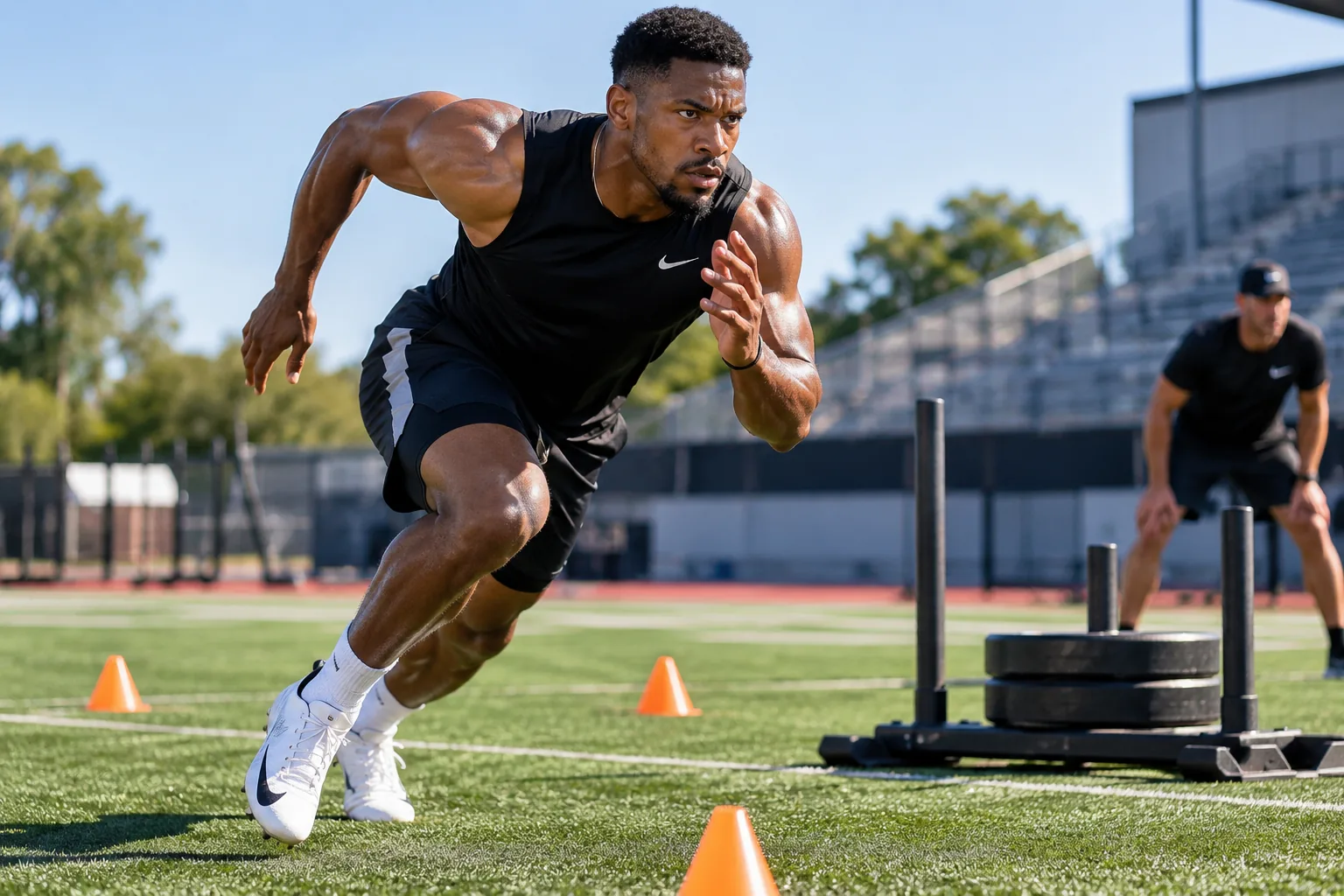
What happens in an NFL weight room is only one part of preparing a player for Sunday.
Football asks athletes to produce enormous force, accelerate in a few steps, absorb contact, stop abruptly, change direction and then do it again after a short recovery. A receiver may sprint downfield before cutting at speed. A lineman may have to generate force almost immediately from his stance. A linebacker can move forward, laterally and backward during the same sequence.
That is why there is no single “NFL workout.”
Understanding how NFL players train means looking at the entire performance system: resistance training, explosive power, sprinting, deceleration, agility, conditioning, position work, mobility and recovery. The balance changes according to the player's position, physical characteristics, injury history, time of year and coaching program.
A 315-pound offensive lineman and a 190-pound wide receiver are playing the same sport, but they are solving very different physical problems.
Quick Answer: How Do NFL Players Train?
NFL players generally combine resistance training, explosive power exercises, sprint work, change-of-direction and agility training, conditioning, football practice, mobility and recovery. The exact mix varies substantially by position, season phase and individual needs. Training is designed to make strength and speed useful on the field rather than simply producing impressive gym numbers.
What NFL Training Is Actually Designed to Do
A bodybuilding program can be successful if it builds muscle. A general fitness workout might aim to improve health, cardiovascular fitness or overall strength.
Football performance training has a different target.
The player needs to produce the right amount of force, in the right direction, at the right time, while performing a football task. That requires several physical qualities to work together.
A player can therefore be extremely strong in a weight room without being exceptionally powerful, fast or skilled.
Football strength and conditioning attempts to connect those qualities instead of treating them as unrelated goals.
Why NFL Players Do Not All Train the Same Way
Position is one of the biggest reasons an NFL player workout cannot be reduced to a universal template. Even players at the same position may train differently because of body type, experience, previous injuries, strengths, weaknesses and team philosophy.
Quarterbacks
Quarterbacks need enough total-body strength to tolerate contact and maintain sound mechanics, but maximal lifting numbers are rarely the entire point.
Their job places a premium on footwork, coordination, rotational force production, throwing mechanics, movement inside and outside the pocket and the ability to repeat technically precise actions while fatigued.
Strength work can support the lower body, trunk and shoulder complex, while movement training often emphasizes efficient footwork and controlled changes of direction. Conditioning must support repeated plays without unnecessarily compromising throwing quality.
Running Backs
Running backs operate in crowded spaces where acceleration, balance and rapid changes of direction matter.
They may need to explode through a small opening, decelerate, redirect, absorb contact and accelerate again within seconds.
Lower-body strength, unilateral strength, explosive power and short-distance acceleration therefore have obvious relevance. Their conditioning also has to support repeated high-intensity efforts rather than simply producing a good long-distance running time.
Wide Receivers
Wide receivers depend heavily on acceleration, route mechanics, high-speed running, deceleration and reacceleration.
A receiver may need to build speed vertically, brake into a route, change direction without wasting steps and accelerate away from a defender. Strength remains useful, particularly for force production, body control and handling contact, but adding strength cannot come at the expense of movement quality.
High-speed sprint exposure and sufficient recovery between quality sprint repetitions are particularly important considerations.
Tight Ends
Tight ends occupy a hybrid physical role.
They can be asked to block like a larger player and then run routes, catch passes and move through open space. Training therefore needs to accommodate substantial strength and power while retaining acceleration, mobility and movement ability.
The exact emphasis can differ considerably depending on how a team uses a particular tight end.
Offensive Linemen
Offensive linemen perform a different speed task from wide receivers.
They need rapid force production over short distances, strong initial steps, powerful hips and legs, upper-body strength, trunk control and the ability to repeatedly handle large external forces.
Absolute strength matters more here than it does for many lighter positions, but slow strength alone is not enough. Linemen still need to produce force quickly and move efficiently at a large body mass.
Defensive Linemen
Defensive linemen combine short-area explosiveness with considerable strength and power.
A defensive lineman may need to explode from the line, defeat a block, redirect toward the ball and pursue a play. Their programs can therefore blend heavy resistance work with explosive movements, acceleration and short-area change of direction.
Body composition, mobility and the ability to repeat explosive efforts also matter.
Linebackers
Linebackers need an unusual combination of size, strength and multidirectional speed.
Depending on the play, a linebacker might move laterally, drop into coverage, accelerate toward the ball carrier or engage a blocker. That makes acceleration, braking, lateral movement and reactive ability important alongside traditional strength and power.
Cornerbacks and Safeties
Defensive backs require exceptional movement capabilities.
They may accelerate forward, backpedal, open their hips, redirect and sprint at high speed while responding to another player's actions. Straight-line speed matters, but it is only part of the job.
High-speed mechanics, acceleration, deceleration, reactive agility and position-specific movement all deserve attention.
The broader lesson is simple:
football performance training follows the demands of the job.How NFL Players Build Strength
Strength gives a football player a larger physical foundation from which other qualities can develop.
NFL strength training commonly revolves around fundamental movement patterns rather than one mandatory list of exercises:
Squatting
Hip hinging
Pushing
Pulling
Single-leg movements
Loaded carries
Trunk stabilization and rotation control
Depending on the athlete and program, that can involve squat variations, trap-bar or conventional deadlift variations, split squats, presses, rows, pull-ups and loaded carries.
Compound exercises are useful because football rarely asks a player to produce force with one muscle operating in isolation. ACE's discussion of professional-football-inspired strength work similarly identifies compound and contrast methods among approaches used to develop strength and power.
The exercise itself, however, is only a tool.
A player who increases a squat while becoming slower, more fatigued or less capable of completing football practice has not necessarily improved his overall performance.
Progressive overload still matters. Training must gradually provide enough stimulus for adaptation. But coaches can manipulate load, repetitions, sets, exercise selection, movement velocity and total volume instead of simply adding weight indefinitely.
Range of motion and technique also need to fit the individual athlete. Limb proportions, mobility, training history and previous injuries can influence which variation is appropriate.
This is why two successful NFL players can have noticeably different strength programs.
Strength Is Not the Same as Power
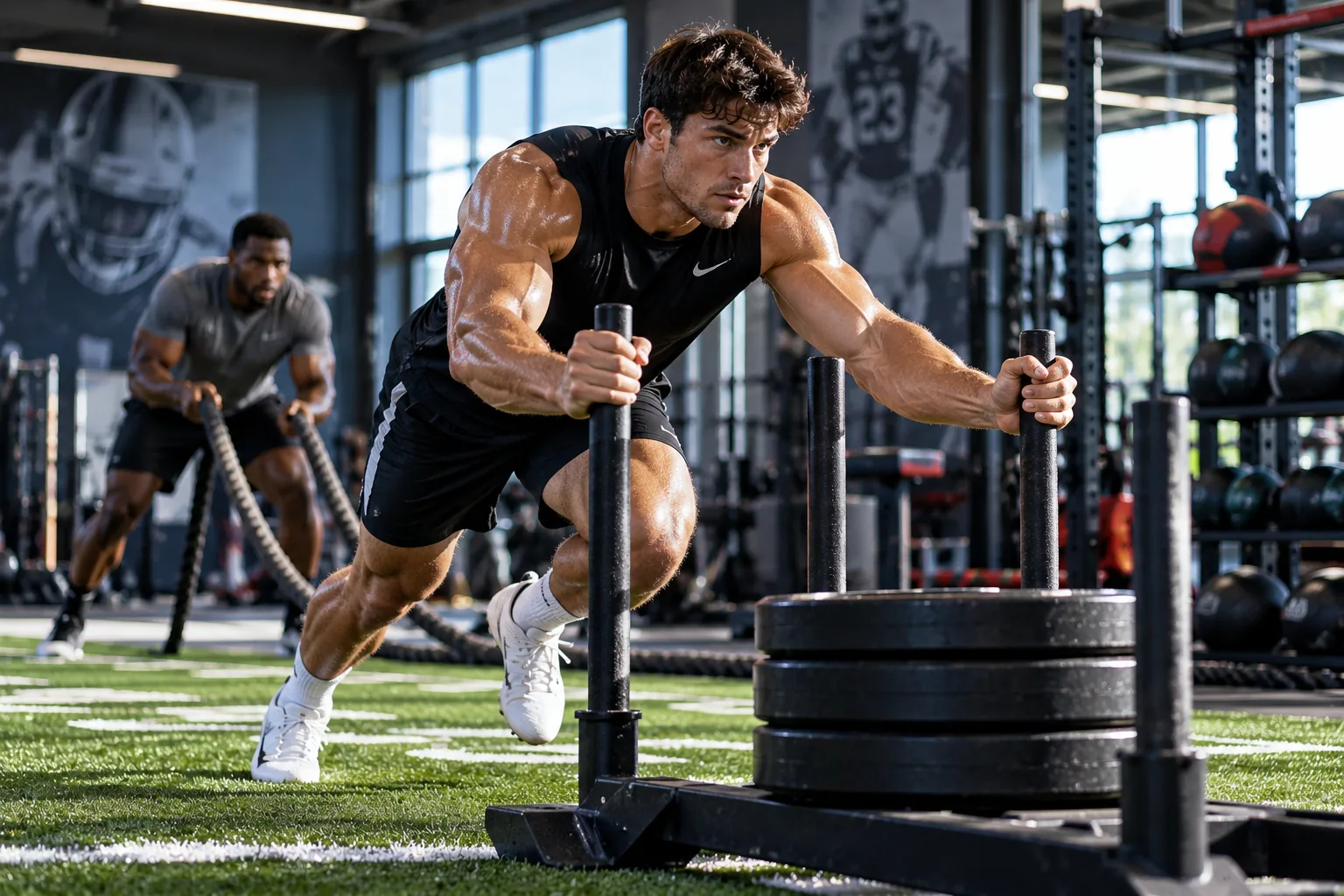
Strength is the ability to produce force.
Power describes how rapidly force can be produced.
That distinction is crucial in football because players frequently have very little time to apply force.
Imagine two athletes capable of producing similar peak force. If one can produce useful force much faster during the first steps of a sprint, jump or block, that difference can matter on the field.
Power training may include jumps, bounds, medicine-ball throws, appropriately loaded jumps and Olympic-lift derivatives under qualified coaching. Contrast training can also pair a strength movement with an explosive movement when programmed appropriately.
Plyometric exercises make use of the stretch-shortening cycle, in which a rapid eccentric action precedes an explosive concentric action. This is one reason jumps and bounds can be relevant to sports requiring explosive movement.
Quality matters more than exhaustion during dedicated power work.
If jump height is collapsing, landings are deteriorating and every repetition is becoming slower, the session has shifted away from high-quality explosive training. More fatigue does not automatically mean more power development.
How NFL Players Train for Speed
Football speed training is not simply “run as hard as possible until tired.”
Developing maximum speed requires high-quality repetitions, sound mechanics and enough recovery to allow an athlete to run fast.
Acceleration
Acceleration describes the process of increasing velocity.
In football, this often means the first several steps after a player begins moving. Athletes train acceleration through short sprints, starting variations and, where appropriate, resisted sprint work such as sled sprints.
The objective is to teach the athlete to apply force effectively while gaining speed.
Maximum-velocity work
Top-speed training exposes an athlete to faster running velocities after the acceleration phase.
The mechanics change as the athlete becomes more upright and approaches maximum velocity. Receivers and defensive backs can have particular reasons to develop this quality because their roles may require longer downfield sprints.
The NSCA identifies both acceleration and maximal velocity as important components of football sprint performance.
Rest matters
One of the easiest mistakes to make is turning speed training into conditioning.
Suppose an athlete runs a fast sprint and then repeats it before adequately recovering. The next repetition may be slower. Continue shortening the rest, and eventually the athlete is practicing sprinting while fatigued rather than producing maximum-quality speed.
That can be useful when conditioning is the objective.
It is not the same training stimulus as maximum-speed development.
Reaction matters too
Football is not track.
Players rarely sprint in a perfectly predictable environment. They respond to the snap, ball movement, routes, blocks, opponents and coaching assignments.
That means football speed eventually has to connect physical sprint ability with perception and decision-making.
NFL-Inspired Speed Session — Not an Actual NFL Team Program
For an experienced, healthy recreational athlete with an established sprinting background, a simplified session might look like this:
Dynamic warm-up and progressive running preparation.
Several short acceleration drills performed at controlled intensity.
Four to six high-quality sprints over approximately 10–20 yards with generous recovery.
A small number of longer sprint exposures if the athlete has appropriate experience.
A few planned change-of-direction repetitions.
Full recovery between demanding speed efforts.
The objective is crisp, technically sound movement. Stop or reduce the workload when sprint quality clearly deteriorates.
Acceleration vs. Top Speed
Acceleration and top speed are related, but they are not interchangeable.
A 10-yard burst asks a player to overcome inertia and gain velocity rapidly. A longer sprint gives the athlete enough distance to approach a higher speed.
Many football situations are decided during the first few steps. Linemen, linebackers and running backs frequently perform short accelerations in limited space.
Receivers and defensive backs may encounter longer runs where maximum velocity becomes more important.
The NFL Combine illustrates the distinction particularly well. The 40-yard dash evaluates the complete sprint, while split times provide additional information about how quickly a prospect covers earlier portions of the run.
As of 2026, the NFL's official Combine database continues to list Xavier Worthy's 4.21-second 40-yard dash from 2024 as the fastest official time in its database dating to 2003.
That is an extraordinary testing result, but an elite 40 time alone does not describe everything required to play receiver in the NFL.
Agility, Deceleration and Change of Direction
Straight-line speed gets attention because it is easy to understand.
Football movement is messier.
Players constantly need to reduce speed, reposition their bodies and accelerate in another direction. The ability to brake effectively is therefore a performance quality in its own right.
Change-of-direction training can use planned movements in which the athlete knows the route beforehand. These drills can develop foot placement, braking mechanics, body control and reacceleration.
Reactive agility adds another element: the athlete has to respond to information.
A coach pointing left or right, a partner moving unexpectedly or a football-specific visual cue changes the task because the athlete must perceive, decide and then move.
This distinction matters. Running quickly around a predetermined cone pattern can measure or train change-of-direction ability, but it does not automatically measure the complete perceptual component of agility.
How NFL Players Build Endurance and Conditioning
Football endurance should not be confused with marathon endurance.
A football game consists of repeated bouts of activity separated by periods of lower activity and recovery. Within a play, athletes can sprint, push, pull, collide, cut and accelerate at high intensity.
The conditioning challenge is therefore not simply “How long can you run?”
It is also “How well can you repeat demanding efforts while preserving performance?”
That requires contributions from both anaerobic and aerobic energy systems.
High-intensity actions depend heavily on anaerobic energy pathways. Aerobic fitness still matters because recovery takes place repeatedly across practices, drives and an entire game.
Research on repeated-sprint training in team-sport athletes supports its usefulness for repeated-sprint ability and other performance measures, although protocols and sporting demands differ.
Football conditioning can include intervals, tempo work, repeated efforts, position-specific drills and practice itself.
The correct dose depends on the player.
A defensive back covering large areas does not have exactly the same work-rest profile as an offensive lineman. Training camp also creates a very different total workload from early offseason preparation.
Good conditioning programming accounts for the football work an athlete is already doing rather than piling extra running on top of it without purpose.
NFL Conditioning vs. Running Long Distance
Do NFL players run long distances?
Some may use steady aerobic work at certain points in their preparation, and lower-intensity aerobic training can have value for general conditioning and recovery capacity.
That does not make long-distance running the centerpiece of football conditioning.
The sport repeatedly demands short, intense actions with recovery between them. Conditioning therefore tends to become more useful as it reflects the energy and movement demands relevant to the athlete's position and current training phase.
The mistake is taking either extreme.
Saying every player needs extensive distance running ignores football specificity. Saying football players should never perform aerobic work ignores the role aerobic fitness can play in recovery and work capacity.
Context determines the tool.
What the NFL Combine Can—and Cannot—Tell Us About Athleticism
The NFL Scouting Combine gives teams standardized physical information about draft prospects.
At the 2026 Combine, notable testing included the 40-yard dash, bench press, vertical jump, broad jump, three-cone drill, 20-yard shuttle and 60-yard shuttle, alongside position-specific work.
Each test examines a narrower quality.
40-yard dash:
evaluates sprint performance across 40 yards. Split data can provide additional information about acceleration.Vertical jump:
assesses vertical explosive ability.Broad jump:
evaluates horizontal lower-body explosiveness from a standing start.Three-cone drill:
challenges planned acceleration, directional changes and body control through a set course.20-yard shuttle:
tests rapid changes of direction over a short predetermined pattern.60-yard shuttle:
involves longer repeated directional efforts.Bench press:
tests repeated upper-body pressing performance under the Combine protocol.Combine preparation is highly specific because prospects are trying to perform well on standardized tests.
That is not the same thing as year-round NFL training.
A professional performance program has to prepare an athlete for football practices and games, manage training load and support the demands of a particular position. The Combine measures useful qualities, but no collection of testing numbers can fully reproduce what happens during an NFL play.
How Training Changes Through the NFL Year
NFL offseason training is not simply a longer version of in-season training.
Training priorities shift as competition approaches.
Early Offseason
After a demanding season, athletes may need recovery before rebuilding workload.
This period can provide an opportunity to address movement quality, restore or develop strength and work on individual physical needs.
Training volume can be easier to manage because weekly games are no longer competing with weight-room and field work.
Late Offseason
As football activities approach, training can become more specific.
Power, acceleration, speed, change of direction and football-specific conditioning may receive greater emphasis alongside continued strength work.
Skill work also becomes increasingly important.
Training Camp and Preseason
Football practice now becomes a major physical stressor.
Players are running routes, completing position drills, competing and accumulating far more football-specific work.
Weight-room programming therefore has to coexist with practice. Simply maintaining offseason lifting volume while dramatically increasing field workload could create unnecessary fatigue.
Regular Season
The priority shifts toward readiness for games.
Strength and power work may continue, but volume and timing have to account for games, practice, travel, soreness and individual recovery.
The goal is not to win the weight-room week. It is to arrive prepared to play football.
There is no single Monday-to-Sunday schedule that accurately represents every NFL team or player.
Recovery Is Training Too
Adaptation does not occur simply because an athlete worked hard.
The athlete also needs an opportunity to recover from that work.
Sleep is one of the foundations. Hydration and sufficient nutrition support training and recovery. Mobility work may help athletes maintain movement options relevant to their individual needs.
Professional environments also have athletic trainers, medical professionals and performance staff who can monitor health, rehabilitation and workload.
Soft-tissue techniques and other recovery tools may be used, but they should not distract from fundamentals.
A sophisticated recovery device cannot replace inadequate sleep, poor nutrition or badly managed training volume.
NFL athletes also face a challenge recreational lifters rarely experience: collisions. That makes medical support and workload decisions particularly important during the season.
What NFL Players Eat to Support Training
There is no single NFL diet.
Consider the range of body sizes and jobs across an NFL roster. A lineman maintaining a very large body mass has different energy requirements from a defensive back. Even two players at the same position can require different nutrition strategies.
The basic principles are more consistent than the exact menus.
Protein supplies amino acids needed for muscle protein remodeling and adaptation. Carbohydrates are an important fuel source for high-intensity exercise and demanding training. Dietary fats also serve essential physiological functions.
Hydration matters because athletes need to replace fluid lost through training and competition.
The quantities depend on body size, workload, goals, environment and individual needs. Professional athletes may work with sports dietitians or other qualified nutrition professionals to personalize those decisions.
That is more realistic than trying to copy a celebrity player's reported meal plan.
Sample 4-Day NFL-Inspired Training Week
This is an NFL-inspired framework for trained recreational adults. It is not an NFL team program and should not be interpreted as professional-level training volume.
The important part is the organization.
Speed is performed while the athlete is relatively fresh. Strength has a clear purpose. Conditioning is not allowed to ruin every other training quality, and recovery is deliberately included.
An experienced coach would adjust the volume to the athlete rather than forcing every person through the same prescription.
Beginner NFL-Inspired Training Plan
Someone with ordinary gym experience should not jump directly into advanced NFL-style training.
A simpler three-day structure is more appropriate.
Day 1: Foundational strength
Practice squat, hinge, push and pull patterns with manageable resistance. Add basic trunk work and finish with easy aerobic conditioning.
Day 2: Movement and introductory power
After a thorough warm-up, use low-volume basic jumping or landing practice and a few controlled short accelerations. The emphasis should be technique, not maximal effort.
Day 3: Full-body strength and conditioning
Use another manageable full-body resistance session followed by short, controlled intervals appropriate to current fitness.
Leave recovery days between demanding sessions.
Beginners should build the ability to sprint, jump and lift safely before chasing professional-level intensity.
How to Measure Progress
Training feels more purposeful when progress can be measured.
For strength, recreational athletes can track consistent submaximal lifts performed with good technique rather than frequently testing one-repetition maximums.
A 10-yard sprint can provide a simple acceleration measure. Experienced athletes with suitable facilities can track 20- or 40-yard sprint performance.
A standing broad jump provides an accessible indicator of horizontal explosive ability.
Conditioning can be tracked through a standardized shuttle or interval test that can be repeated under similar conditions.
Recovery is less tidy but still worth monitoring. Persistent soreness, declining training performance, unusual fatigue and subjective readiness can provide useful context.
Testing conditions should remain consistent. Use the same surface, distance, timing method, warm-up and similar environmental conditions whenever possible.
A hand-timed sprint on grass should not be compared too confidently with an electronically timed sprint on another surface.
Common Mistakes When Trying to Train Like an NFL Player
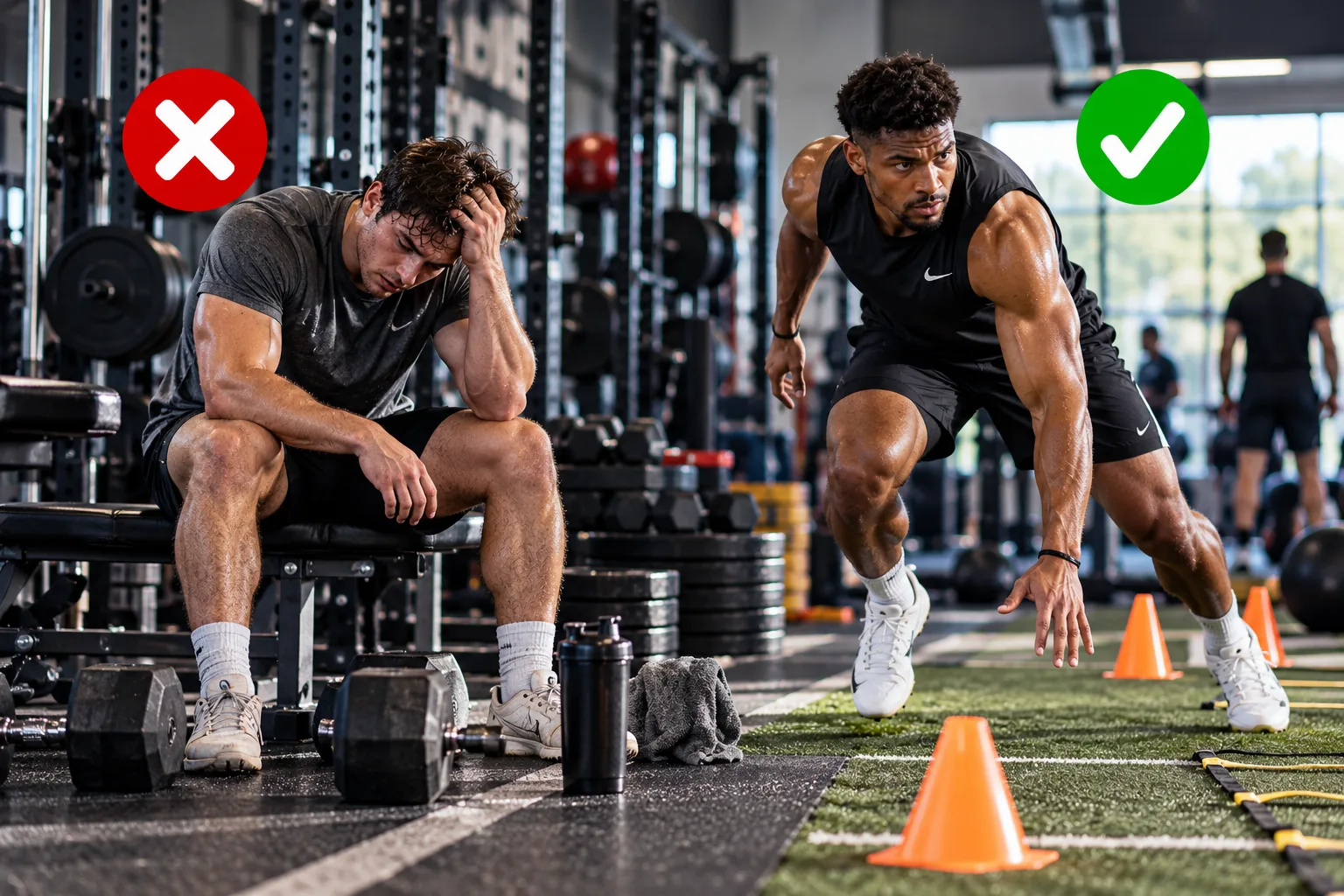
1. Copying a professional player's exact program.
The program was designed around that player's body, position, schedule and training history. Copy the principle, not the workload.
2. Training at maximum intensity every session.
High-intensity work requires recovery. Constant maximal effort can reduce the quality of later training.
3. Confusing conditioning with speed training.
Short rest periods create fatigue. Maximum-speed development generally needs enough recovery to preserve sprint quality.
4. Ignoring position and individual goals.
A receiver and lineman should not prioritize every physical quality identically.
5. Adding advanced plyometrics too soon.
Explosive exercises place meaningful demands on the body. Build landing skill, strength and tolerance first.
6. Neglecting recovery.
More training is useful only while the athlete can adapt to it.
7. Chasing soreness instead of progress.
Soreness is not a performance metric. Better movement, strength, sprint times and repeatability are more informative.
8. Following random social-media workouts.
A collection of difficult exercises is not a training program. Effective programs manage progression and workload over time.
9. Ignoring technique.
Loading a poor movement or sprinting carelessly at high intensity does not make the exercise more athletic.
10. Trying to improve everything simultaneously.
Training resources are finite. Programs usually work better when priorities are clear and change over time.
Can a Regular Person Train Like an NFL Player?
Yes, if “train like” means borrowing principles rather than copying workload.
A recreational athlete can use compound resistance exercises, short quality sprints, appropriate explosive movements, change-of-direction work and structured conditioning. Progressive overload and deliberate recovery are equally transferable.
Professional volume is not.
NFL players have years of sport-specific development and access to coaches, athletic trainers, medical staff, facilities and recovery resources. Their bodies are also being prepared for professional football.
Collision drills, highly advanced plyometrics, extreme workloads and individualized return-to-play programs should not be copied from a video or workout sheet.
The smartest NFL-inspired workout is one scaled to the athlete actually performing it.
When to Work With a Qualified Coach
Coaching becomes particularly valuable as training gets faster, heavier or more technically demanding.
A qualified strength and conditioning professional can help with lifting technique, sprint progression, plyometric selection and overall program design.
Athletes returning from pain or injury should work with appropriate medical and rehabilitation professionals rather than treating a generic football workout as rehabilitation.
Sprinting deserves respect as well. Maximum-speed running places substantial demands on the body, particularly if someone has not sprinted regularly for years.
Build toward it.
Final Takeaway
NFL players are not elite because they discovered one magical workout.
Their preparation works because multiple qualities are coordinated around the demands of football. Strength provides a foundation. Power helps athletes express force rapidly. Sprint training develops acceleration and speed. Deceleration and agility prepare them to control and redirect that speed. Conditioning supports repeated effort, while practice converts physical qualities into football performance.
Then recovery allows the process to continue.
The exact balance changes with position, individual needs and time of year. That is why a lineman's preparation should not look identical to a cornerback's, and why an offseason program should not simply continue unchanged during the regular season.
For recreational athletes, that is the most useful lesson from how NFL players train:
train with structure and purpose, not with professional-level volume.Frequently Asked Questions
How do NFL players train?
NFL players generally combine strength training, explosive power work, sprinting, deceleration and change-of-direction training, conditioning, football practice, mobility and recovery. The exact program varies by position, team, season phase and individual needs. A receiver may emphasize high-speed running more than a lineman, while a lineman may devote more attention to absolute strength and short-area force production.
How many days a week do NFL players work out?
There is no universal number. It varies by season phase, team schedule, position and individual program. During the offseason, players may have more opportunities for dedicated weight-room and field sessions. During training camp and the regular season, football practices and games become major parts of the workload, so strength and conditioning volume has to be adjusted accordingly.
Do NFL players lift weights every day?
Not necessarily. Resistance training is important, but lifting frequency varies. Training every day would not automatically produce better results because players also need sprint work, practice, skill development and recovery. During the regular season, weight-room volume may be managed carefully around practices and games.
How do NFL players train for speed?
Football speed training can include acceleration work, short sprints, maximum-velocity exposures, resisted sprinting where appropriate, technique work and football-specific reactive movement. High-quality speed sessions generally provide enough recovery for athletes to sprint fast. Repeated short-rest sprints serve a different purpose and move training toward conditioning.
How do NFL players build endurance?
Football players need the capacity to repeat high-intensity actions and recover between them. Conditioning may therefore combine aerobic development, intervals, repeated-effort work, tempo sessions, position-specific conditioning and football practice. The correct approach depends on position, season phase and the amount of football work already being performed.
What exercises do NFL players do?
Programs vary, but football strength and conditioning can include squats, deadlift variations, split squats, presses, rows, pull-ups, carries, jumps, medicine-ball throws and sprint work. Exercise selection is individualized. There is no official list of exercises every NFL player performs.
Do NFL players run long distance?
Some players may use steady aerobic work, particularly when developing general conditioning or recovery capacity, but football conditioning is not simply long-distance running. The sport relies heavily on repeated bursts of high-intensity activity. Conditioning programs therefore often include intervals, tempo work, repeated efforts and position-specific drills.
How do wide receivers train differently from linemen?
Wide receivers generally place greater emphasis on acceleration, high-speed running, route movement, deceleration and reacceleration. Linemen require considerably more absolute strength and short-area force production because of blocking and contact demands. Both groups need strength, power and conditioning, but the relative importance and training dose differ.
Can beginners do NFL-style workouts?
Beginners can adapt the principles but should not copy NFL intensity or volume. Start with fundamental strength movements, basic landing and jumping skills, controlled short sprints and manageable conditioning. Progress gradually. Advanced plyometrics, maximal sprinting and heavy lifting are better introduced after an appropriate foundation has been established.
How long are NFL workouts?
There is no single standard duration. Session length depends on the player, team, training phase and purpose of the day. A speed session, strength session, practice and recovery day can all have different structures. Duration alone also says little about training quality. A shorter, focused session can be more appropriate than adding unnecessary volume.
Reader Reaction
Was this article useful?
1 reader likes this article.
Share This Article
Found this story useful? Share it with your network.
Comments
0 discussionsAdd your perspective, reply to other readers, and keep the conversation useful.
Conversation
Reader responses