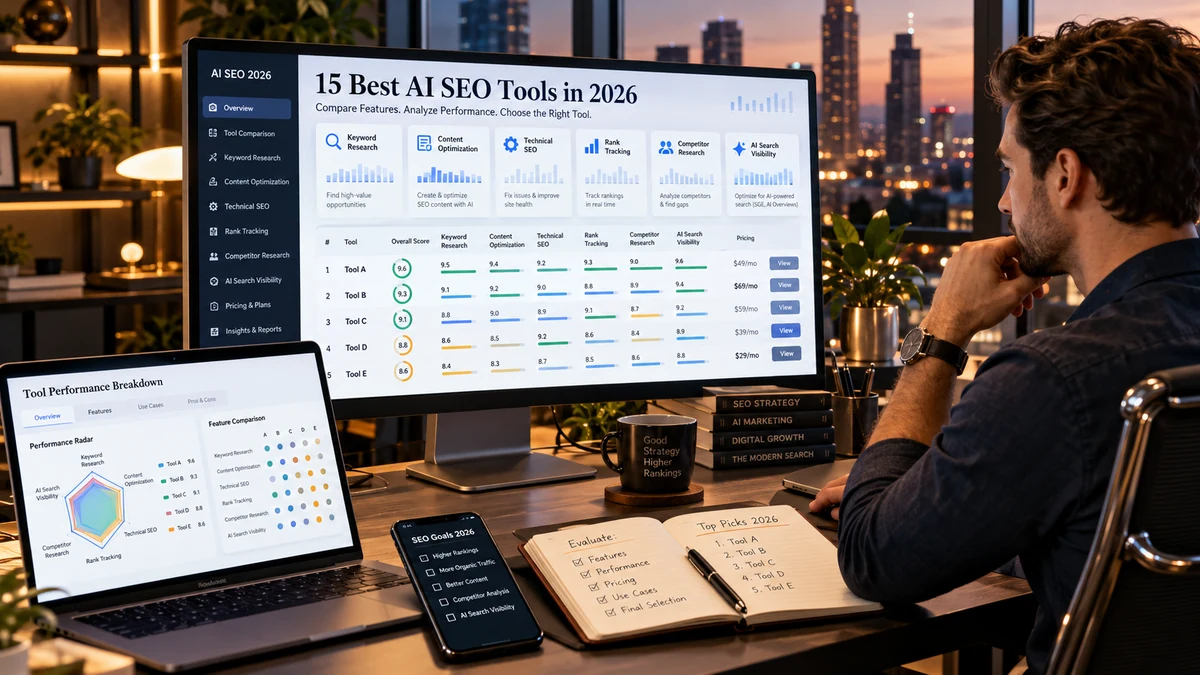
15 Best AI SEO Tools in 2026 for Rankings, Content and Search Visibility
AI SEO tools now cover very different jobs, from keyword research and content optimization to technical automation and tracking brand visibility in ChatGPT, Gemini and Google AI. This guide compares 15 useful options, what each does well, where it falls short and which type of SEO team it suits.

Choosing an AI SEO tool has gotten harder, mostly because the label no longer tells you what the software actually does.
Semrush and Ahrefs are research platforms.
Surfer and Clearscope live closer to the writing desk.
Alli AI and Search Atlas lean toward automation.
And then you have OtterlyAI and Profound, whose whole job is checking whether your brand shows up inside AI-generated answers.
Lumping all of them into one ranking without explaining that gap doesn't help anyone.
So this guide compares 15 active AI SEO tools by the work they're built for, how they price their plans, where they fall short, or how much AI search visibility is part of the product.
The goal isn't to crown one tool that does everything. It's to figure out which part of your SEO process actually needs better software.
What Is an AI SEO Tool?
AI SEO tool uses machine learning or generative AI somewhere in the SEO workflow. That's a very wide definition, which is why two products with the same label can have almost nothing in common.
In 2026, most of them fall into four loose groups:
Traditional SEO platforms with AI features:
Content optimization platforms:
SEO automation tools:
AI search visibility platforms:
This split matters. You wouldn't judge Ahrefs as a prompt tracker, and you shouldn't expect OtterlyAI to replace a backlink database.
That said, the groups are starting to blur. Several platforms now cover classic rankings and AI visibility in a single subscription.
AI SEO Tools at a Glance
Pricing for newer AI visibility products changes often. The figures above reflect official product information available in October 2026, so double-check them before you buy.
15 Best AI SEO Tools in 2026
1. Semrush.
If you want classic SEO and AI search measurement under one roof, Semrush is the most natural fit right now.
The core side still handles keyword research, competitor analysis, Position Tracking or Site Audit. Its newer AI visibility tools track brand mentions and prompts across ChatGPT, Gemini, Perplexity and Google's AI experiences. There's also an AI-focused site audit that flags issues affecting AI crawler access.
That breadth is the real selling point. An agency can go from keyword research to technical audits, ranking data and AI visibility without stitching together dashboards from four unrelated products.
The catch is price. The basic SEO plan costs $139 per month on monthly billing, and the broader SEO + AI Search packages go up from there. The standalone AI Visibility offering is $99 per month per domain on annual billing, with a fixed prompt allowance.
Best for: agencies that provide a specific service or act on behalf of another person or group, established marketing teams and businesses that want one big search platform.
If you only need content briefs or the occasional keyword check, you'll likely pay for far more than you use.
2. Ahrefs
People still buy Ahrefs for one reason: research.
Its strength is how well keywords, competitors, backlinks, content opportunities, site audits or rank tracking connect to each other. AI has been added around that foundation instead of replacing it.
Brand Radar is how Ahrefs steps into AI search. It analyzes brand mentions and citations across ChatGPT, Gemini, Perplexity, Copilot, Google AI Overviews and AI Mode. Paid plans also include some custom prompt tracking, and bigger prompt packages are sold separately.
Pricing starts with a $29 Starter plan, then Lite at $129 per month. Full Brand Radar access begins separately at $199 per month, and you can expand custom prompt tracking without buying the whole Brand Radar dataset.
Ahrefs shines when your question starts with "why is this competitor outranking us?" rather than "how do I generate an article?"
For serious competitor, keyword and backlink work, it's still one of the strongest options here.
3. SE Ranking
SE Ranking sits in a very useful middle spot.
It covers what many agencies actually open every week: rank tracking, keyword and competitor research, backlink analysis, site audits, reporting and content tools. AI search is folded into that workflow instead of being treated like a separate discipline.
Its AI tracking covers ChatGPT, Gemini, Perplexity, Google AI Overviews and AI Mode, and reports on mentions, links, competitors and prompt-level visibility.
Core is $129 per month on monthly billing, and Growth is $279. Annual billing brings the effective monthly rate down, and new accounts get a 14-day trial. Core currently includes 100 daily GEO prompts, while Growth goes up to 250.
For agencies that want solid everyday SEO software without jumping straight to enterprise pricing, that's an appealing setup.
Just watch the limits. Projects, keywords, prompts, API use and seats all change by tier, so compare your real workload, not the headline price.
4. Surfer
Surfer is built much closer to content production.
Its Content Editor analyzes competing pages and gives writers a framework of topics and terms to cover while drafting or updating. It works well for teams where the bottleneck is publishing consistent, search-focused content, not hunting for backlinks or auditing a million URLs.
Surfer has also moved into AI search tracking. Its standalone AI Search Analytics product monitors ChatGPT, Perplexity, Gemini, Google AI Mode and AI Overviews, with visibility, mention-gap and sentiment reporting.
The main platform starts at $49 per month on annual billing, and Standard is $99. The standalone AI tracker starts at $95 on monthly billing, or $82 per month billed yearly, for 50 tracked prompts. There's a seven-day trial.
Surfer is not trying to be Ahrefs. That is fine.
Pick it when content optimization sits at the center of your process, and keep a separate research platform if backlink analysis and deep technical digging matter just as much.
5. Clearscope
Clearscope has long been a favorite of editorial teams who want guidance without turning the writing screen into an SEO control room.
That positioning still holds up.
It covers topic exploration, drafts, content inventory and optimization, and it has now added AI search visibility too. Current plans include query tracking across ChatGPT and Gemini, brand visibility monitoring and analysis of query fan-out behavior.
Essentials is $129 per month and includes 20 monthly drafts, 20 Topic Explorations, 50 tracked queries and 50 pages. Business jumps to $399. Both plans include unlimited users and projects, which can matter more than the entry price if you run a big editorial team.
If you only publish a handful of pages and want cheap on-page scoring, Clearscope will feel like overkill.
But for editors juggling several writers, the restrained workflow is exactly the point. It supports the content process instead of trying to take it over.
6. Frase
Frase has outgrown its early reputation as a brief generator.
Today it connects research, drafting, optimization, publishing, page monitoring and AI visibility. Starter tracks ChatGPT and Google AI visibility. Professional widens that, adds crawler monitoring and brings in Perplexity, and higher plans extend engine coverage further.
Starter costs $49 month to month or $39 per month billed annually. Professional is $129 monthly and Scale is $299. You can start a seven-day trial without a credit card.
It suits smaller content teams that want fewer handoffs between research, writing and publishing.
The tradeoff is depth. A tool that covers the whole content cycle won't match Ahrefs on backlink data or a dedicated technical crawler on site analysis. For content-led businesses, though, that's often a fair deal.
7. Writesonic
Calling Writesonic "an AI writer" no longer really fits.
It now mixes content production, site auditing, AI search monitoring and agent-based SEO workflows in one product.
The Starter plan tracks ChatGPT, Gemini and Google AI Overviews, and also includes AI articles and site audits. Higher tiers raise prompt tracking, projects, content limits and workflow automation, and Enterprise expands monitoring to many more AI platforms.
Starter begins at $79 per month billed annually. Basic is $199 and Growth is $399, also on annual billing.
If you want content creation and GEO measurement in the same place, the appeal is obvious.
Read the plan details carefully, though. The more interesting visibility and workflow features aren't all available at entry level, so if AI tracking is your main reason to buy, compare its platform coverage against dedicated tools first.
8. MarketMuse
MarketMuse tackles a different content problem.
Rather than polishing one article at a time, it's built around content strategy, topic coverage, site inventory and deciding where your team should spend its next piece of effort.
That makes it a better match for publishers with an existing library than for someone starting a blank blog.
The free tier includes one user and 10 queries per month. Paid tiers are built around Optimize, Research and Strategy packages with growing allowances for tracked topics, briefs and strategy documents. MarketMuse doesn't currently list simple self-serve prices for them on its pricing page.
It's strongest when your question isn't "how do we optimize this page?" but "which parts of this topic do we already cover well, and what's missing?"
If all you want is a cheap writing assistant, it's hard to justify.
9. NEURONwriter
NEURONwriter is the budget pick for content optimization, and it's no longer limited to basic NLP suggestions.
Plans combine SERP-based content analysis, AI generation, content planning and a growing layer of AI monitoring. The entry-level Bronze plan includes a small number of monitored AI questions, and an advanced monitoring add-on expands coverage to ChatGPT, Perplexity and Google's AI experiences.
Pricing is simple. Bronze costs $23 per month, or $19 per month billed annually. Gold, which adds collaboration, integrations and advanced content features, is $69 monthly. You can try Gold for seven days.
For freelancers, bloggers and small agencies, that price deserves a real look.
The limit is scale and data depth. Think of it as an efficient content optimization workspace, not a replacement for a major keyword, backlink and competitor research database.
10. Keyword Insights
Keyword clustering is still one of the best uses of automation in SEO, and that's why Keyword Insights makes this list.
Feed it a large keyword set and it groups terms by SERP relationships, helps identify search intent and turns the research into a content plan. The workflow now also includes Keyword Discovery, briefs, a writing assistant and an AI Writer Agent.
The Basic plan starts at $58 per month with 10,000 universal credits. Professional is $99 with 20,000 credits and more team capacity. There's also a $1 seven-day trial with 5,000 one-time credits.
An August 2026 update added AI Overview citation sources to the SERP Analyzer. That's handy, but don't mistake it for a full multi-platform LLM visibility tracker.
It's a great pick when you have thousands of keywords and need to decide which ones belong on the same page.
11. Search Atlas
Search Atlas is for teams that want software to do more than hand over recommendations.
The platform combines SEO data, content creation, publishing, automation and AI visibility. Growth tracks ChatGPT, Gemini and Google AI Mode, while Pro adds Perplexity and Copilot plus more agency-style reporting.
The public pricing page lists Starter from $79 per month on annual billing, Growth at $159 and Pro at $319. A seven-day trial is available.
One thing to check before buying: Search Atlas has changed how OTTO SEO and related credits are packaged, and its help documentation doesn't always match the main pricing page. Confirm how many OTTO sites and automation credits come with the exact offer at checkout.
Complexity aside, it's more interesting for agencies that want execution, not yet another dashboard full of suggestions.
12. Alli AI
Alli AI is all about implementation.
Once a site is connected, the platform helps teams find and deploy large numbers of on-page and technical changes without editing every page by hand. That makes it far more relevant to big sites, agencies and ecommerce stores than to a blogger tuning ten articles.
Plans now include an AI Search Visibility Engine, AI bot traffic monitoring, pre-rendering for AI crawlers, keyword tracking and technical optimization tools.
Business costs $299 per month on monthly billing, or $249 per month when paid annually, and covers five sites, five team members and 500 keywords. Agency raises those limits a lot. Every paid plan includes a 10-day trial.
Automation is also the reason to be careful.
A suggestion in a content editor affects one draft. A site-wide automated change can touch hundreds or thousands of URLs. If you use a tool like this, set up staging, approval rules and a clear rollback process first.
13. Rankability
Rankability now looks less like a content optimizer and more like an agency search operations platform.
Current plans combine classic rank tracking, AI mentions and citations, audits, content workflows, reporting, publishing integrations and an AI assistant called Serena. Depending on the plan, AI tracking covers ChatGPT, Google AI Mode, AI Overviews, Claude, Perplexity, Gemini, Grok and Copilot.
General self-serve pricing starts at $99 per month with a seven-day trial. There's also a separate agency pricing structure with a $97 Starter tier and different client and delivery allowances, so agencies should use the route that fits their account setup instead of assuming the plans match.
The draw is integration. An agency can connect content work, Google rankings and AI search monitoring, rather than selling GEO reports from a separate product.
For one small site, it's probably more workflow than you need.
14. OtterlyAI
OtterlyAI is the easiest tool here to understand, because it does one thing: AI search monitoring.
The Lite plan tracks 15 prompts daily across ChatGPT, Google AI Overviews, Perplexity and Microsoft Copilot. Standard raises that to 100 prompts and Premium to 400. Google AI Mode, Gemini and Claude are paid add-ons.
Pricing starts at $29 per month, with Standard at $189 and Premium at $489, and annual billing brings those down. There's a seven-day trial with no credit card.
That $29 entry point makes it a sensible way to start measuring AI visibility without buying a full enterprise AEO platform.
It won't replace Ahrefs or Semrush for keyword and backlink research, so use it next to your regular SEO software.
15. Profound
Profound is made for companies that treat answer-engine visibility as its own marketing program.
Answer Engine Insights measures brand presence, citations, sentiment and competitor visibility across AI systems. Prompt Volumes shows what people are asking AI platforms, and Agent Analytics looks at AI crawler activity and AI-referred traffic.
It has clearly moved toward the enterprise end of the market over the past year.
The official pricing page offers a free seven-day trial with 50 prompts run daily across ChatGPT, Gemini and Google AI Overviews. Ongoing Enterprise plans use custom pricing and can cover up to nine answer engines.
Profound starts to make sense when you need answer-engine reporting across several brands, markets and teams, not just a monthly screenshot proving ChatGPT mentioned your name.
For a small publisher, there are much cheaper ways to find out whether your brand appears in AI results.
Which AI SEO Tool Fits Which Job?
There's no reason to pay for the same kind of software three times. A practical shortlist looks like this:
Broad all-in-one SEO: Semrush or SE Ranking
Keyword, backlink and competitor research: Ahrefs
Content optimization: Surfer or Clearscope
Content operations: Frase or Writesonic
Content strategy: MarketMuse
Keyword clustering: Keyword Insights
Lower-cost content optimization: NEURONwriter
Technical and on-page automation: Alli AI or Search Atlas
Agency SEO + AI workflow: Rankability
Affordable AI search visibility: OtterlyAI
Enterprise AI search intelligence: Profound
If you're looking at AI software beyond search marketing, Sponsored Post Hub also has a wider guide to the best AI tools for work, business and productivity.
Traditional SEO and AI Search Optimization Are Not the Same Thing
Traditional SEO is about getting your pages crawled, indexed and shown for the right queries.
AI search adds another layer. Someone can ask ChatGPT, Gemini or another AI search experience a full question and get a written answer with brands, facts and citations, without ever scrolling through ten blue links.
That's where terms like AEO (answer engine optimization) and GEO (generative engine optimization) come from.
The terminology is still settling, so it's more useful to think about the work underneath. Traditional SEO helps search systems find, understand and trust your site. AI search optimization asks whether your information is also being retrieved, cited and described accurately in generated answers.
The two are connected, not rivals.
Google itself says its existing SEO best practices still apply to AI Overviews and AI Mode. You don't need special AI markup, separate AI text files or a brand-new playbook to be eligible.
Can AI SEO Tools Improve Rankings?
They can improve the work that feeds rankings. They can't promise the ranking itself.
A good tool can help you find missed keywords, catch crawl problems, understand competing pages, improve internal links, organize content and check whether your changes worked.
That's genuinely useful.
But an optimization score of 92 instead of 84 isn't a Google ranking factor just because a software company puts the number on a dashboard.
Google says its ranking systems aim to reward helpful, reliable, people-first content. Its guidance for generative AI search also stresses useful, original, non-commodity material over pages made mainly to game visibility.
Human judgment still matters here. Software doesn't know your customers, your commercial priorities, your in-house expertise or what genuinely new information your business can add.
Use the score as feedback. Do not mistake it for Google's score.
What to Check Before Paying for an AI SEO Tool
Before adding another subscription, get clear on the job you need the software to do. Check:
the actual SEO problem you're trying to solve
where the product gets its keyword, ranking and competitor data
whether you need content creation or just optimization
whether technical crawling and site audits are included
which AI engines it monitors, if AI visibility matters to you
project, domain, keyword and prompt limits
team seats and extra-user pricing
integrations with your CMS, Search Console and analytics tools
how much control you keep over automated changes
export and API access
overlap with tools you already pay for
Paying for three products that all generate content briefs is usually wasted money.
A better stack often pairs one strong research platform with one specialized tool that fixes a real bottleneck.
Where AI SEO Tools Still Fall Short
AI makes SEO software faster. It doesn't remove the need to check its work.
Content recommendations can turn generic when every competing page tells the tool roughly the same thing. Search intent can also be misread, especially when a query has mixed commercial and informational results.
Automation brings its own risk. Pushing 5,000 changes quickly only helps if those changes should have been made in the first place.
Proprietary scores need the same caution. Every platform measures relevance or visibility its own way, so a score from one tool isn't a universal measure of quality.
AI visibility data is messy too. Generated answers vary, models get updated, location matters, prompt wording matters and vendors collect responses differently. Two trackers can show different visibility numbers without either one being fake.
And then there's business context. A tool can analyze pages, but it doesn't know which products carry the best margins, what your sales team hears from customers or which topics your company is truly qualified to talk about.
Free vs Paid AI SEO Tools
Free SEO software works well for occasional checks and early research.
Paid plans mostly buy capacity, not secret ranking signals. You're usually paying for more:
websites and projects
tracked keywords or prompts
reports and historical data
content briefs or generated articles
users and client workspaces
crawl capacity
integrations, exports and APIs
automation
Read the wording around "free" carefully. A seven-day trial isn't a free plan, and a handful of one-time credits isn't permanent free access either.
That difference matters once your team starts relying on the tool every week.
Final Verdict: Which AI SEO Tools Are Worth Paying For?
Start with the part of SEO that eats the most useful human time.
If research is your bottleneck, Ahrefs is a strong place to start. If you want one broad platform for SEO and AI search, Semrush or SE Ranking makes more sense.
Content-heavy teams should compare Surfer, Clearscope and Frase before buying another general SEO suite. Keyword Insights is more specialized and shines when a huge keyword list has to become a sensible content structure. NEURONwriter is a cheaper way into content optimization.
For site-wide execution, Search Atlas and Alli AI need a different kind of evaluation, because automation is the core of what they sell.
AI visibility is its own buying decision. OtterlyAI is an easy way to begin tracking it, and Profound fits much bigger AEO programs. Semrush, Ahrefs, SE Ranking, Surfer, Frase and several others now sit somewhere between those two by adding AI monitoring to existing SEO workflows.
The market will keep moving, and feature lists will keep getting longer.
One simple rule outlasts all of that: choose software around the problem you need to solve, not around how many AI features are listed on the pricing page.
FAQ
What is the best AI SEO tool in 2026?
For broad SEO work, Semrush, Ahrefs and SE Ranking are among the strongest because they pair established SEO data with newer AI features. For content optimization, Surfer and Clearscope are more focused. For dedicated AI visibility tracking, look at OtterlyAI or Profound.
Can AI SEO tools improve Google rankings?
They can improve research, technical checks, content planning and execution, which may help your SEO performance. No legitimate tool can guarantee a Google ranking.
Which AI tool is best for SEO content?
Surfer and Clearscope are strong choices for optimization. Frase works well when research, drafting, publishing and page upkeep need to live in one workflow, and NEURONwriter is the more affordable option.
Which AI SEO tool is best for keyword research?
Ahrefs, Semrush and SE Ranking offer the deepest traditional keyword research in this comparison. Keyword Insights is especially useful after research, when a large keyword list needs to be clustered into pages and topics.
What is GEO in SEO?
GEO usually stands for generative engine optimization. It means work aimed at improving how a brand, website or piece of information shows up in AI-generated answers. It overlaps heavily with good SEO instead of replacing it.
Are AI SEO recommendations reliable?
They're useful as inputs, not orders. Check every recommendation against search intent, business context, technical evidence and what real readers need before you publish or deploy anything.
Reader Reaction
Was this article useful?
0 readers like this article.
Share This Article
Found this story useful? Share it with your network.
Comments
0 discussionsAdd your perspective, reply to other readers, and keep the conversation useful.
Conversation
Reader responses